Assembly Line Supply Carts
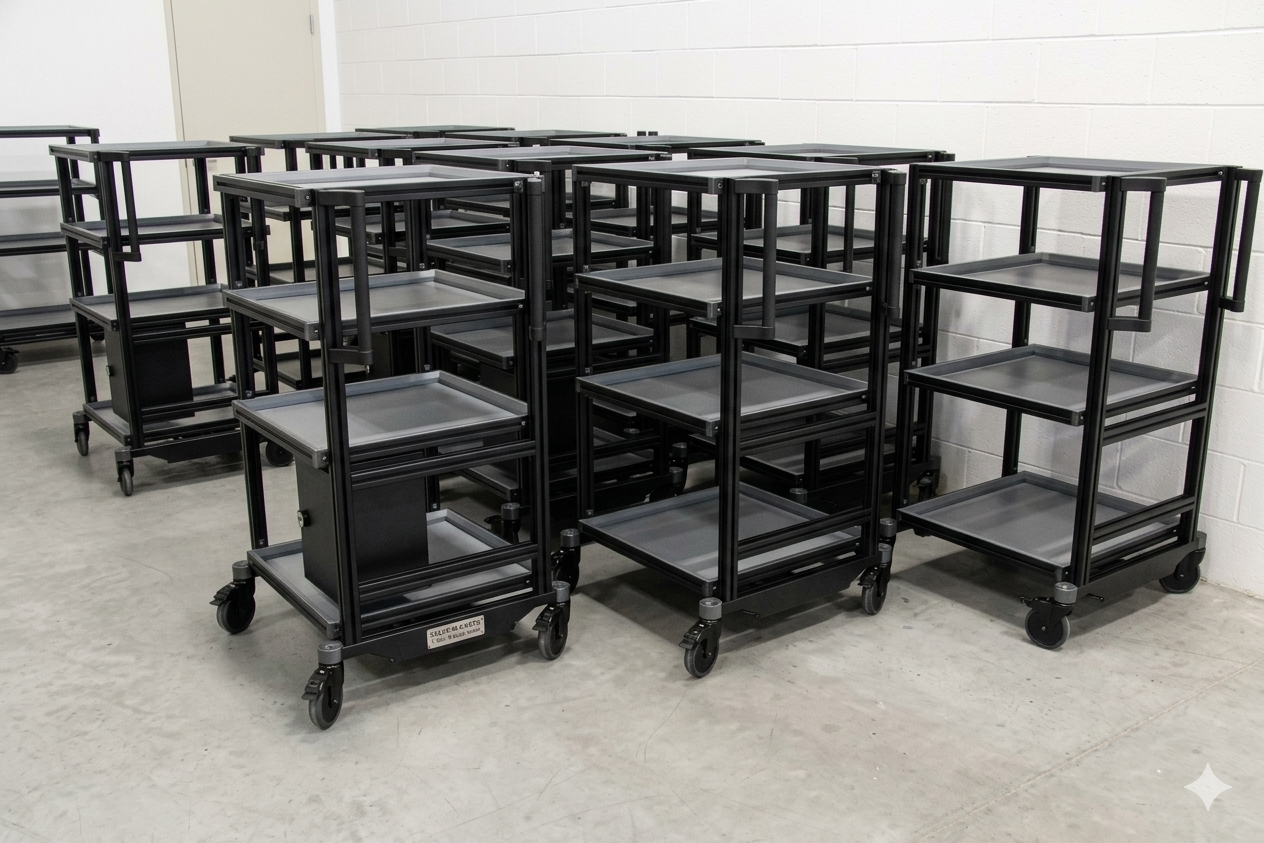
T-slot aluminum high-capacity line-side supply carts designed to maintain continuous parts availability at assembly stations throughout the shift — without requiring the assembly operator to stop work for manual replenishment. Cart capacity is sized for the consumption rate and replenishment interval at each station, and the cart design supports full-cart swap replenishment in under 30 seconds.
Why Choose Modular Solutions for Assembly Line Supply Carts?
A supply cart sized for the wrong interval, or designed so that replenishment requires stopping assembly, undermines the production flow it was meant to support.
Capacity Sized for the Replenishment Interval
Cart capacity is calculated from the actual consumption rate at the station and the planned replenishment interval — the result is a cart that holds exactly enough parts to supply the station from one tugger delivery to the next with a buffer margin, rather than a standard cart that happens to be large enough most of the time.
Full-Cart Swap Replenishment
Pre-loaded replacement carts allow replenishment in a single cart exchange rather than bin-by-bin restocking at the station. The exchange takes less than 30 seconds — the depleted cart rolls out and the pre-loaded cart rolls in without stopping the assembly process. The depleted cart is returned to the supermarket for reloading while the operator continues working.
High-Density Bin Layout
Supply carts for high-consumption stations use tiered shelf layouts, double-deep gravity lanes, and mixed-height shelf levels to maximize the number of bins in the cart footprint — fitting the required parts capacity into the floor space available at the station without expanding into the aisle or adjacent workstation zones.
Operator Access Optimized
Even high-capacity supply carts must present the most-consumed parts within the operator's primary reach zone. Cart layout places high-cycle parts on the shelf levels between 30 and 55 inches from the floor, with lower-consumption parts on the upper or lower shelves where less-frequent reaches are acceptable.
Station Footprint Compliance
Cart dimensions are designed to fit within the designated station footprint without blocking aisle clearance, emergency egress paths, or adjacent station access. Modular Solutions designs the cart from the available floor space at the station — not from a standard cart size that may or may not fit.
Aisle-Side Replenishment Access
Cart positioning and handle placement are designed so that the full cart can be pushed into the station from the aisle side and the depleted cart can be pulled out to the aisle without requiring the operator to step out of the work zone or reposition tools and fixtures at the station.
Key Features & Benefits
Structural and functional design details for assembly line supply carts in high-volume production environments.
Multi-Level Tiered Shelf System
Four to six shelf levels with independent angle, width, and lane configuration per level maximize parts capacity within the cart height. Each level is sized and angled for its specific bin type — combining large tote levels with small bin levels on the same cart frame without compromising access to any level.
Double-Deep Gravity Lanes
Double-deep lanes on high-consumption shelf levels provide a full bin backup behind each active bin — doubling the supply without doubling the cart count. Gravity advance moves the backup bin to the pick position automatically when the active bin empties.
Visual Empty Alert
Color-coded front stop rails or visual indicators at each lane position show empty positions at a glance to the replenishment driver — without requiring the driver to count bins or read labels to identify which positions need restocking on the replacement cart.
Caster Selection for Loaded Weight
Casters for high-capacity supply carts are selected for the fully loaded cart weight — ensuring smooth push-in, pull-out replenishment at the station without the heavy cart resisting lateral movement. Polyurethane tread casters are standard for smooth floor roll; total-lock casters prevent cart drift during assembly operations.
Push Handle Ergonomics
Push handles on supply carts are positioned at the correct height for comfortable single-handed push and pull during the cart exchange — typically 36 to 40 inches from the floor for standing operators. Handles are mounted on T-slot profiles and can be repositioned if operators of different heights use the same replenishment route.
Color-Zone Station Identification
Supply carts can be powder-coated in station-specific colors to identify which cart belongs at which station — preventing carts from being placed at the wrong station during high-volume replenishment operations. Color identification is applied to the T-slot profiles before cart assembly.
Common Applications
Assembly line supply carts are used at high-throughput stations where parts consumption is fast enough that standard Kanban bin carts cannot provide adequate supply between scheduled replenishment cycles.
- High-Takt Automotive Assembly Stations - High-capacity supply carts at fast-cycle automotive assembly stations where short takt times drive high parts consumption rates and frequent replenishment cycles — supply carts providing shift-length or multi-hour supply to reduce replenishment route frequency.
- Fastener and Consumable Supply - Large-capacity supply carts presenting high-volume fasteners, clips, seals, and consumables in bulk tote bins at high-consumption assembly stations — reducing replenishment frequency from multiple times per hour to once per shift for high-volume consumables.
- Packaging Line Supply - Supply carts presenting cartons, inserts, labels, and packaging materials at packaging stations — sized to hold a full shift's supply of packaging materials so that packaging operators are not interrupted by mid-shift restocking.
- Kitting Pre-Stage Supply - Supply carts staging pre-kitted component sets at assembly stations — each cart position holding a full shift's worth of pre-assembled kits for a specific build variant so that kit replenishment happens once per shift rather than continuously.
- Electronic Sub-Assembly Feed Stations - Supply carts at SMT and PCB assembly station feeders presenting high-volume component reels and trays for continuous automated pick operations — sized to minimize feeder change interruptions in high-speed automated assembly.
- Welding and Fabrication Consumable Carts - Supply carts at welding stations presenting wire spools, flux, consumable tips, and PPE in a single organized cart that reduces the time welders spend locating and retrieving consumables during active welding production.
Specifications & Configurations
Design parameters for assembly line supply carts. Capacity and dimensions are calculated from station consumption rate and replenishment interval.
| Specification | Detail |
|---|---|
| Frame Profile | 45 or 90 Series T-slot aluminum depending on load weight |
| Shelf Levels | 3 to 6 levels; mixed angles and lane widths per level |
| Lane Depth | Single-deep or double-deep gravity flow per level |
| Capacity Sizing | Calculated from consumption rate × replenishment interval + safety buffer |
| Replenishment Method | Full-cart swap; rear-load; bin-by-bin available |
| Load Capacity | 200 lb to 800 lb total depending on frame and shelf configuration |
| Cart Identification | Powder coat color coding; station ID plaques; label holders |
| Lead Time | 4 to 6 weeks from approved design |
Frequently Asked Questions
Common questions about assembly line supply carts from Modular Solutions.
How is the cart capacity sized for a given assembly line supply application?
Cart capacity is sized by calculating the consumption rate for each part at the station over the replenishment interval — how many parts are consumed per hour multiplied by the number of hours between tugger route deliveries. The cart must hold at least this quantity for each part, plus a safety buffer to accommodate cycle time variation. Modular Solutions calculates the required bin count and part quantity per bin for each SKU at the station and designs the cart shelf layout to meet the calculated supply requirement for the specified replenishment interval.
Can a single supply cart support multiple assembly operators at the same station?
Yes. High-capacity supply carts for multi-operator stations present parts on multiple faces — front and side faces — so that each operator in the cell can access the bins they need without crossing another operator's work zone. Cart geometry is designed around the operator work zones and the assembly process layout to ensure that each operator's most-consumed parts are on the face closest to their work position.
How are supply carts replenished without stopping the assembly line?
Supply carts at a fixed station position are replenished by a full-cart swap — a pre-loaded replacement cart is positioned at the station and the depleted cart is removed in a single exchange operation that takes less than 30 seconds. The swap is timed to occur during a natural line pause or break period, or is designed to be quick enough that line production continues during the exchange. Cart designs that allow replacement without moving the depleted cart first — where the new cart slides into position from the aisle and displaces the depleted cart — minimize the interruption window further.
What is the advantage of a dedicated supply cart over fixed flow rack installed at the station?
Assembly line supply carts provide three advantages over fixed flow rack installations: they can be removed and replaced for replenishment without interrupting line access, they can be reconfigured for different products without structural changes to the line-side installation, and they can be relocated to different stations as production layout changes occur. Fixed flow rack is permanently installed at a specific station position — it cannot be moved when the production layout changes and it cannot be replaced with a pre-loaded unit to minimize replenishment interruption. For high-variety or frequently changing production environments, supply cart flexibility provides significant operational advantages over fixed installation.
Can Modular Solutions help calculate the required cart capacity for our assembly stations?
Yes. Modular Solutions performs cart capacity calculations as part of the design phase for every assembly line supply cart project. Provide the part consumption rate (parts per hour or parts per shift), the planned replenishment interval, the bin sizes and quantities you currently use at the station, and the available floor space. We will calculate the required bin count, shelf levels, and cart dimensions to meet the supply requirement within the station footprint and present the result in the design brief before cart fabrication is released.
Ready to Size Your Assembly Line Supply Cart?
Share your station consumption rates, replenishment interval, bin sizes, and available floor space. We will calculate the required capacity and design the cart to fit your line.
Modular Solutions — 4280 Giddings Rd, Auburn Hills, MI 48326