Bin Presentation Carts
T-slot aluminum carts with angled bin rails and gravity-flow lanes presenting standard Kanban bins, KLT totes, and returnable containers at the optimal pick angle for line-side parts replenishment. Designed to match your bin standard, your two-bin Kanban cycle, and your tugger route delivery method — from rear-load access to empty-bin return provisions on the same cart.
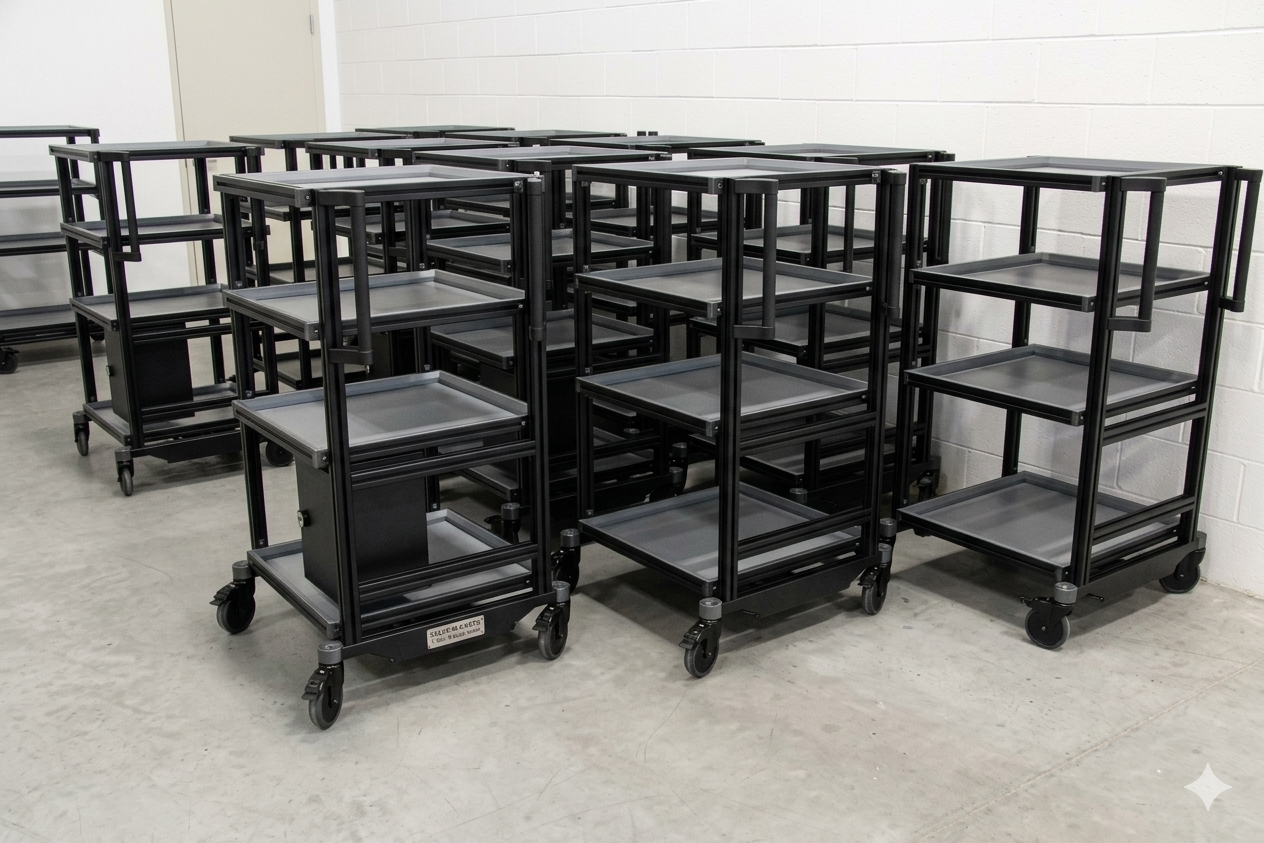
Why Choose Modular Solutions for Bin Presentation Carts?
Bin presentation cart design details — lane width, shelf angle, front stop height, empty-bin return provisions — directly affect the efficiency of every Kanban replenishment cycle at the station.
Bin Standard Matched Design
Lane width, front stop height, rear guide channel spacing, and shelf level height are all designed around your specific bin dimensions — not a generic average. A cart designed for 400×300 Euro bins has different geometry than one designed for KLT totes. The difference shows in how reliably bins slide, stop, and are removed at the station every cycle.
Gravity-Flow Two-Bin Lanes
Gravity-flow double-deep lanes allow a full bin behind the active bin at each position — when the front bin empties, the next full bin slides forward automatically. The two-bin Kanban cycle runs without operator intervention beyond removing the empty bin and placing it in the return position to trigger replenishment.
Rear-Load Aisle Access
Rear-load cart designs allow tugger drivers to replenish full bins from the aisle side while assembly operators continue working from the front face. No cart removal from the station — no interruption to the assembly cycle. Rear guide rails direct bins into the correct lane without precise driver alignment.
Empty-Bin Return Tier
A flat lower shelf on the cart collects empty bins for return to the supermarket on the same tugger cycle that delivers full bins. Single-stop replenishment — the driver delivers full bins to the angled rails and collects empty bins from the flat return shelf in one cart visit.
Mixed Bin Size Lanes
Different lanes on the same shelf level can be set to different widths to accommodate mixed bin sizes for different part SKUs at the station. A station with small fastener bins alongside medium-sized hardware bins uses a single cart with mixed-width lanes rather than two separate carts.
Label Holder Integration
Bin label holders, part number displays, and Kanban card slots mount on T-slot channels at the front of each lane without adhesive tape or drilled holes. Label positions update with product changeovers by sliding the holder to the new position — no re-drilling, no adhesive residue.
Key Features & Benefits
Construction and configuration details for reliable bin presentation cart operation in high-cycle Kanban environments.
Roller Lane Gravity Advance
Roller lane inserts in the shelf channel allow bins to roll forward smoothly under gravity when the forward bin is removed — more reliable bin advance than on smooth aluminum shelf surfaces, especially for bins with textured bases or bins that are loaded heavy and light alternately.
Front Stop Rail
A front stop rail across the leading edge of each shelf prevents bins from sliding off the cart during delivery transit, while being low enough for easy one-hand bin removal during the pick operation. Stop rail height is designed for the specific bin being used — not a compromise that is too high for easy removal or too low to retain the bin during transit.
Rear Bin-Loading Guide
Rear guide channels at each lane position direct bins into the lane from the aisle side during tugger replenishment without requiring the driver to align the bin precisely. Guide channels are designed for the bin footprint being loaded — they accept bins loaded from either the front or back face depending on the cart orientation at the station.
Kanban Signal Card Holder
Kanban signal card holder slots at the front of each lane allow the paper Kanban card to travel with the bin or remain at the station as a replenishment signal depending on the Kanban system design used in the facility. Card holders are T-slot-mounted and repositioned easily as the Kanban design evolves.
Stainless Hardware Option
Stainless steel T-slot hardware and caster fittings are available for bin presentation carts used in food processing, washdown, and corrosive environments where carbon steel hardware would corrode. Stainless hardware upgrade is compatible with the standard T-slot aluminum profile — no profile substitution required.
Floor Lock Casters
Total-lock casters prevent cart movement during bin removal and loading operations at the station. The operator does not need to brace the cart during the pick motion — the locked casters hold the cart position without floor anchors or wall brackets.
Common Applications
Bin presentation carts are the primary line-side material delivery vehicle for Kanban-driven lean assembly and point-of-use storage operations.
- Automotive Assembly Line-Side Kanban - Two-bin Kanban carts at automotive assembly stations delivering fasteners, brackets, clips, and small parts in gravity-feed Euro bin lanes — replenished by tugger train on timed route cycles without disrupting assembly.
- Electromechanical Assembly Stations - Multi-level bin carts presenting electronic components, connectors, cable assemblies, and hardware at electronics and electromechanical assembly stations where a large number of small part numbers must be accessible within arm's reach.
- Tugger Route Delivery Carts - Rear-load bin presentation carts designed for tugger route delivery — loaded from the aisle without cart removal, presenting parts from the assembly side throughout the shift without requiring the operator to interrupt work for replenishment.
- Supermarket Lane to Line-Side Flow - Bin carts bridging the supermarket lane and the assembly station — loaded at the supermarket with the next Kanban cycle's bin set and pushed to the station for direct replacement of the depleted cart.
- Mixed-Model Production Lines - Adjustable-lane bin carts reconfigured between model changeovers to present the correct bin set for each product mix — lane widths and label holders updated in the facility between shifts without tools beyond a hex key.
- Maintenance Parts Delivery - Bin presentation carts in maintenance areas presenting consumable parts, fasteners, and repair hardware in organized, labeled lanes at the mechanic's reach zone — replacing flat parts drawers with ergonomically presented, visually managed bin systems.
Specifications & Configurations
Standard design parameters for T-slot aluminum bin presentation carts. Lane geometry is application-specific.
| Specification | Detail |
|---|---|
| Frame Profile | 45 Series T-slot aluminum standard |
| Bin Compatibility | Euro norm, KLT, SSI Schaefer, Akro-Mils, custom totes; mixed sizes per level |
| Shelf Levels | 2 to 4 levels within ergonomic reach zone |
| Lane Depth | Single-deep or double-deep (gravity flow) per shelf level |
| Load Access | Front-load, rear-load, or dual-access depending on station layout |
| Empty Bin Return | Flat return shelf standard; return hooks available |
| Capacity | 9 to 30 bins depending on bin size, levels, and lane depth |
| Lead Time | 3 to 5 weeks from approved design |
Frequently Asked Questions
Common questions about bin presentation carts from Modular Solutions.
What bin standards are supported by T-slot bin presentation carts?
T-slot bin presentation carts support all standard bin sizes including Euro norm bins (200×300, 300×400, 400×600 mm footprints), SSI Schaefer series, Akro-Mils bins, injection-molded KLT totes, and returnable packaging totes. Rail spacing and lane divider positions are designed for the specific bin footprint dimensions used in the facility. Mixed-bin configurations — different bin sizes on different shelf levels or lanes — are standard practice in Kanban-driven assembly operations and are fully accommodated in the cart design.
How does the bin exchange work on an angled bin presentation cart?
Bin exchange on an angled bin presentation cart uses a gravity-flow two-bin or flow-rack principle. The forward bin is consumed by the operator from the front of the angled shelf. When the forward bin is empty, the operator removes it and the next full bin slides forward from behind. In a two-bin Kanban configuration, the empty forward bin is placed in an empty-bin lane or hung on a return hook at the rear of the cart, signaling the tugger driver to replenish that position on the next route cycle.
Can bin presentation carts be loaded from the rear while the operator picks from the front?
Yes. Rear-load bin presentation carts allow a tugger route driver to load full bins from the aisle side of the cart while the assembly operator continues picking from the front face — without the cart leaving the station and without the operator stepping aside. Rear-load access requires the cart to be positioned with the aisle face accessible to the tugger route, and the cart design includes rear guide rails that direct bins into the correct lane during loading without requiring precise alignment by the driver.
How many bins can a typical bin presentation cart hold?
Bin capacity depends on the bin footprint, the number of shelf levels, and whether the cart is configured for single-deep or double-deep (flow-rack) lanes. A typical three-level cart with 400×300 Euro bins in single-deep lanes holds 9 to 12 bins. Double-deep configurations double the bin count but require deeper shelves and a gravity-flow mechanism to advance the second bin to the pick position when the first is consumed. Cart width is designed to match the number of lanes required for the station's Kanban bin count.
Can empty bins be collected on the same cart that delivers full bins?
Yes. Bin presentation carts can include an empty-bin return tier — typically a flat shelf at the bottom of the cart — where the operator places empty bins after consumption. The tugger driver collects the empty bins from the return tier and replaces them with full bins on the presentation shelves in a single stop at the station. Combined delivery and empty-return carts are common in facilities with high Kanban bin volume and limited aisle space for separate delivery and return carts.
Ready to Design Your Bin Presentation Cart?
Share your bin dimensions, Kanban cycle design, tugger route layout, and station access requirements. We will design a cart that supports your replenishment system correctly.
Modular Solutions — 4280 Giddings Rd, Auburn Hills, MI 48326