Ergonomic Material Presentation Carts
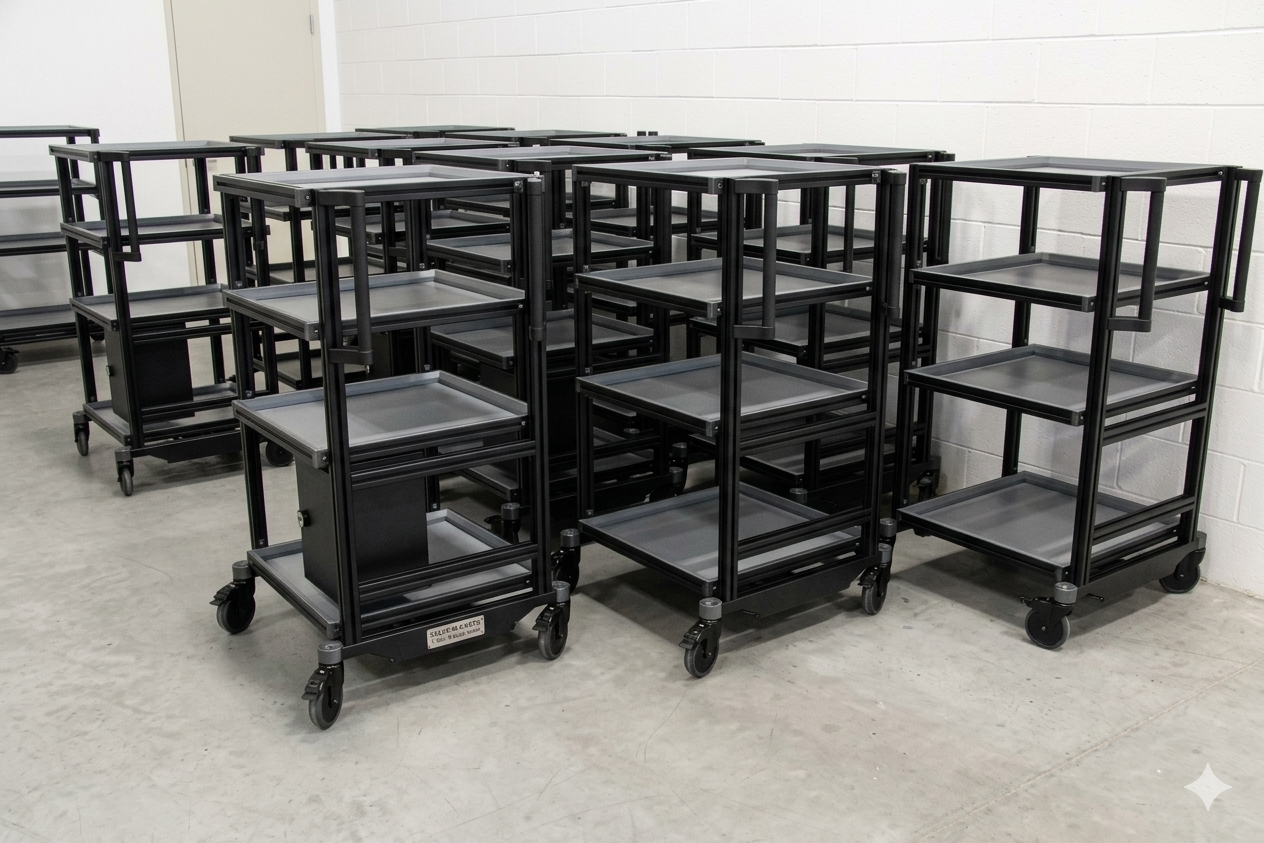
T-slot aluminum material presentation carts engineered to NIOSH ergonomic guidelines — presenting parts within the optimal knuckle-to-shoulder pick height zone, correct horizontal reach distance, bin tilt angle for forward part presentation, and push force compliance for the operator population. Designed to measurably reduce cumulative motion exposure and injury risk at repetitive assembly stations.
Why Choose Modular Solutions for Ergonomic Presentation Carts?
Ergonomic compliance is not achieved by selecting a standard cart catalog item — it requires designing to the specific operator population, part weight, reach distance, and pick frequency at each station.
Primary Pick Zone Shelf Placement
All high-frequency bin positions are placed within the NIOSH primary pick zone — knuckle to shoulder height (approximately 30 to 52 inches for a standing worker). Secondary and low-frequency positions may be placed above or below this zone, but the design ensures that the highest-consumption parts are always within the ergonomically acceptable range for the station operator population.
Horizontal Reach Distance Control
Cart depth and bin positioning are designed to keep horizontal reach distances within NIOSH Revised Lifting Equation limits — typically a maximum of 25 inches from the operator's body to the part at the back of the bin. Carts are not designed wider than the operator can comfortably reach without stretching or rotating at the torso.
Bin Tilt Angle for Forward Presentation
Bin shelf tilt angles of 15 to 30 degrees bring parts toward the operator at the bin front, reducing the reach required to retrieve the last part from the bin. The correct tilt angle is determined by the bin depth and part size — tilted enough to present the part without requiring a deep reach, but not so steep that parts slide out when the bin is less than full.
Push Force Compliance
Fully loaded cart push force is controlled by caster selection — type, count, tread durometer, and swivel offset — to keep initial and sustained push forces within Liberty Mutual and NIOSH acceptable limits for the planned operator population. Push force calculations are performed at the design stage, not after cart fabrication.
Height-Adjustable Shelf Design
T-slot column mounting for shelf levels allows individual shelf heights to be adjusted when operators of different stature use the station — maintaining primary pick zone compliance without replacing the cart. Height adjustments require only an Allen wrench and can be completed in under five minutes during a changeover or break period.
Cumulative Motion Documentation
Ergonomic cart designs from Modular Solutions include a design brief documenting the NIOSH zone compliance for each shelf position, the reach distance calculation for each bin, the bin tilt angle and its effect on maximum reach, and the push force estimate — providing the documented ergonomic assessment basis required by facilities with formal ergonomic review programs.
Key Features & Benefits
Structural and functional design elements that differentiate ergonomic presentation carts from standard presentation carts.
Adjustable Bin Tilt Rail System
Bin support rails mounted on T-slot channels allow bin tilt angle to be adjusted by repositioning the front support rail height — enabling tilt angle to be tuned for the specific bin and part type at each shelf level without replacing the shelf hardware.
Sit-Stand Access Design
Presentation carts for sit-stand operator workstations position the primary pick zone at the correct height for the seated or standing posture the operator uses for each pick — typically placing high-frequency picks at seated reach height and lower-frequency picks at standing height, with cart geometry that accommodates both without requiring the operator to change posture for frequent picks.
Anti-Fatigue Mat Clearance
Cart base design includes clearance for the anti-fatigue mat at the operator's position — the cart footprint does not cover the mat or force the operator to stand on a hard floor surface to access the cart. Cart feet or leveling pads are positioned outside the mat boundary.
Lightweight Frame Construction
T-slot aluminum frames for ergonomic carts are designed to the minimum structural section that safely carries the load — keeping the unloaded cart weight as low as possible to reduce the push force required during cart exchange and the lift force if the cart needs to be tipped or positioned. Aluminum frames are typically 40 to 60% lighter than equivalent steel weldment carts.
Ergonomic Handle Height and Profile
Push handles are positioned at the correct ergonomic push height — 36 to 44 inches from the floor — and use a tubular grip profile that distributes push force across the palm without requiring a power grip. Handle height can be adjusted on T-slot columns for different operators without tools beyond a standard hex wrench.
Label Positioning for Minimal Neck Flexion
Part identification labels and bin placards are positioned at eye level or slightly below — avoiding the forward neck flexion that occurs when operators read labels at low shelf positions. Label holder positions are built into the cart design rather than added as afterthoughts after fabrication.
Common Applications
Ergonomic presentation carts are specified for assembly stations where high pick frequency, long shift duration, or workforce injury history make ergonomic compliance a formal design requirement.
- High-Frequency Small Parts Assembly - Ergonomic carts at stations where operators pick small components hundreds or thousands of times per shift — fasteners, clips, sensors, switches — where cumulative wrist, shoulder, and back load from non-ergonomic bin positions is a documented injury source.
- Women-Inclusive Workforce Assembly Lines - Ergonomic carts designed to the 10th to 90th percentile of a mixed male and female operator population — ensuring that reach distances, bin heights, and push forces are acceptable to the full range of operators on the line, not just the median male worker.
- Sit-Stand Workstations - Presentation carts for assembly stations with sit-stand operator configurations, where bin heights must be appropriate for both postures and the cart geometry must not force the operator to stand or sit at an incorrect height to access parts.
- Medical Device and Cleanroom Assembly - Ergonomic carts for assembly stations where the combination of detailed precision work, PPE restrictions on movement range, and long shift durations creates elevated cumulative motion risk — and where formal ergonomic documentation is required as part of the assembly process validation record.
- Automotive Door and Trim Stations - Ergonomic presentation carts at vehicle trim and door assembly stations where operators work in laterally constrained positions and must reach across the vehicle body to install components — cart positioning and bin angles are designed to minimize the cumulative load of asymmetric reaching combined with installation force application.
- Electronics and PCB Assembly - Ergonomic carts at electronics assembly stations where prolonged static posture and fine motor precision combine with high pick frequency to create elevated shoulder and neck fatigue — cart design controls bin height and reach distance to support the neutral posture the station requires for precise small-part placement.
Specifications & Configurations
Design parameters for ergonomic material presentation carts. Key dimensions are set by operator anthropometrics and pick frequency — not by standard cart catalog sizes.
| Specification | Detail |
|---|---|
| Primary Pick Zone | 30 to 52 in. from floor for standing operator (knuckle to shoulder) |
| Horizontal Reach Design Limit | ≤ 25 in. from operator to part at bin back |
| Bin Tilt Angle Range | 15° to 30° forward tilt; adjustable per shelf level |
| Push Force Target | ≤ 50 lb initial, ≤ 30 lb sustained at loaded weight |
| Frame Profile | 45 or 90 Series T-slot aluminum; lightweight by design |
| Shelf Adjustability | T-slot column mounting; adjustable without tools beyond Allen wrench |
| Documentation | NIOSH zone compliance brief per shelf position included with design |
| Lead Time | 4 to 6 weeks from approved design |
Frequently Asked Questions
Common questions about ergonomic material presentation carts from Modular Solutions.
What NIOSH guidelines apply to material presentation cart design?
The NIOSH guidelines most applicable to presentation cart design are the Revised NIOSH Lifting Equation (1994) — which establishes the Recommended Weight Limit for lifting tasks based on height, horizontal reach, asymmetry, frequency, coupling, and duration — and the NIOSH guidelines for manual materials handling that define acceptable push and pull force limits based on population capability data. For presentation carts, the most impactful design parameters are the bin height (parts should be presented in the NIOSH primary pick zone between knuckle height and shoulder height — approximately 30 to 52 inches for a standing worker), the horizontal reach distance from the operator's body to the part, and the tilt angle of the bin that affects how far into the bin the operator must reach for the last part.
What is the NIOSH primary pick zone and how does cart design affect compliance?
The NIOSH primary pick zone is the vertical range between the operator's knuckle height (approximately 30 inches) and shoulder height (approximately 52 inches) in which frequent repetitive picking is ergonomically acceptable for most of the working population. Cart shelf heights that position bin access points above shoulder height or below knuckle height place frequent pick tasks outside the acceptable zone and increase cumulative load on the shoulder, back, and wrist over a full shift. Ergonomic cart design positions all high-frequency bin access within the primary pick zone — and uses bin tilt angles of 15 to 30 degrees to bring the last part in the bin forward without requiring the operator to reach over the bin front.
How are push and pull force limits applied to cart design?
NIOSH and Liberty Mutual manual materials handling guidelines define acceptable initial and sustained push force limits at 50th and 90th percentile capability levels for standing male and female workers. For presentation carts, the fully loaded cart weight and the caster selection determine the push force required to initiate and sustain cart movement during the cart exchange or line-feeding operation. Ergonomic cart design specifies caster type, caster count, and tread material to keep the required push force within acceptable limits for the target operator population — typically below 50 lbs initial and 30 lbs sustained for routes with mixed male and female operators.
Can ergonomic carts be adjusted to accommodate operators of different heights?
Yes. T-slot aluminum presentation carts designed for height adjustment allow individual shelf levels to be repositioned along the vertical T-slot columns when the station operator changes — maintaining primary pick zone compliance for operators of different stature. Height-adjustable cart designs are particularly valuable in facilities with rotating operator assignments, high operator turnover, or deliberately mixed-stature workforce planning. Adjustments can be made with standard T-slot hardware in under five minutes without tools beyond an Allen wrench.
How does bin tilt angle affect ergonomic reach and part accessibility?
Bin tilt angle — the forward downward angle of the bin from horizontal — affects both the horizontal reach required to retrieve the last part from the bin and the visibility into the bin during picking. A flat (0 degree) bin requires the operator to reach over the full depth of the bin to retrieve parts at the back — increasing forward reach, wrist extension, and shoulder load for parts near the bin back. A bin tilted at 15 to 30 degrees brings the bin bottom toward the operator, reducing horizontal reach by the bin depth times the sine of the tilt angle. For a 12-inch-deep bin, a 20-degree tilt reduces the maximum reach distance by approximately 4 inches — a meaningful reduction for parts that are picked at high frequency over a full shift.
Ready to Design Your Ergonomic Presentation Carts?
Share your operator anthropometrics, part weights, pick frequencies, and any existing ergonomic assessment data for the station. We will design presentation carts that meet NIOSH guidelines and provide a documented compliance brief with the design.
Modular Solutions — 4280 Giddings Rd, Auburn Hills, MI 48326