Parts Presentation Carts
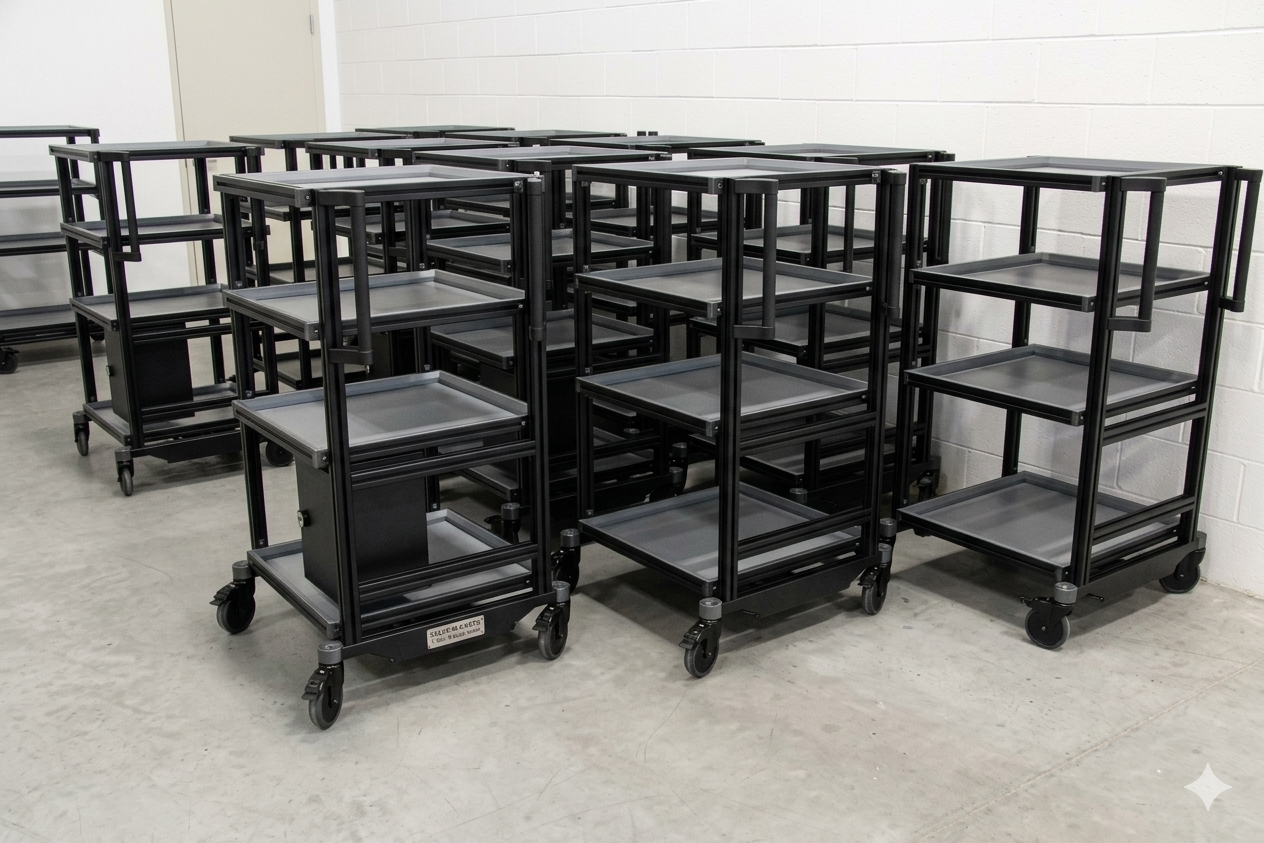
T-slot aluminum carts with angled shelves, gravity-feed lanes, and adjustable bin rails that position parts at the correct height and angle for efficient operator access at assembly stations. Every design dimension — shelf height, pitch angle, lane width, front stop height — is set for the specific parts and bins used at the station, not for a generic average.
Why Choose Modular Solutions for Parts Presentation Carts?
A parts presentation cart that doesn't match the operator's work envelope adds motion waste instead of eliminating it.
Shelf Height Matched to Operator Reach Zone
Shelf levels are positioned within the operator's optimal reach zone — typically 30 to 60 inches from the floor for standing assembly. Parts outside this zone require bending or overhead reach that accumulates fatigue over a shift. Shelf height is set in the design, not adjusted to fit whatever height a standard cart happens to use.
Gravity-Feed Shelf Angle
Angled shelves (10° to 25° from horizontal depending on bin type and part weight) allow bins and containers to slide forward under gravity as parts are consumed — presenting the next part at the front of the shelf without the operator reaching to the back. Angle is set for the specific bin base friction and part weight.
Adjustable Lane Dividers
Lane dividers on T-slot channels set the lane width for each shelf level independently. Mixed bin sizes across shelf levels — different SKUs with different bin footprints — are accommodated on the same cart by setting each lane to the correct width for that shelf's bin.
Front Stop and Bin Retention
Front stop rails at the leading edge of each shelf retain bins at the pick position and prevent them from sliding off during cart movement. Stop height is designed for the bin in use — tall enough to retain the bin during transit, low enough to allow easy one-hand bin removal for full-cart swap at Kanban replenishment.
Rear Load Access
For presentation carts loaded from the rear — tugger delivery or in-aisle replenishment — the rear of the cart is open above the shelf level for easy bin insertion from the back without reaching across to the front face. Rear guide channels direct bins into the lane and prevent misalignment during loading.
T-Slot Field Adjustability
Shelf heights, lane widths, and shelf angles are all adjusted with a hex key in the facility as products change, bin sizes change, or operator ergonomic reviews identify improvements. No fabrication rework required — the cart adapts to the process, not the process to the cart.
Key Features & Benefits
Design details that make T-slot parts presentation carts effective in production assembly environments.
Roller Lane Inserts
Gravity roller lane inserts in the shelf channels allow bins to roll forward smoothly as parts are consumed — reducing the push force needed to advance bins on smooth shelves and maintaining consistent bin presentation even as the shelf angle decreases due to heavy bin loads.
Multi-Level Mixed Configuration
Different shelf levels can carry different bin sizes, different shelf angles, and different lane widths on the same cart frame. A common configuration combines a wide lower shelf for large totes and narrow upper shelves for small parts bins — all on one T-slot frame with independent shelf geometry per level.
Double-Sided Presentation
Double-sided carts serve two operator positions or two assembly stations from the same cart frame — front and rear faces each carrying their own angled shelf system. Double-sided configuration maximizes the parts density per unit of floor space at the station.
Label and Shadow Board Provisions
T-slot channels at the front face of each shelf level provide mounting positions for bin label holders, shadow boards, and visual standard work aids without adhesive tape or drilled holes. Label holders are repositioned as part numbers change without marking the cart frame.
Caster Selection for Assembly Environments
Casters are selected for smooth roll on the specific floor surface at the station — polyurethane wheels for smooth concrete, non-marking rubber for tile floors, and stainless bearings for washdown environments. Total-lock casters prevent cart movement during pick operations.
Durable Aluminum Construction
T-slot aluminum frame resists corrosion without painting, is lighter than steel carts of equivalent capacity, and does not chip or flake in production environments. Anodized and powder-coat finishes are available for facilities with specific color coding or contamination prevention requirements.
Common Applications
Parts presentation carts are used wherever operator pick efficiency, reach ergonomics, and bin organization at the assembly station are production priorities.
- Automotive Assembly Line-Side Carts - Angled bin rail carts at automotive sub-assembly and final assembly stations presenting fasteners, clips, seals, and small components within the operator's primary reach zone to support takt-time assembly.
- Electronics Assembly Pick Stations - Multi-level small-parts presentation carts at SMT and through-hole assembly stations presenting component reels, tubes, and trays at the correct pick height and angle for both sit-down and stand-up operator configurations.
- Medical Device Assembly Carts - FDA-compliant material presentation carts with anodized aluminum surfaces presenting components, packaging inserts, and labels at the operator's reach zone during clean-room-adjacent assembly operations.
- Kitting Station Parts Carts - Carts at manual kitting stations presenting a full kit's worth of part bins in station-sequence order, allowing the kitter to pick left-to-right across the cart without searching for the next part.
- Tugger Route Line-Side Carts - Presentation carts delivered by tugger trains and positioned at line-side stations — designed for rear-load access from the aisle and front-pick access from the assembly side without the cart needing to be repositioned after delivery.
- Mixed-Model Assembly Flexibility Carts - Adjustable-lane carts that are reconfigured between production shifts or model changeovers to present the correct bin set for the next product mix — lane width and label holder positions updated without tools beyond a hex key.
Specifications & Configurations
Standard design parameters for T-slot aluminum parts presentation carts. All dimensions are application-specific.
| Specification | Detail |
|---|---|
| Frame Profile | 45 Series T-slot aluminum standard; 90 Series for heavy bin loads |
| Shelf Levels | 2 to 4 levels within ergonomic reach zone (30–60 in. from floor) |
| Shelf Angle | 10° to 25° from horizontal; set per shelf level for bin type |
| Bin Compatibility | Euro bins, Schaefer/SSI bins, Akro-Mils, custom totes; mixed sizes per level |
| Lane Configuration | Adjustable lane dividers; roller lane inserts available |
| Cart Orientation | Single-sided or double-sided; rear-load access standard |
| Capacity | 50 lb to 400 lb total cart load depending on profile and shelf count |
| Lead Time | 3 to 6 weeks from approved design |
Frequently Asked Questions
Common questions about parts presentation carts from Modular Solutions.
What is the correct shelf angle for a parts presentation cart?
The optimal shelf angle for a parts presentation cart depends on the part or container type and the desired gravity-feed behavior. Angled shelves for bins and small parts typically run 15° to 25° from horizontal — sufficient for parts to slide forward under gravity without tipping over the front edge. Deeper bins and totes often use shallower angles (10° to 15°) to keep the container stable while still presenting the opening toward the operator. Cart shelf angle is set during the design phase based on the specific bin type, part weight, and friction characteristics of the bin base material.
Can shelf height and angle be adjusted after the cart is delivered?
Yes. T-slot aluminum construction allows shelf height and angle to be adjusted without any cutting, welding, or fabrication. Shelf brackets slide in the T-slot channels and lock at any position — shelf height adjustment is a single hex key operation. Shelf angle is set by adjusting the front and rear support bracket heights independently. Adjustment takes minutes in the facility without tools beyond a standard hex key set.
What bin sizes are compatible with T-slot parts presentation carts?
T-slot parts presentation carts can be designed for any standard or custom bin size. Common bin families accommodated include Euro bins (400×300, 600×400), Schaefer and SSI Schaefer bins, Akro-Mils bins, and injection-molded production totes. The shelf width, lane divider pitch, and front stop height are designed for the specific bin dimensions used in the facility. Mixed-bin configurations — different bin sizes on different shelf levels — are common and are designed into the cart drawing.
How many shelf levels can a parts presentation cart have?
Parts presentation carts typically have two to four shelf levels within the ergonomic reach zone — between approximately 30 and 60 inches from the floor for standing operators. The number of levels is determined by the bin height, the required shelf-to-shelf clearance for loading bins from the rear, and the total cart height constraint. Modular Solutions designs the shelf layout to maximize parts capacity within the ergonomic reach envelope, rather than adding shelves beyond the zone where the operator can access bins comfortably.
Can a single presentation cart serve parts to two operators facing opposite sides?
Yes. Double-sided presentation carts present parts on both the front and rear faces — used at two-operator stations or at cells where operators work on both sides of the cart. Double-sided designs use a common T-slot frame structure with independent shelf systems on each face. Bin rail angles on each face can be set independently to match the optimal pick angle for each operator's work position.
Ready to Design Your Parts Presentation Cart?
Tell us your bin sizes, shelf count, operator standing height, and station layout. We will design a presentation cart that positions every part within the operator's optimal reach zone.
Modular Solutions — 4280 Giddings Rd, Auburn Hills, MI 48326