Pick-to-Light Carts
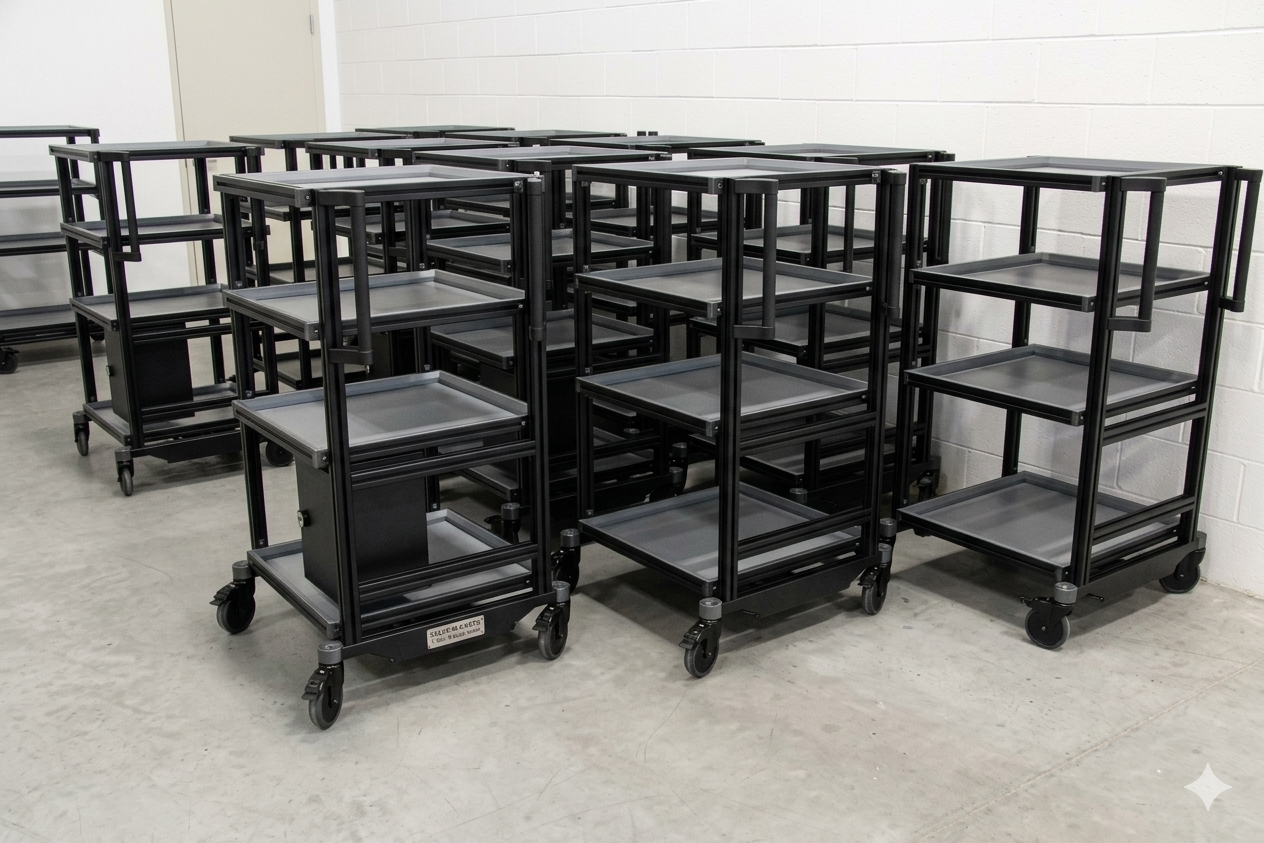
T-slot aluminum carts with integrated LED pick indicators that light the correct bin position for each pick step — eliminating the need for operators to read paper pick lists or search across a cart face for the right part. Pick-to-light hardware, cable routing, controller enclosure, and power provisions are designed into the cart frame structure, not clipped onto a finished cart after delivery.
Why Choose Modular Solutions for Pick-to-Light Carts?
A pick-to-light cart is only as good as the cart structure that supports the electronics — loose hardware and exposed cables in a production environment create maintenance problems that undermine the system's error-reduction purpose.
Electronics Integrated into the Frame
LED module mounting channels, cable routing trays, controller enclosure positions, and power inlet provisions are part of the T-slot cart frame design — not added to a standard cart after the electronic components arrive. The finished cart is a clean, maintainable system rather than a cart with hardware zip-tied to its structure.
Any Pick-to-Light Platform
T-slot aluminum frames are compatible with pick-to-light modules from any major provider — the T-slot channel accepts DIN-rail adapters and direct T-nut mounting for modules from Würth, Banner, Lightning Pick, Knapp, and others. Module selection is driven by your system platform, not by what fits a proprietary cart.
Wired and Wireless Options
Wired pick-to-light carts use structured internal cable runs from each module to the controller — clean, low-maintenance, and fully protected from snag and abrasion. Wireless options with battery power and Wi-Fi or Bluetooth controller communication are available for carts that move during the pick cycle rather than staying at a fixed station.
Confirmation Button Integration
Confirmation button modules at each bin position record the pick and advance the sequence — or flag an error if the confirmation is not received in sequence. Button positions are designed into the cart face at the correct height and location for one-hand confirmation during the natural pick motion.
Mixed Bin and Module Configuration
Different shelf levels can carry different bin sizes with different LED module types per level — all on the same cart controller. A cart with large tote positions on the lower shelf and small parts bins on the upper shelf uses different module formats per level while the single controller manages the full pick sequence across all positions.
Field-Reconfigurable Pick Positions
T-slot construction allows LED modules to be repositioned in the channel as bin configurations change with product changeovers. Cable management trays run along the T-slot frame and allow cable re-routing during reconfiguration without disassembling the cart structure.
Key Features & Benefits
Hardware and integration details for reliable pick-to-light cart operation in production environments.
Internal Cable Routing Channels
T-slot profile cable channels route signal and power cables from each LED module to the controller enclosure without any exposed cable on the pick face of the cart. Protected cable routing prevents snag, abrasion, and cord damage during bin loading and operator pick operations.
Controller Enclosure with Service Access
The controller enclosure mounts on the cart frame at a position that allows service access without moving the cart from its operating position. Enclosure rating is IP54 standard for production floor environments — IP65 available for washdown applications.
24V DC Battery Pack
For mobile pick-to-light carts, a 24V DC battery pack on the cart frame provides 8 to 16 hours of pick-to-light operation per charge. Automatic charging at dock positions recharges the battery between shifts or during line stops without manual battery swap.
Multi-Color LED Options
Multi-color LED modules allow the same cart to use color coding to indicate pick urgency, part type, or operator assignment — in addition to the standard position-indicating function. Color coding is programmed in the controller without hardware changes to the modules.
Quantity Display Integration
LED modules with integrated quantity displays show the pick count at each position — allowing the operator to pick the correct number of parts in a single step without counting from a paper list or memorized standard. Quantity is transmitted from the WMS or MES as part of the pick instruction.
Error Proofing Provisions
Physical poka-yoke provisions — spring-loaded bin gates, access interlocks, and bin covers — can be added to the cart at positions that should not be picked until lit. Physical interlocks prevent wrong-bin picks even when the operator's attention is divided between the cart and the assembly operation.
Common Applications
Pick-to-light carts are used wherever pick accuracy, speed, and verification are critical to downstream quality or assembly sequence compliance.
- Mixed-Model Assembly Kitting - Pick-to-light carts guiding kitters through variable pick lists for mixed-model assembly builds, where the parts required change per unit built and paper pick lists create error-prone searching and reading steps.
- High-SKU Small Parts Picking - Carts with 20 to 50 pick positions presenting small fasteners, clips, seals, and hardware at a kitting station — pick-to-light replacing paper lists for operators picking from many nearly identical positions under time pressure.
- Sequenced Assembly Delivery - Pick-to-light carts guiding sequence-order picking at assembly stations to ensure that parts are picked and installed in the correct sequence — preventing out-of-sequence errors in complex multi-step assembly operations.
- Returns and Sortation Operations - Pick-to-light carts at returns processing stations directing operators to sort returned items into the correct bin category based on condition and disposition code — reducing sort errors and downstream inventory reconciliation work.
- Training Assistance for New Operators - Pick-to-light carts at training stations guiding new operators through pick procedures with LED direction, reducing training time to proficiency and reducing the monitoring burden on experienced operators assigned to train new team members.
- Pharmaceutical Kit Assembly - Pick-to-light carts at pharmaceutical kit assembly stations providing guided, logged, and confirmable pick operations for regulated kit assembly where a documented pick record is required for each completed kit.
Specifications & Configurations
Standard design parameters for pick-to-light T-slot carts. Electronics platform and bin configuration are application-specific.
| Specification | Detail |
|---|---|
| Frame Profile | 45 Series T-slot aluminum with internal cable routing channels |
| Pick Positions | 4 to 60 positions per cart depending on bin size and shelf count |
| Compatible Platforms | Würth, Banner, Lightning Pick, Knapp, and other DIN-rail-compatible modules |
| Communication | Ethernet, Wi-Fi 802.11, RS-485 Modbus per system platform |
| Power | 24V DC hardwired dock; 24V DC battery pack with dock charging |
| Controller Enclosure | IP54 standard; IP65 available; on-cart mounting with service access |
| Display Options | LED position indicator; multi-color LED; LED + quantity display |
| Lead Time | 5 to 8 weeks from approved design including electronics integration |
Frequently Asked Questions
Common questions about pick-to-light carts from Modular Solutions.
Which pick-to-light systems are compatible with T-slot aluminum cart frames?
T-slot aluminum cart frames are compatible with pick-to-light systems from major providers including Würth, Banner Engineering, Lightning Pick, and other DIN-rail-mounted and T-slot-mountable pick indicator modules. The T-slot channel provides a natural mounting rail for pick indicator modules, cable management trays, and controller enclosures without requiring drilled holes or adhesive mounting that limits future reconfiguration. Module selection is coordinated with your controls team or pick-to-light system integrator during the cart design phase.
How is the pick-to-light system powered on a mobile cart?
Pick-to-light carts use one of two power strategies: battery-powered with wireless communication, or hardwired via a quick-connect cable at the station dock position. Battery-powered systems use a 24V DC battery pack on the cart with automatic charging at designated dock positions. Hardwired systems use a retractable or hanging cable that connects at the station when the cart is in the operating position. The power strategy is selected based on whether the cart moves during the pick cycle or stays at a fixed station throughout the shift.
Can the pick-to-light system interface with our WMS or MES?
Yes. Pick-to-light controllers on the cart can interface with WMS, MES, and ERP systems via Ethernet, Wi-Fi, or serial communication. The cart hardware — controller enclosure, cable routing, antenna position — is designed to support the communication protocol specified by your IT and controls teams. The WMS or MES sends pick sequence instructions to the cart controller, which activates the LED at the correct bin position for each pick step in the sequence.
What happens when the operator picks from the wrong bin?
Pick-to-light systems with confirmation buttons at each bin position record the pick confirmation event for each bin. If an operator picks from a bin without the confirmation button being activated (indicating a wrong-bin pick), the system generates an error alert and withholds the next pick instruction until the error is acknowledged. Error records are logged in the system for process quality reporting. Poka-yoke provisions — physical bin covers, gate releases, and access interlocks — can be added to the cart design to physically prevent access to bins that are not the current pick target.
Can the number of pick positions be changed after the cart is installed?
Yes. T-slot cart frames allow bin positions to be added, removed, or repositioned as the pick configuration changes. Adding a pick position requires installing a new LED module and routing a cable to the controller — operations that take less than an hour in the facility. The pick-to-light controller is reprogrammed for the new position map without hardware changes to the controller itself. This makes T-slot pick-to-light carts significantly more adaptable than carts with fixed-position pick indicator hardware.
Ready to Build Your Pick-to-Light Cart System?
Tell us the pick-to-light platform you use, bin count, cart mobility requirements, and power infrastructure. We will design a cart with the electronics integrated from the start.
Modular Solutions — 4280 Giddings Rd, Auburn Hills, MI 48326