Sequencing Carts
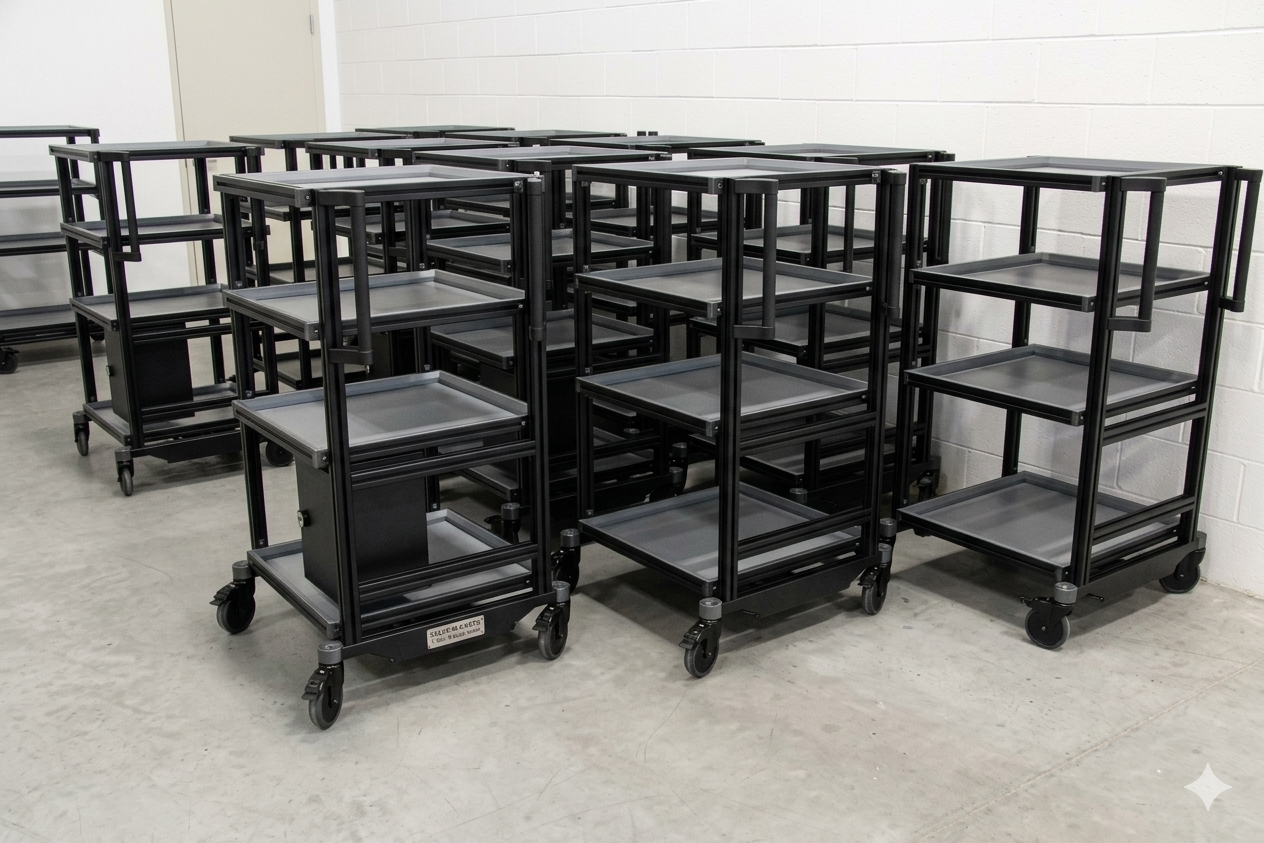
T-slot aluminum carts configured to stage parts in the correct production build sequence — delivering the right components to the right assembly station in the exact order the schedule requires. Designed for mixed-model production lines, JIT and JIS supply systems, and high-variety assembly operations where out-of-sequence parts delivery creates downstream quality and rework problems.
Why Choose Modular Solutions for Sequencing Carts?
The sequencing cart's structure must make the correct sequence position obvious and the wrong position difficult — the design enforces the sequence, not just displays it.
Clear Sequence Position Identification
Each cart position is clearly numbered and labeled with sequence identifiers visible to both the sequencing operator loading the cart and the assembly operator consuming parts from it. Position marking is built into the cart structure — not written on tape labels that fade and fall off in a production environment.
Part-Specific Position Holders
Foam inserts, part nests, and fixture holders at each sequence position locate the specific part or kit for that build sequence slot — preventing parts from being placed in the wrong position during loading. Position holders are designed for the specific part geometry in each slot.
Consumed-Position Visual Management
Empty sequence positions after part consumption are visually obvious from the assembly station — the empty nest or holder at a position shows clearly that the part has been used and the next position should advance. Visual management reduces the cognitive load on the assembler tracking their position in the sequence.
Synchronized to Delivery Interval
Cart size — the number of sequence positions — is designed to match the delivery interval from the sequencing station to the assembly station. The cart holds exactly the parts needed between delivery cycles, so the assembly operator never works from a partially depleted previous cart mixed with a new cart.
Modular Part Holder System
T-slot cart frames allow part holder inserts at each sequence position to be swapped out when the product changes — the cart frame stays in service and only the holders that are specific to the old product are replaced with holders for the new product. Changeover cost is holder cost, not cart replacement cost.
FIFO Return Loop Compatible
Sequencing cart designs that operate in a first-in, first-out return loop allow the empty cart to return to the sequencing station in the same sequence order it was delivered — so the sequencing operator reloads from the front of the empty cart queue in the correct sequence without needing to sort empty carts before reloading.
Key Features & Benefits
Design details for sequencing carts used in JIT and mixed-model production environments.
Numbered Position Plaques
Anodized aluminum or stainless steel sequence position plaques mounted on T-slot channels at each cart position provide durable, permanent position identification that survives production floor conditions without fading, peeling, or requiring replacement.
Part Cradles and Foam Inserts
Custom foam inserts and machined cradles at each sequence position secure parts during cart transit and present them at the correct orientation for installation at the assembly station — eliminating the handling step of orienting the part before use.
Visual Build Sheet Holder
A build sheet or sequence card holder at the top of the cart displays the sequence ID, model variant, and build order for the current cart load — allowing any operator on the line to confirm that the cart at their station matches the current build schedule.
Scan Verification Provisions
Barcode scan windows or RFID read zones at each sequence position allow sequence verification scanning at the loading station before the cart departs — confirming that each position contains the correct part for the scheduled build sequence before the cart is released to the line.
Caster Configuration for AGV or Tugger Tow
Sequencing carts used in AGV or tugger-towed train delivery are configured with the coupling interface and caster type required for the delivery vehicle. All-swivel casters for tow train operation, total-lock casters at the station, and tow pin receivers are specified for the AGV or tugger system in use.
Stackable Empty Cart Design
Empty sequencing carts can be designed to nest or stack for space-efficient empty-cart storage at the sequencing station — reducing floor space consumed by the empty cart queue between reload cycles.
Common Applications
Sequencing carts are used in mixed-model, high-variety, and JIS supply chain environments where build sequence compliance at the assembly station is a quality and efficiency requirement.
- Automotive Mixed-Model Assembly Lines - Sequencing carts delivering color-matched, trim-level-matched, and option-matched components to vehicle assembly stations in the exact build sequence broadcast by the production control system.
- EV Battery Module Assembly - Sequencing carts staging battery cells and module components in build-order sequence for automated and manual assembly cells where cell matching and grade sequence compliance are required.
- Appliance Production Lines - Sequencing carts delivering color panels, door liners, and trim parts in the production sequence for mixed-color appliance lines where the wrong color part at the wrong station creates rework and paint repair costs.
- Seat Assembly Delivery - JIS sequencing carts delivering pre-assembled seats to a vehicle assembly line in the exact sequence of the vehicles approaching the seat install station — a classic sequencing application where seat color, trim level, and headrest configuration must match the vehicle in sequence.
- Medical Device Kit Sequencing - Sequencing carts staging procedure kit components in assembly-step order for medical device kit assembly — ensuring that each assembly step uses the correct component and that the kit build record matches the component sequence loaded at the start of the build.
- Printed Circuit Board Assembly - Sequencing carts at PCB assembly lines staging component feeders, solder paste kits, and stencils in the sequence required for each product run — reducing changeover time by presenting the next product's materials in order at the changeover station.
Specifications & Configurations
Standard design parameters for T-slot aluminum sequencing carts. Sequence position count and holder geometry are application-specific.
| Specification | Detail |
|---|---|
| Frame Profile | 45 or 90 Series T-slot aluminum depending on part size and weight |
| Sequence Positions | 4 to 20 positions per cart; set by part size and delivery interval |
| Position Holders | Custom foam inserts, machined cradles, bin slots per part geometry |
| Position ID | Anodized aluminum plaques, stainless placards; T-slot mounted |
| Verification Options | Barcode scan window, RFID read zone per position; pick-to-light overlay available |
| Delivery Compatibility | Manual push, tugger tow, AGV tow; coupling provisions designed to vehicle spec |
| Empty Cart Handling | Flat-deck stackable design available; FIFO return loop compatible |
| Lead Time | 4 to 7 weeks from approved design |
Frequently Asked Questions
Common questions about sequencing carts from Modular Solutions.
What is a sequencing cart and how is it different from a standard parts cart?
A sequencing cart is a presentation cart configured to stage multiple part sets in the specific order of the production build sequence — rather than presenting parts by bin or part number. The cart's shelf or slot positions correspond to build positions in the assembly sequence, and parts are loaded into the cart in sequence order before delivery to the line. The assembler consumes position 1 parts first, then position 2, and so on — following the cart sequence rather than reading a build sheet. This eliminates the search-and-select step at the line and ensures that the correct parts are used in the correct build order on every unit.
How is the sequencing cart synchronized with the production schedule?
Sequencing carts are loaded at a sequencing station — typically in a buffer area adjacent to the main line — where a sequencing operator receives the production schedule from the MES or build management system and stages parts in the cart in the order the schedule requires. The loaded cart is then delivered to the line station in time to be ready when the corresponding vehicle, unit, or build arrives at that station. The synchronization interval — how far ahead the sequencing cart is prepared relative to when it is needed — is determined by the transit time from the sequencing station to the assembly station.
How many build positions can a sequencing cart carry?
The number of build positions a sequencing cart can carry depends on the part size and the cart dimensions. Sequencing carts are commonly designed to carry 4 to 20 build sets depending on whether parts are bulky sub-assemblies or small components. Carts designed for larger, bulkier parts (seats, bumpers, panels) typically carry 4 to 8 sets. Carts for small parts (switches, clips, fastener kits) can carry 10 to 20 sets. Cart design matches the sequence set size and the delivery interval to the assembly station so that the cart contains exactly the parts needed between replenishment cycles.
Can sequencing carts be used for just-in-sequence (JIS) delivery from a supplier?
Yes. Sequencing carts designed for just-in-sequence (JIS) supplier delivery are built to the sequence order received from the customer's production broadcast and delivered in sequence — either on milk-run routes from a near-line sequencing center or directly from the supplier facility for short-distance JIS supply arrangements. The cart design accommodates the specific part types and packaging used in the JIS supply chain and the handling interface at the receiving dock and line-side station.
What happens if the sequence order changes after the sequencing cart is already loaded?
Sequence order changes after cart loading require unloading and reloading the affected cart positions or, in some systems, diverting the loaded cart to a buffer and preparing a replacement cart in the correct sequence. T-slot sequencing carts with clear, numbered position markers help the sequencing operator quickly identify which positions need to be changed when a schedule revision is broadcast. The T-slot structure allows sequence position markers and part holders to be repositioned easily as product configurations change over time.
Ready to Design Your Sequencing Cart System?
Share your part types, build set size, delivery interval, and production schedule synchronization method. We will design a sequencing cart that enforces correct sequence delivery to your assembly line.
Modular Solutions — 4280 Giddings Rd, Auburn Hills, MI 48326