Mobile Robot Training Enclosures
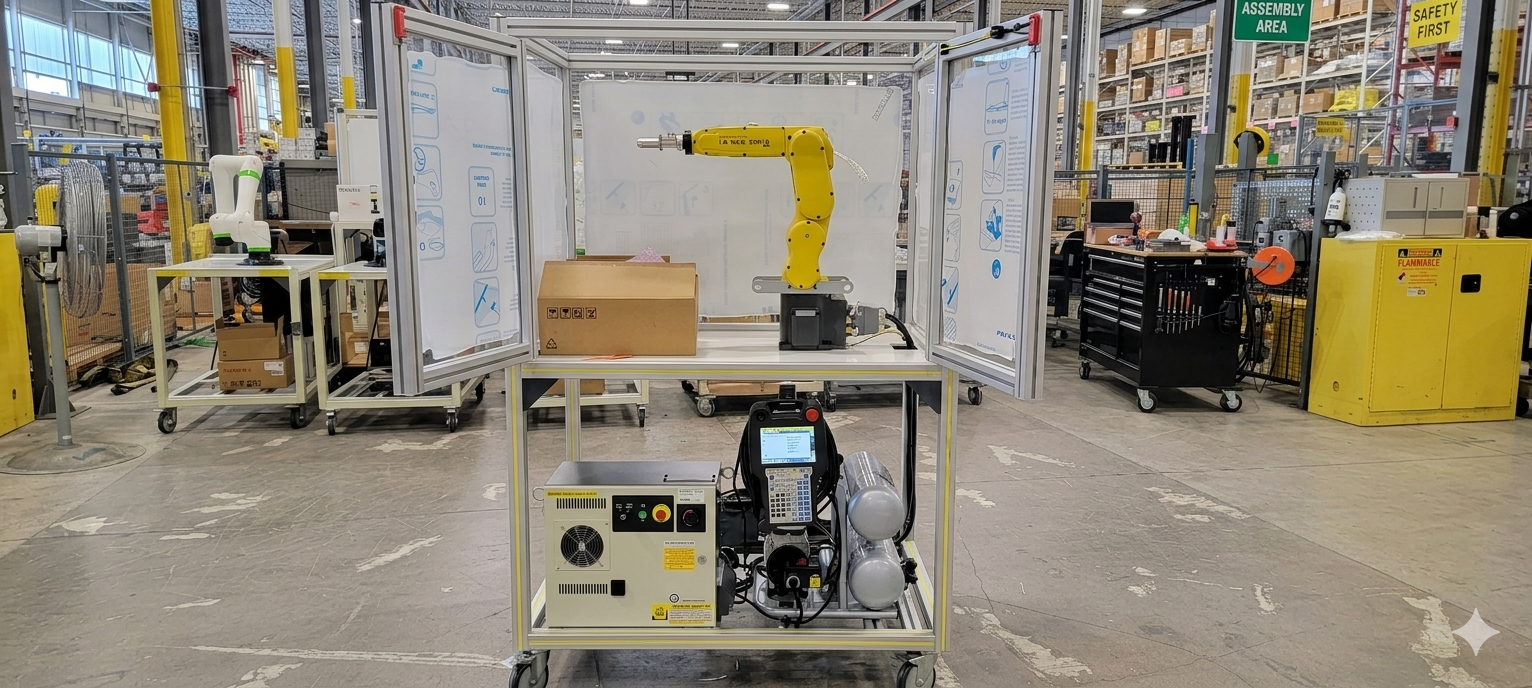
Self-contained modular aluminum enclosures on locking casters — purpose-built to house a robot or cobot and its training fixtures in a single portable unit that rolls to any classroom, training center, or plant floor and provides a compliant, safe work zone without floor anchoring or permanent facility infrastructure. Designed and manufactured in Auburn Hills, MI.
Why Choose Modular Solutions for Mobile Robot Training Enclosures?
The only training cell that goes where the training happens — without permanent installation, facility modification, or a dedicated training room.
Modular aluminum T-slot construction means the enclosure ships flat, assembles on-site, and reconfigures as your robot models or training curriculum changes — protecting your training investment through every equipment upgrade and program evolution.
Full Mobility on Locking Casters
Heavy-duty 4” polyurethane swivel casters with integrated locking brakes allow single-person repositioning on any smooth floor — roll to the classroom, lock in position, train, and roll back to storage.
Self-Contained Safety Guarding
Interlocked access doors, clear polycarbonate viewing panels on three sides, and E-stop mounts on the exterior provide a compliant, contained work zone — OSHA guarding provisions without fixed facility infrastructure.
Robot-Specific Interior Sizing
Each enclosure is dimensioned to the specified robot’s full reach envelope plus safety clearances — tabletop cobots, floor-mount training robots, and AMR demo units all accommodated to exact model specifications.
Integrated Power & Utilities
NEMA power inlet, PDU strip, internal cable management for controller and teach pendant, and optional 24VDC safety circuit — plug in at any wall outlet and the training cell is ready to operate.
Viewing Panels for Group Training
Clear polycarbonate panels on operator-facing and side walls allow instructor and entire class observation of the robot operation without enclosure entry — maximizing group training engagement and safety simultaneously.
Freight-Shippable Between Sites
Anchor point provisions in the base frame and caster locking systems allow secure truck transport between facilities — the complete training cell ships as a single unit to any location in the fleet.
Mobile Robot Training Enclosure Applications
Configured for training programs, academic institutions, system integrators, and manufacturing facilities deploying robotic automation.
- Corporate Robot Training Programs — Mobile enclosures deployed to any plant floor training area for operator certification programs — no dedicated training room required, and the cell relocates between facilities to follow the training schedule.
- Community College & Vocational Programs — Portable training cells that roll between classrooms and labs, are secured overnight, and provide a self-contained safe robot work zone without the cost of a fixed robot lab installation.
- Cobot Operator Certification — ISO/TS 15066-compatible mobile training cells for collaborative robot operator safety certification — providing the defined human-robot interaction zone required for formal cobot training programs.
- Automation System Integrator Demos — Mobile demo enclosures for system integrators showing robot capabilities at customer sites — self-contained, professional-appearing, and ready to demonstrate within 15 minutes of arrival.
- AMR Route Programming & Testing — Mobile enclosures creating a defined, obstacle-free zone for AMR route development, obstacle detection testing, and operator training on autonomous mobile robot systems.
- Plant Floor Upskilling — Training cells deployed directly to the production floor for just-in-time operator upskilling adjacent to the actual robot installation — trainees learn on the same robot model they will operate without disrupting production.
- Trade Show & Exhibition Demos — Compact mobile training enclosures that ship to trade shows in road-case configurations, assemble in under 2 hours, and provide a safe, professional robot demonstration environment at any exhibit.
- Robot Distributor Training Centers — Mobile training cell fleets at distributor locations for multi-brand robot training — each brand in its own mobile enclosure, rolled into the training configuration for each session.
Specifications & Configurations
Standard configurations — all dimensions and safety provisions are custom-engineered to your robot model and training program requirements.
| Specification | Detail |
|---|---|
| Frame System | 45mm T-slot aluminum extrusion; knock-down flat-pack shipping available |
| Interior Sizing | Engineered to robot reach envelope + safety clearances; custom per model |
| Mobility | 4” polyurethane swivel casters with locking brakes; rated 300 lbs each |
| Viewing Panels | 10mm clear polycarbonate on operator and side faces; UV-stabilized |
| Access Doors | Hinged single or double doors with magnetic safety interlock; keyed locking available |
| E-Stop | 1 or 2 exterior E-stop mushroom buttons; wired to robot controller safety input |
| Power | NEMA 5-15 or 5-20 inlet; PDU strip; internal cable management; 120VAC or 240VAC |
| Freight Transport | Base frame anchor points for tie-down straps; caster locking for deck security |
| Lead Time | 3–5 weeks from approved drawings |
Frequently Asked Questions
Common questions about mobile robot training enclosure design, safety, and deployment.
What is a mobile robot training enclosure and how does it differ from a fixed robot cell?
A mobile robot training enclosure is a self-contained, caster-mounted aluminum enclosure that houses a robot or cobot and its associated training fixtures in a single relocatable unit. Unlike a fixed robot cell anchored to a facility floor, the mobile enclosure rolls to any training room, classroom, or plant floor location, locks in position with wheel brakes, and provides a safe, contained work zone immediately. No floor anchoring, no facility modification, and no electrical infrastructure at a fixed location are required. The complete training environment — robot, fixtures, power, and safety guarding — travels with the enclosure.
What robot and cobot models fit inside a mobile training enclosure?
Modular Solutions sizes each mobile training enclosure to the specific robot or cobot model specified by the customer. Common training robots include tabletop cobots in the 600–1000mm reach range (Universal Robots UR3e, UR5e; FANUC CRX series; ABB GoFa) and small industrial robots on integral base frames. The enclosure interior is dimensioned from the robot’s full reach envelope plus clearances for safety interlocks, fixture placement, operator interaction zones, and teach pendant access. Custom sizing is standard — not optional.
How is operator safety managed in a mobile training enclosure?
Mobile training enclosures include interlocked access doors with magnetic or mechanical safety switches that connect to the robot controller’s safety input — the robot is forced to a safe state when any door is opened. Clear polycarbonate viewing panels on three sides allow instructor and student observation without enclosure entry. Light curtains or area scanners can be integrated for collaborative robot (cobot) applications operating under ISO/TS 15066. E-stop buttons are mounted on the exterior at operator reach. All safety provisions are documented in the enclosure’s engineering package.
Can the enclosure be transported between facilities or loaded on a truck?
Yes. Mobile robot training enclosures are designed for both within-facility rolling transport and inter-facility freight shipment. Within the facility, locking swivel casters allow single-person repositioning on smooth floors. For truck transport, the caster locking system secures the unit on the deck, and anchor point provisions allow tie-down straps to attach to the base frame without damaging the enclosure structure. The robot and fixtures are secured inside the enclosure for transport — the complete unit ships as a single, self-contained package.
What power and utilities are typically integrated into the enclosure?
Standard mobile training enclosures include a NEMA 5-15 or 5-20 receptacle for robot controller connection, a power strip or PDU for accessories, internal cable management for controller and teach pendant cables, and an external inlet cord that plugs into any standard 120VAC or 240VAC wall outlet. Optional integrations include 24VDC power for safety PLC, compressed air quick-connect for pneumatic tooling, integrated lighting for the work zone, and wireless E-stop for classroom use at a distance from the enclosure.
Design Your Mobile Robot Training Enclosure
Tell us your robot model, training program requirements, and mobility needs — our engineers will design a self-contained training cell and return a quote with a layout drawing.