Lean bin flow systems integrate gravity-fed bin lanes with visual management, pull-signal hardware, and point-of-use material presentation to eliminate the seven wastes at the production line. Every rack configuration is designed around standard work, takt time, and replenishment cycle requirements.
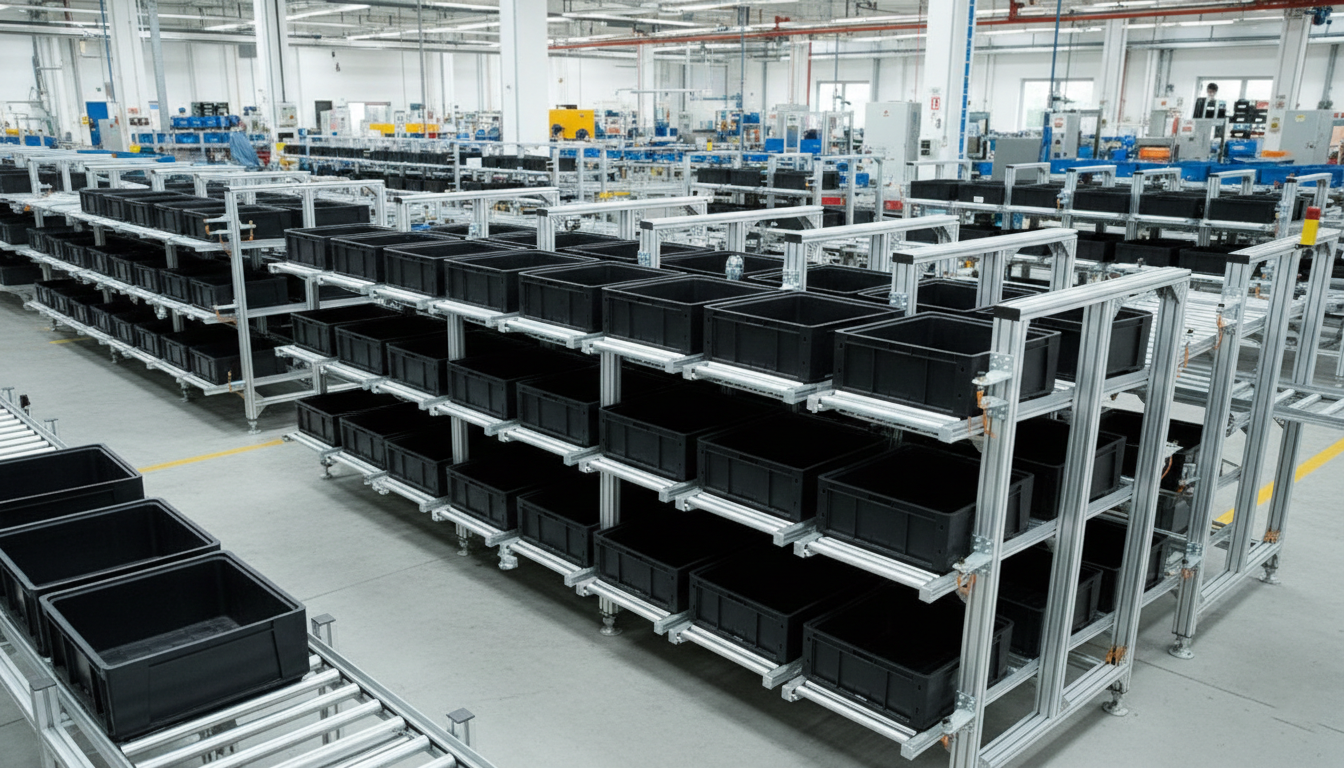
Color-coded lanes, shadow boards, and min/max indicators built into the frame structure — no secondary boards or tape required.
Kanban card holders, two-bin dividers, and empty-lane signal lights mount directly to T-slot channels without drilling.
Bins flow to the operator's optimal ergonomic reach zone — eliminates stretching, bending, and walking waste at every pick station.
Lane layout maps directly to the assembly BOM sequence — operators pick left to right in build order, minimising motion and cognitive load.
Tool-free divider adjustment enables lane width changeover in under two minutes — supports high-mix, low-volume production without dedicated bins.
Lane depth sized to hold exactly one takt cycle of supply — triggers replenishment precisely when needed, not before.
Material presentation aligned to TPS standards — pull replenishment, visual control, and zero-waste material flow at every station.
Rapid lane changeover supports model-mix production without dedicated bin structures per model variant.
Line-side supermarket lanes timed to tugger delivery frequency — bins consumed at line pace, tugger replenishes at milk-run interval.
Shadow board lanes with fixed bin positions and color coding support 5S audits and sustain visual workplace standards.
Modular frames enable rapid lean simulation and layout testing during kaizen events — no structural modifications needed between trials.
Physical rack layout mirrors VSM material flow arrows — visual representation of material state at every process step.
Lane width and divider settings physically prevent wrong-bin placement — error-proofing at the material supply point.
Lane sequence and bin position documented in standard work sheets — new operators trained to rack layout in minutes.
Lane depth is sized to hold exactly one replenishment cycle of supply — typically one takt cycle to one shift, depending on replenishment frequency and bin fill quantity. Modular Solutions calculates this from your takt time, pick rate, and bin capacity.
Yes. T-slot channel mounts accept pick-to-light bar brackets and photoelectric lane-empty sensors. Electronic Kanban signal integration connects to standard WMS or production control systems via the sensor outputs.
Modular Solutions offers RAL powder coat options on dividers and frame sections. Common lean conventions use red for high-velocity SKUs, blue for medium-velocity, and yellow for slow-movers — but custom schemes are engineered to your standard.
A physical stop divides each lane into a front active bin zone and a rear reserve bin zone. When the front bin empties, the operator removes it and the reserve bin slides forward. The empty bin is the Kanban card — placed in the replenishment queue to trigger a warehouse pick.
Yes. Frame height and bin lane face height are designed to match tugger cart presentation height, enabling direct bin transfer without lifting. AGV-compatible frames use standardised lane openings sized to AGV gripper specifications.
Modular Solutions provides lane layout drawings with BOM-sequenced lane numbering, bin position coordinates, and divider setting dimensions. These feed directly into standard work documentation and operator training materials.
Request a quote or contact our engineering team to discuss your lean bin flow systems requirements.