Sloped Shelf Bin Racks

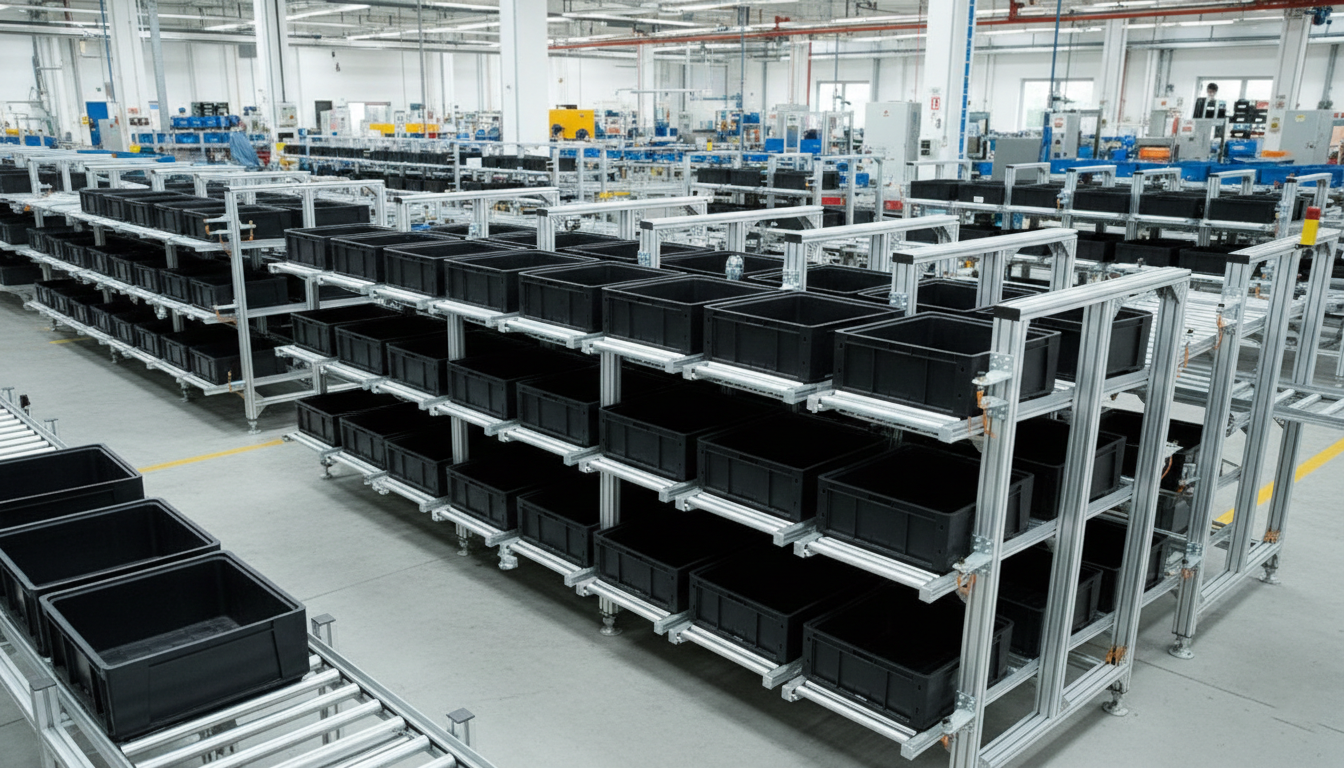
Sloped shelf bin racks provide fixed-angle inclined shelving for ergonomic bin and tote presentation at line-side workstations and assembly areas. Unlike roller-track flow lanes, sloped shelves support a wider range of bin types — including open-top containers, trays, and non-standard footprints — while maintaining gravity-assisted forward presentation.
Key Features

Fixed-Angle Inclined Shelves

Shelf angle set at 10°–20° for consistent bin presentation without roller track — suitable for open-top trays, irregular bin bases, and mesh containers.

Ergonomic Reach Zone

Shelf heights engineered to NIOSH recommended lift envelope — minimises reach distance and improves operator posture at long-cycle stations.

Bin Retention Lip

Front lip prevents bins from sliding off the shelf face — adjustable depth to suit bin height and shelf angle combination.

Wide Bin Compatibility

Non-track shelf surface accepts any bin footprint without lane divider constraints — ideal for large trays or non-standard containers.

T-Slot Adjustable Heights

Shelf bracket positions adjust in T-slot increments — tier spacing changed without tools to accommodate different bin heights.

Workstation Integration

Shelf modules bolt to existing T-slot workstation uprights — no separate rack structure needed for integrated workstation-shelf configurations.

Specifications

Shelf Pitch 10° – 20° fixed
Shelf Width 300 mm – 1200 mm
Shelf Depth 200 mm – 600 mm
Number of Tiers 2 – 6
Tier Spacing T-slot adjustable
Retention Lip Height 20 mm – 80 mm adjustable
Shelf Material Aluminum or steel sheet
Frame Material 6063-T5 aluminum extrusion
Max Load per Shelf Up to 50 kg
Frame Finish Clear anodized or powder coat
Bin Compatibility Open tray, Eurobin, custom
Workstation Attach T-slot bracket mount

Applications & Use Cases

Open-Top Tray Presentation

Sloped shelves support open-top parts trays and pallets not suited to roller lane track — wider bin range in a single structure.

Assembly Workstation Parts Shelf

Integrated shelf module on workstation uprights presents bins in the operator's ergonomic reach zone without a separate rack footprint.

Large Tray and Sheet Metal Staging

Wide sloped shelves accommodate large flat trays, sheet metal blanks, and cut kits not compatible with standard lane divider systems.

Returnable Container Presentation

Automotive returnable containers on inclined shelves gravity-feed to the line face and return to the rear via a separate lane or manual cycle.

Quality Hold and Inspection Staging

Inclined shelves present inspection sample bins to QC operators at consistent ergonomic height without manual repositioning.

Packing Station Carton Supply

Sloped shelves supply flat-pack cartons, foam inserts, and packing materials to pack station operators in gravity-fed sequence.

Tool and Fixture Staging

Small tool trays and fixture holders on sloped shelves at assembly stations — gravity-returns tools to the presentation position after each use cycle.

Batch Component Kitting

Sloped shelf kitting stations hold batch-kitted trays in BOM sequence — operators work left to right through the kit in correct assembly order.

Frequently Asked Questions

What is the difference between a sloped shelf and a roller flow lane?

A roller flow lane uses wheel or roller track to allow bins to slide forward under gravity as each is consumed. A sloped shelf is a flat inclined surface — bins rest on the shelf and slide or are manually pushed forward. Sloped shelves accept a wider range of bin types including open-top trays and irregular footprints not suited to roller track.

What shelf angle is recommended for typical parts bins?

10°–15° is standard for most Eurobin and open-top tray configurations. Steeper angles (15°–20°) suit shallow trays where gravity assist is needed but must be combined with adequate front lip height to prevent bins sliding off.

Can sloped shelves be combined with roller lanes in the same frame?

Yes. T-slot frames allow sloped shelf brackets and roller lane brackets to be mixed across tiers in the same upright structure — sloped shelves on wider tiers, roller lanes on narrow-bin tiers.

What is the maximum load per shelf?

Standard aluminum shelf panels support up to 50 kg per shelf. Steel sheet options are available for heavier loads up to 100 kg per shelf with appropriate frame upright sizing.

How are shelf heights adjusted?

Shelf brackets slot into T-slot channels on the upright frames and lock with T-bolts. Tier height changes require loosening the T-bolt, sliding the bracket to the new position, and re-tightening — no tools beyond a standard hex key.

Can the shelf lip be removed for large trays?

Yes. The front retention lip attaches to T-slot channels on the shelf front edge and is removable. Large flat trays that overhang the shelf front face are installed without the lip, relying on sufficient shelf depth for stability.

Ready to Get Started?

Request a quote or contact our engineering team to discuss your sloped shelf bin racks requirements.

Request a Quote Contact Engineering