Two-bin replenishment bin flow racks implement the classic two-bin Kanban pull system in gravity-fed aluminum frames — a physical lane divider creates an active front bin zone and a reserve rear bin zone in a single lane depth. When the front bin empties, the reserve slides forward and the empty bin becomes the pull signal.
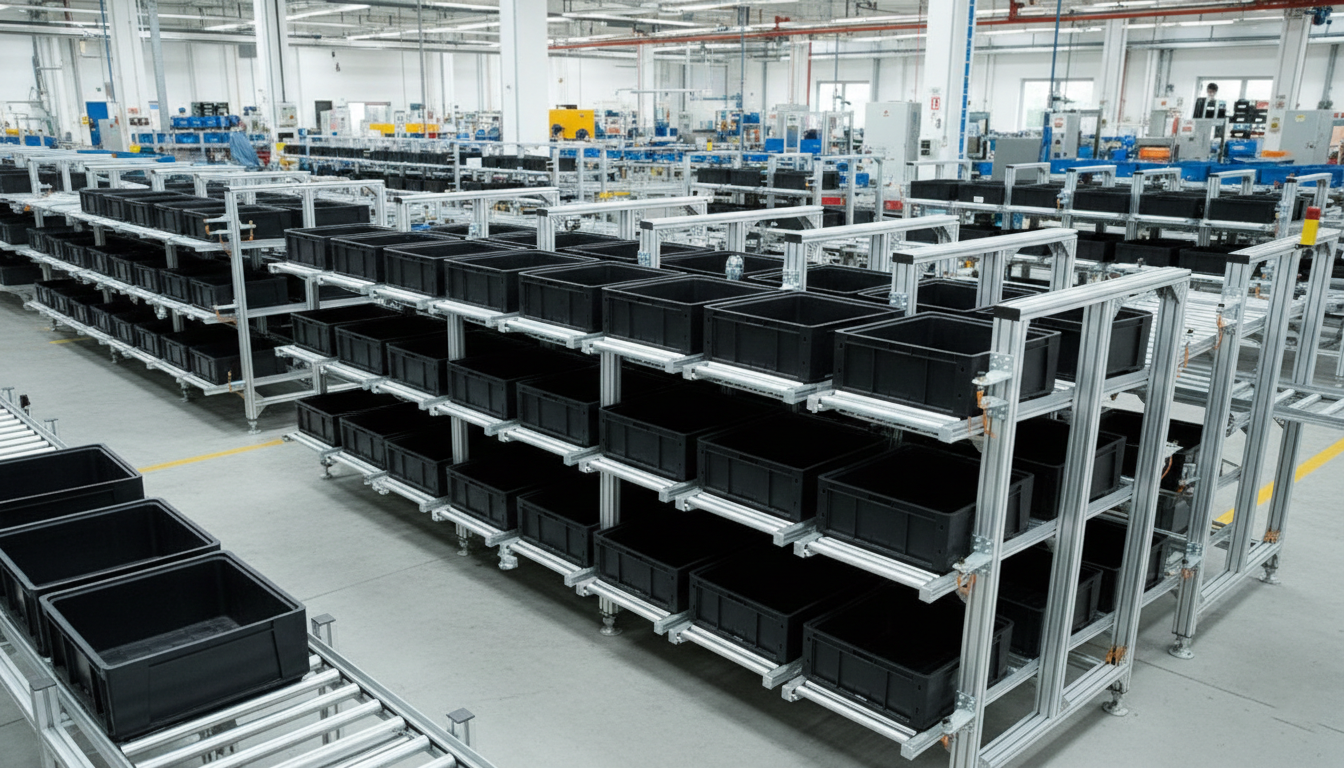
Adjustable T-slot stop divides each lane into front active and rear reserve zones — no electronics, no software, no failure modes.
Reserve bin supplies the line while the empty front bin triggers replenishment — zero line stoppages from material shortage during normal operation.
Empty front bin is the Kanban card — physical object that must be moved to the replenishment queue, impossible to lose or forget unlike paper cards.
Two-bin system occupies a single lane depth — half the floor space of two separate one-bin lanes per SKU.
Lane stop adjusts to any bin depth — works with Eurobins, custom containers, and mixed bin sizes without lane-specific hardware.
Empty bin collection points at rack end face feed directly to tugger route pickup — replenishment loop designed into rack face layout.
Two-bin lanes at every assembly station eliminate material stoppages — reserve bin always available while empty triggers supermarket replenishment.
Line-side supermarket two-bin lanes support fixed replenishment cycle times — warehouse replenishes on fixed route without real-time demand signaling.
Two-bin system for maintenance consumables — reserve bin ensures continuous availability while empty triggers purchase order without manual stock counts.
Two-bin Kanban for medical consumables — FIFO rotation with guaranteed continuous supply and simple visual replenishment trigger for non-technical staff.
Two-bin bin flow for packaging materials and ingredients — FIFO rotation and continuous supply with full lot traceability via bin labelling.
Two-bin tote lanes for packing materials, void fill, and poly bags — visual replenishment trigger without WMS integration for simple consumable SKUs.
Two-bin tape-reel and component bin lanes at SMT lines — ESD-safe options with continuous component supply during long production runs.
Two-bin lanes for high-consumption fasteners at assembly stations — eliminates multiple daily replenishment trips for critical high-velocity parts.
The reserve rear bin supplies the production line while the empty front bin is returned for replenishment. As long as the replenishment cycle time is shorter than the consumption time for one bin, the reserve bin is refilled before it is needed — eliminating stoppages from material shortage.
The stop divides the lane so each zone holds exactly one bin. The bin footprint depth determines the zone length. Total lane depth equals two bin depths plus the thickness of the physical stop.
This is a system alert condition. The empty lane face triggers a visual or electronic alarm. Standard corrective action is emergency replenishment from a nearby buffer. Root cause analysis investigates the replenishment delay to prevent recurrence.
Yes. Additional lane stops create three or more zones in longer lane depths. Three-bin systems are used where replenishment cycle times are long or bin sizes are small, requiring a second reserve bin for safety stock.
Empty bins are placed in the collection zone at the rack end face. The tugger operator picks up empties at each line stop on the milk-run route and returns them to the supermarket for refilling. The physical bin is the Kanban card — no separate card system required.
Yes. T-slot stops use locking T-bolts that require a hex key to reposition — prevents accidental movement during normal operation while allowing deliberate reconfiguration by maintenance or engineering staff.
Request a quote or contact our engineering team to discuss your two-bin replenishment systems requirements.