Assembly Line Flow Racks

Assembly line flow racks are fixed line-side structures that deliver all BOM components to each assembly station in gravity-fed FIFO lanes. Each station's rack is engineered to its specific BOM subset — lane widths, depths, and tier heights matched to the station's component mix — so assemblers never leave their station for material.
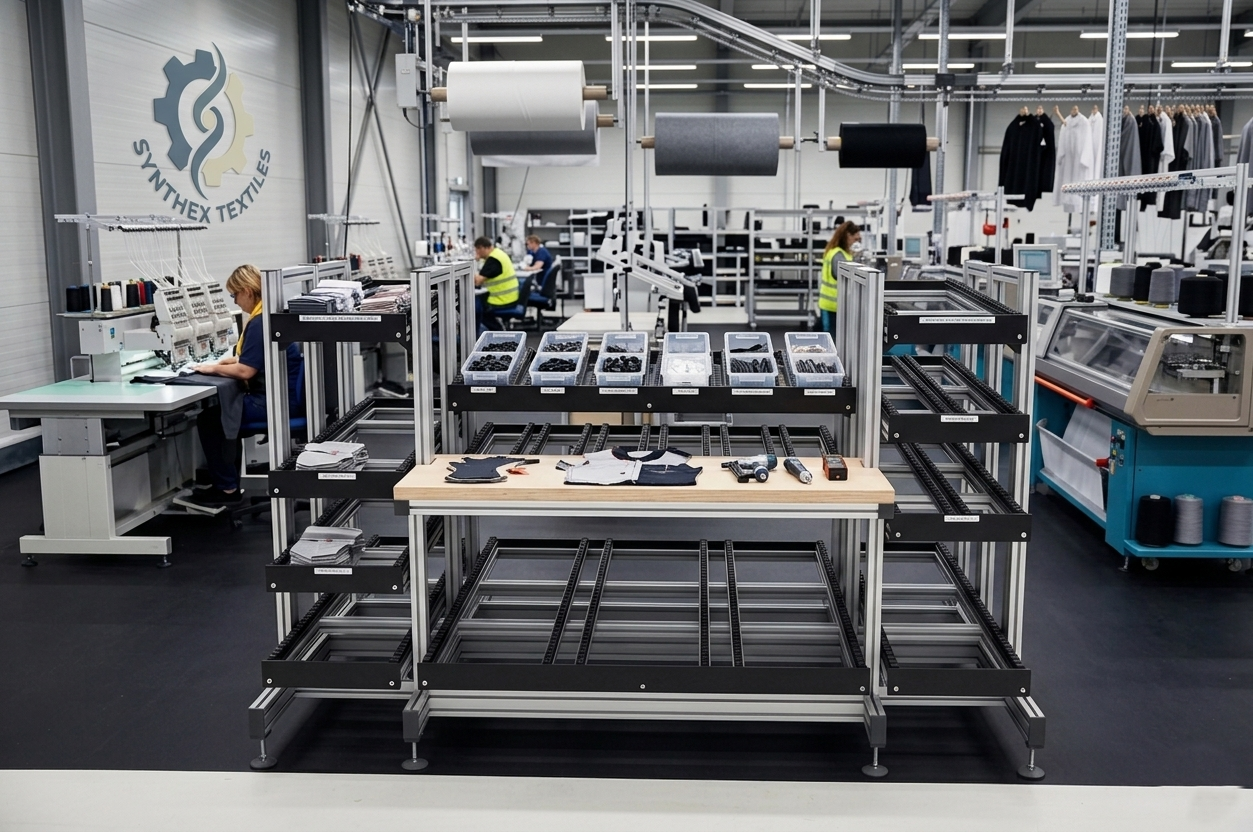
Key Features

Station-Specific BOM Layout

Each station's flow rack built to that station's BOM subset — only the components needed at that station, in assembly sequence, at that position.

Continuous Line Integration

Rack structures attach to line frames or stand independently alongside the assembly line — no floor drilling required for freestanding configurations.

Takt-Time Sized Lanes

Lane depth sized to hold exactly one takt cycle of supply — triggers replenishment precisely when needed without over-stocking the line side.

Multi-Station Scalability

Same modular T-slot platform serves every station on the line — consistent hardware simplifies maintenance, spare parts, and operator training.

Overhead and Under-Line Options

Components can be delivered from overhead suspended racks or under-line trays in addition to standard side-racks — maximises floor space on tight lines.

Tugger Replenishment Alignment

Lane face heights and bin opening dimensions matched to tugger cart height — direct bin transfer at every station without lifting.

Specifications

Lane Width Range 50 mm – 600 mm adjustable
Lane Depth 200 mm – 1600 mm
Rack Height Up to 2200 mm
Number of Tiers 2 – 5
Track Type Plastic wheel or roller
Lane Pitch 3° – 8°
Line Attachment T-slot bracket or freestanding
Frame Material 6063-T5 aluminum extrusion
Max Component Weight 30 kg per lane
Replenishment Side Rear-load, front-pick
Frame Finish Clear anodized or powder coat
Tugger Alignment Matched to standard cart heights

Applications & Use Cases

Automotive Final Assembly

Line-side racks at every body assembly and trim station — all fasteners, clips, harnesses, and panels presented at operator reach without station-leaving.

Electronics Final Assembly

Component flow racks at PCB assembly and test stations — parts presented in assembly sequence for right-first-time builds.

Appliance Manufacturing Lines

Mixed large-component and small-hardware flow racks at appliance assembly stations — all BOM items at the operator's reach zone.

Industrial Equipment Assembly

Heavy sub-assembly and hardware flow lanes for large industrial equipment final assembly stations with mixed component sizes.

Consumer Products Lines

High-mix consumer product assembly lines with rapid changeover between product variants using adjustable T-slot lane configurations.

Defence Systems Assembly

Controlled component delivery at defence equipment assembly stations — physical lane sequence enforces documented build procedure compliance.

Medical Device Final Assembly

ISO 13485 compliant component flow at medical device assembly stations — FIFO rotation and lot-level lane traceability.

HVAC Equipment Assembly

Large-component and hardware flow racks at HVAC assembly stations — all BOM parts within reach for long-cycle manual assembly operations.

Frequently Asked Questions

How are line-side racks anchored to the production floor?

Freestanding racks use levelling feet with optional anchor bolt kits. Line-attached racks use T-slot brackets that bolt to existing line frame uprights without drilling. Both configurations are compliant with standard factory floor load requirements.

How is replenishment performed without stopping the line?

Replenishment is performed from the rack rear face while the assembler works at the front. The rear-load, front-pick architecture physically separates replenishment and assembly tasks — no line stop required for material replenishment.

Can the racks be repositioned between model changeovers?

Yes. Freestanding racks on levelling feet reposition with standard material handling equipment. Line-attached racks detach from line frame brackets in minutes. Full rack repositioning between product family changeovers is supported by the modular T-slot design.

What is the standard rack depth for line-side installations?

Standard depths are 400–800mm for assembly line racks — deep enough to hold one replenishment cycle, shallow enough to keep the rack footprint within the line-side space allocation. Modular Solutions calculates exact lane depth from takt time and replenishment frequency.

How are new BOM components added to existing racks?

New component lanes are added by repositioning existing dividers or adding new shelf brackets on existing uprights. If additional lane capacity is needed, bay extensions attach end-to-end on existing uprights. No new rack purchase required for incremental BOM changes.

Can flow racks be used on both sides of the assembly line simultaneously?

Yes. Operator-side racks present frequently used components at ergonomic reach. Non-operator-side racks hold lower-velocity components accessed from the operator-side via a turn. Double-sided rack configurations are standard for high-BOM-count assembly stations.

Ready to Get Started?

Request a quote or contact our engineering team to discuss your assembly line flow racks requirements.

Request a Quote Contact Engineering