Batch build flow racks are designed for scheduled production campaigns where all components for a defined batch quantity are pre-staged in gravity-fed lanes before the build begins. Lane depths are sized to the exact batch quantity — when the lane empties, the batch is complete, providing a built-in batch count confirmation without counting or scanning.
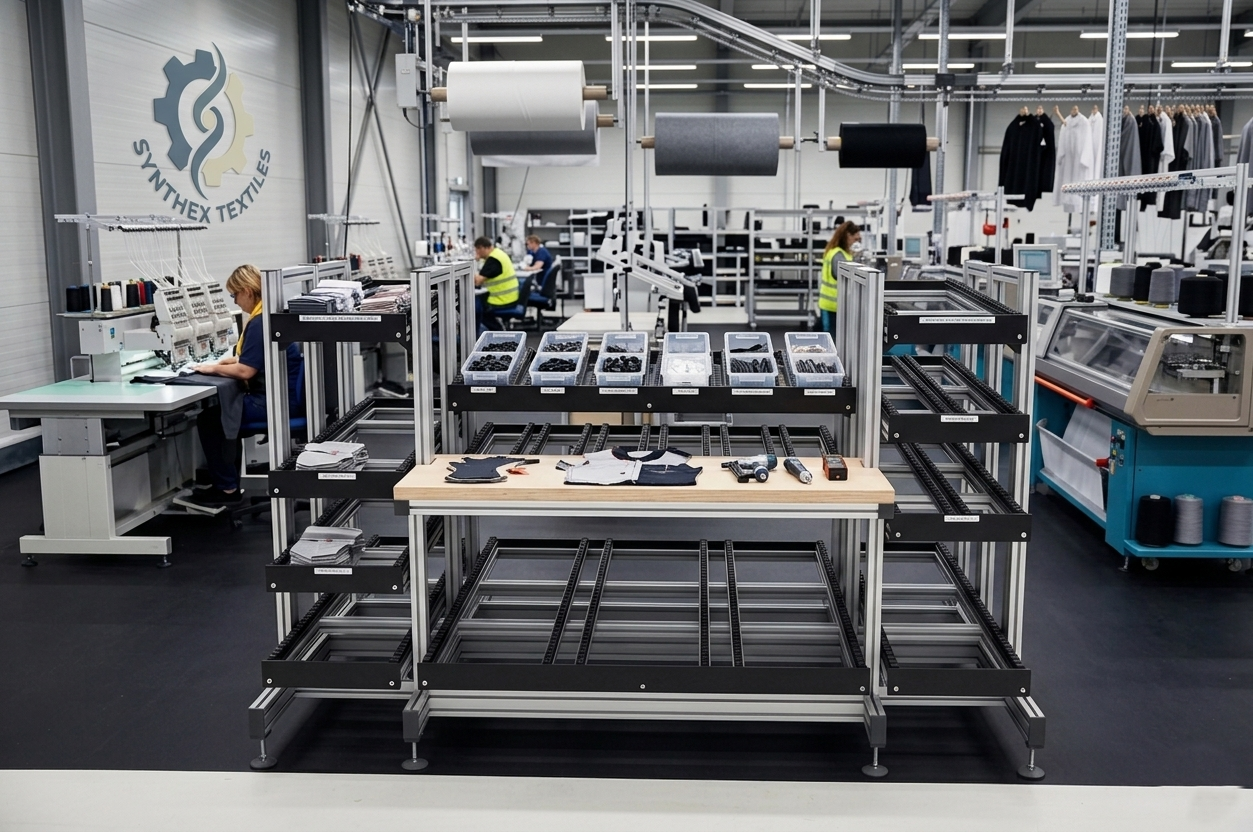
Lane depth sized to hold exactly the batch quantity of each component — empty lane signals batch completion for that component.
All batch components loaded before the production campaign begins — no mid-batch replenishment required for standard batch sizes.
Lane runs empty precisely as the last unit of the batch is completed — physical confirmation of batch count without electronic counting systems.
Lane stops divide lanes into multiple batch zones — next batch loaded in the rear zone while current batch is consumed from the front.
T-slot lane dividers reposition between campaigns to match next batch's BOM and component sizes — full rack changeover in under one shift.
Document holder mounts on rack face carry batch travellers, work orders, and quality documents — all batch information at the build face.
Pre-staged component lanes for campaign production runs — all materials loaded before the campaign starts, no mid-campaign replenishment.
Batch racks for low-volume products where continuous replenishment is impractical — all components staged for the full order quantity before assembly begins.
Batch racks for prototype build campaigns — all BOM components staged and verified before assembly begins to avoid mid-build shortages.
GMP and ISO batch builds where all components must be staged, verified, and released before manufacturing begins.
Batch flow racks for spare parts kit assembly — all kit components staged for the batch quantity before kitting operations begin.
Batch build racks for defence contract production — all controlled components staged and verified before build authorisation.
Pre-staged batch racks for seasonal product campaigns — all components staged during off-season preparation for efficient peak-season execution.
Batch racks for make-to-order production where each order is a batch — components staged to exact order quantities for clean order completion.
Lane depth equals the batch quantity multiplied by the component length (or bin length for binned parts). Modular Solutions calculates this from the BOM component dimensions and batch size, then adds a 5–10% buffer for component dimensional variation and bin stacking tolerance.
The final bin of the batch is partially filled to the batch remainder quantity. The lane stop is set to exclude any surplus from the previous batch. Modular Solutions designs the lane stop and bin fill quantity together so the batch boundary is physically enforced.
Yes. Multi-batch lane partitioning uses T-slot stops to divide each lane into current-batch and next-batch zones. While the current batch is consumed from the front zone, the next batch is loaded into the rear zone. This staging method reduces campaign changeover time to near zero.
Document holder extrusions mount to T-slot channels on the rack face — one holder per rack or per station. Batch travellers, work orders, and quality documents are clipped into the holder at the start of each campaign and removed for quality sign-off at campaign completion.
Yes. The only difference between a batch rack and a continuous-flow rack is the lane depth and the presence of batch stops. Removing the stops and adjusting lane depth to a replenishment-cycle-based depth converts the rack to continuous flow. The same T-slot hardware supports both modes.
Batch staging is the prevention mechanism — all components must be physically present in the lanes before the campaign release. Modular Solutions recommends a batch staging audit: each lane is counted or scanned before build release to confirm all components are present to the required batch quantity.
Request a quote or contact our engineering team to discuss your batch build flow racks requirements.