Mobile Kitting Flow Racks

Mobile kitting flow racks are wheeled T-slot aluminum frame structures combining gravity-fed bin lanes with a mobile base for flexible line feeding, tugger train delivery, and model changeover. Kits are pre-built at the supermarket and the entire rack is transported to the assembly line — delivering all components for a defined production quantity in a single delivery.
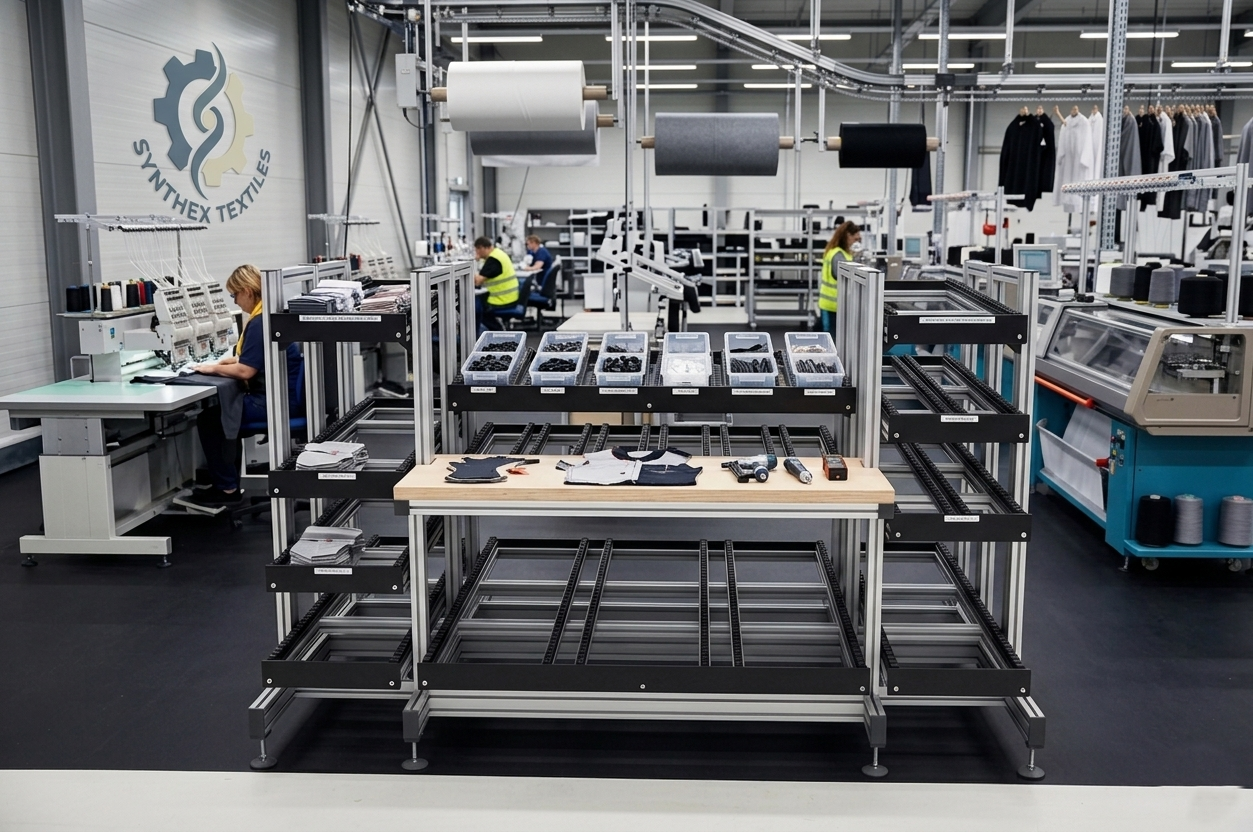
Key Features

Wheeled Mobile Base

Heavy-duty swivel and fixed casters with total load capacity to 500 kg — smooth rolling on factory floors with fork entry points for lift truck relocation.

Supermarket Pre-Loading

All bin lanes loaded at the central supermarket before delivery — assembly line receives fully stocked rack, empties return for restocking in a single exchange.

Tugger Train Compatible

Coupling points on rack sides enable trains of 2–4 racks pulled by a single tugger — high-density milk run delivery without multiple tugger trips.

Model-Change Ready

T-slot lane dividers reposition at the supermarket between model runs — same mobile frame serves different product models without model-specific carts.

Gravity-Fed Bin Lanes

Inclined bin lanes maintain FIFO delivery to the front face during transport and at the line side — component bins accessible immediately on rack arrival.

Parking Alignment Features

Floor guide marks and rack alignment stops ensure precise parking at each line-side position — operators receive components at the designed ergonomic height every delivery.

Specifications

Base Dimensions 600 mm – 1200 mm wide, 600 mm – 1000 mm deep
Rack Height Up to 1800 mm
Caster Capacity Up to 500 kg total load
Caster Type Swivel front, fixed rear
Lane Width Range 50 mm – 400 mm adjustable
Number of Tiers 2 – 4
Track Type Plastic wheel
Lane Pitch 5° – 10°
Frame Material 6063-T5 aluminum extrusion
Coupling Type T-slot tugger train coupling
Parking Stop Floor guide and rack stop
Frame Finish Clear anodized or powder coat

Applications & Use Cases

Tugger Train Line Feeding

Mobile kitting racks coupled into tugger trains deliver all line-side components on fixed milk-run routes — all line stations restocked in a single tugger pass.

Model Changeover Supply

Pre-loaded mobile racks for each model variant delivered to the line at changeover — full component supply ready before the first unit of the new model starts.

High-Mix Low-Volume Assembly

Mobile racks loaded per order at the supermarket and delivered to the line for each order — no permanent line-side storage for low-volume order-specific components.

Flexible Manufacturing Lines

Mobile racks enable line layout changes without fixed rack repositioning — line side is always served by arriving racks, not permanently installed structures.

Maintenance and Service Kitting

Pre-loaded service kits on mobile racks delivered to planned maintenance sites — all parts and consumables on a single mobile structure.

Prototype and Pilot Assembly

Mobile racks for prototype and pilot assembly — components delivered to changing pilot line positions without installing fixed line-side structures.

Seasonal Line Scaling

Additional mobile racks deployed during peak production periods without installing additional fixed infrastructure — capacity scales with mobile fleet size.

Campus Multi-Building Delivery

Mobile racks transported between buildings on facility tow vehicles — same rack design serves multiple buildings and production areas.

Frequently Asked Questions

How is the mobile rack stabilised at the line side to prevent rolling during picking?

Each mobile rack has a parking brake on at least two casters, activated by a foot pedal on rack arrival. Floor guide marks indicate the exact parking position. Alignment stops on the floor or line frame prevent rack drift from the designed position during picking.

What is the maximum number of racks in a tugger train?

Standard tugger trains pull 2–4 racks depending on the tugger capacity and facility aisle widths. Each rack is coupled to the next with T-slot tugger coupling hardware. Modular Solutions calculates the maximum train length from tugger rated pull capacity and the loaded rack weight.

How are gravity-fed lanes maintained during transport?

Bin lanes use standard plastic wheel track with lane dividers — bins are retained by front lane stops during transport. Steep transport pitches are avoided by keeping towing speeds below 5 km/h on standard factory floors. No bin restraints are required for normal factory transport speeds.

Can mobile racks be converted to fixed line-side racks?

Yes. The mobile base is a separate sub-assembly that attaches to the T-slot frame with standard M8 bolts. Removing the mobile base and adding levelling feet converts the rack to a fixed freestanding configuration. The same bin lane modules and T-slot frame are retained.

How are mobile racks tracked in the facility?

Basic tracking uses rack number labels and a visual board at the supermarket showing which racks are at line side, in transit, or at the supermarket for restocking. RFID-based tracking systems integrate with the rack frame via T-slot mounted RFID reader brackets for digital location tracking.

What floor surface conditions are required for mobile rack operation?

Standard factory-grade sealed concrete or epoxy-coated floors are suitable for mobile rack operation. Unsealed concrete, expansion joint gaps above 15mm, or ramp grades above 5% require engineering review. Heavy-duty caster options are available for rougher floor conditions.

Ready to Get Started?

Request a quote or contact our engineering team to discuss your mobile kitting flow racks requirements.

Request a Quote Contact Engineering