Battery Assembly Flow Racks

ESD-safe, fire-rated gravity flow racks for lithium-ion cell handling, module assembly staging, and battery pack line-side supply — engineered to manage ESD sensitivity, thermal runaway risk, and FIFO cell rotation for NMC, LFP, and NCA cell chemistries in EV and energy storage manufacturing.
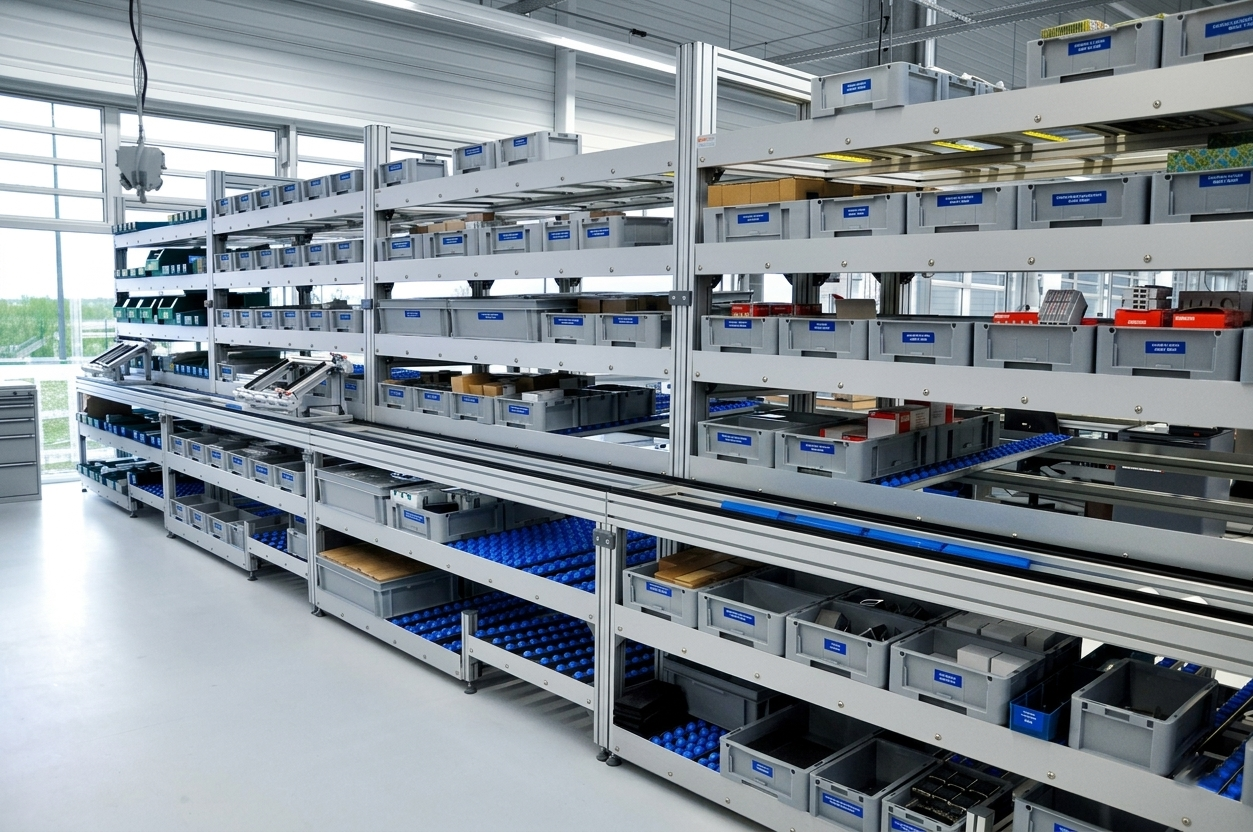
Why Choose Battery Assembly Flow Racks

ESD-Dissipative Lane Surfaces

All lane roller and glide surfaces are ESD-dissipative with a surface resistivity of 10^6 to 10^9 ohms per square, meeting ANSI/ESD S20.20 requirements for ESD-sensitive lithium-ion cell handling. Grounded frame provides a continuous ESD path from cell to ground.

Fire-Rated Materials

All non-metallic rack components including lane guides, end stops, and kanban holders are specified from UL94 V-0 fire-rated materials. No materials are used that would contribute to, accelerate, or sustain a lithium-ion thermal runaway event in the rack environment.

Ventilated Open-Frame Design

Open aluminum frame construction with no panel enclosures ensures natural convection cooling around staged cell containers. No heat-trapping geometries or enclosed spaces that could concentrate thermal runaway off-gassing products near the rack structure.

Cell Chemistry Compatibility

Lane surface materials and surface coatings are verified compatible with NMC, LFP, NCA, and LCO cell chemistries for electrolyte splash, outgassing product exposure, and thermal gradient cycling. No materials that react with lithium-ion electrolyte compounds.

FIFO Cell Rotation

Rear-load front-pick FIFO lanes enforce cell lot rotation, ensuring that the oldest manufactured cell lot always reaches the assembly pick face first. Cell date code and lot traceability integrates with lane-front barcode scanning for first-in-first-out verification records.

No Ignition Source Design

All metallic surfaces are grounded. No sparking materials, no high-friction surfaces, no arc-generating components. Rack passes ignition source risk assessment for installation in areas classified as hazardous due to lithium-ion thermal runaway off-gassing.

Specifications

ESD Lane Surface

10^6–10^9 Ω/sq dissipative; ANSI/ESD S20.20

Frame Material

Anodized aluminum; continuously grounded

Fire Rating

All non-metallic components UL94 V-0

Ventilation

Open frame; no heat-trapping enclosures

Cell Chemistry

NMC, LFP, NCA, LCO verified compatible

FIFO Lane

Rear-load front-pick; lot date code traceability

Ignition Sources

None; no sparking, no arc-generating materials

Grounding

Continuous ESD path; ground lug at frame base

Load Capacity

Up to 600kg per bay; cell weight per lane calculated

Applications

EV Battery Module Assembly

Line-side cell supply racks for electric vehicle battery module assembly lines handling prismatic, cylindrical, and pouch lithium-ion cells in FIFO lot sequence.

Cell Incoming Inspection Staging

Cell incoming quality inspection staging racks presenting cells in lot sequence for dimensional, voltage, and capacity check before assembly entry.

Battery Pack Assembly Supply

Module and BMS component supply racks adjacent to battery pack final assembly stations with ESD control and FIFO lot management.

Energy Storage Manufacturing

Large-format cell and module staging racks for grid-scale and commercial energy storage system manufacturing where thermal management and FIFO control are critical.

Frequently Asked Questions

How do battery assembly flow racks manage ESD risk for lithium-ion cells?

All lane roller and glide surfaces are ESD-dissipative with a controlled surface resistivity of 10^6 to 10^9 ohms per square per ANSI/ESD S20.20. The aluminum frame is continuously grounded through a ground lug at the base, providing a low-impedance ESD discharge path from cell to facility ground. Wrist strap attachment points are integrated for operators working at the rack pick face.

What fire-safety design features are included in battery assembly flow racks?

All non-metallic components including lane guides, kanban card holders, label mounts, and end stops are specified from UL94 V-0 materials that self-extinguish in the vertical burn test. Open frame construction ensures no enclosed spaces that could concentrate thermal runaway off-gas. No ignition-source materials are used anywhere in the rack structure, and the design passes standard ignition source risk assessments for battery manufacturing areas.

How does the rack support FIFO lot traceability for battery cells?

Rear-load, front-pick lane geometry enforces lot sequence rotation by physical design — the oldest lot always reaches the pick face first. Lane-front barcode scanner brackets allow the MES to record the lot number of each container at each pick event. This provides a cell-container-level lot consumption record that ties each lot to the specific battery module or pack consuming that lot.

Can battery flow racks handle large-format prismatic cells?

Yes. Lane width, lane depth, and roller spacing are all configured to the specific cell form factor during the rack design process. Large-format prismatic cells up to 300mm x 175mm x 45mm are routinely accommodated. Pouch cells require lane insert cradles to maintain consistent orientation and prevent edge damage during gravity feed. Cell drawings or samples are reviewed before finalizing lane geometry.

Are battery assembly flow racks suitable for installation in classified hazardous areas?

Standard battery assembly flow racks are designed for ordinary locations (non-classified) adjacent to battery assembly operations. For classified hazardous areas designated due to lithium-ion off-gassing accumulation potential, an ignition source risk assessment is completed for the specific rack configuration and area classification. Modified designs with additional grounding provisions and non-sparking surface treatments are available for Ex/ATEX or NEC Class I area requirements.

Build Your Battery Assembly Flow Rack

Share your cell form factor, chemistry, lot traceability requirements, and facility ESD and fire-safety specifications — we will design a rack system that meets your battery manufacturing safety and quality requirements.

Request a Quote