Body in White Area Fencing

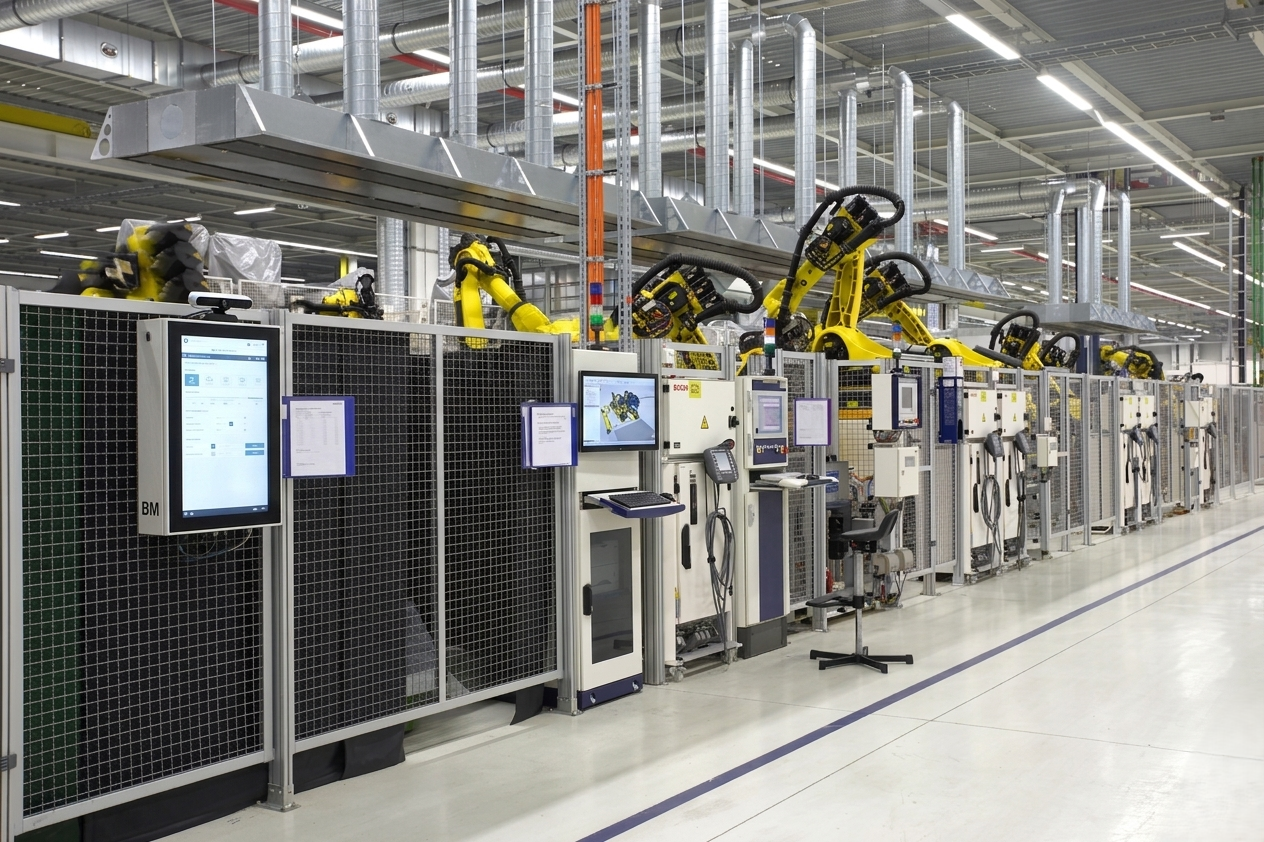
Heavy-duty perimeter fencing engineered for the extreme demands of automotive body-in-white (BIW) stamping, robotic welding, and automated assembly areas. Designed to withstand spatter, primer overspray, high-cycle impact loads, and the large-format access required by body panels, transfer fixtures, and conveyor systems moving vehicle bodies through production.

Request a Quote
Why Choose Modular Solutions for BIW Area Fencing?

BIW environments are among the harshest in manufacturing. Our fencing systems are designed to perform in press shops, weld lines, and assembly framing stations — not standard assembly environments.

High-Load Panel Construction

Heavy-gauge welded wire mesh panels (8 gauge / 4mm wire minimum) withstand the mechanical loads from transfer equipment, tooling carts, and occasional forklift contact without deforming.

Overspray Resistance

Panel and frame finishes selected for resistance to paint, primer, and e-coat overspray common in BIW production areas — no degradation or adhesion failure over service life.

Large-Format Safety Gates

Double-leaf and bi-parting safety gates sized for transfer fixtures, body skids, and maintenance equipment access — up to 4m wide openings with full interlock integration.

Conveyor Integration

Overhead and floor-level conveyor pass-through openings sized for body hangers, friction drive systems, floor AGV conveyors, and automated guided vehicles with full safety compliance.

Robot Reach Envelope Clearance

All fencing positioned at ANSI/RIA R15.06 minimum safety distances from each robot's full range of motion — calculated for the specific robot model and tooling configuration.

OEM-Compatible Design

Designs reviewed against automotive OEM facility standards for guarding height, mesh aperture, gate width, and interlock specifications — experience with GM, Ford, Stellantis, and Toyota facilities.

Key Features & Capabilities

BIW area fencing from Modular Solutions is built for the scale, throughput, and compliance demands of automotive body manufacturing.

Full-Height Perimeter Panels

2000mm to 2800mm standard panel heights. Taller systems for overhead conveyors or gantry robot installations engineered on project basis.

Weld Spatter Skirt Panels

Solid lower skirt panels (500mm–750mm) at the base of fencing in weld areas prevent spatter from traveling under the fence and causing floor slip or fire hazards.

Dual Safety Interlock Gates

All personnel access gates fitted with dual-channel safety interlock switches — wired to the area safety system with auditable fault detection capability.

Tooling Cart Pass-Throughs

Low-height pass-through openings with safety distance-compliant tunnel guards for tooling carts, die carts, and maintenance equipment without full gate opening.

E-Stop Network

Multiple E-stop stations distributed around the fencing perimeter and at all access points — wired to a zone stop circuit for rapid production halt capability.

Modular Expansion Ready

T-slot framing system allows future fence extensions or gate additions when robot cell capacity expands — no replacement of existing fence sections required.

Common Applications

BIW area fencing from Modular Solutions supports the full range of automotive body manufacturing operations.

Specifications

Representative system parameters — all specifications are custom-engineered to your BIW line layout and automotive OEM requirements.

6000-SeriesAluminum Frame Material
BIW / StampingTarget Application
Large Part TransferOpening Capability
ANSI/RIA R15.06Design Standard
Heavy-Duty MeshPanel Grade
1800–2400mmStandard Heights
OEM CompatibleStandards Compliance
Automotive Tier-1Primary Market

Frequently Asked Questions

What is body-in-white (BIW) area fencing?

Body-in-white (BIW) refers to the welded steel body structure of a vehicle before paint and trim are applied. BIW area fencing is safety perimeter guarding around the robotic assembly, stamping, and weld lines that produce these body structures — typically in automotive OEM and Tier-1 stamping plants. BIW lines run at high production rates with large part transfer openings and heavy-duty robots.

What makes BIW fencing different from standard robot cell guarding?

BIW lines typically involve larger robot reach envelopes, higher-speed multi-robot operation, large part transfer openings for vehicle body sections, and much longer guarding runs than a single workstation. Guards are often designed as continuous line barriers rather than isolated cell enclosures, with multiple coordinated safety zones and integration into the line's PLC safety architecture.

What industries use body-in-white safety fencing?

BIW safety fencing is used primarily in automotive manufacturing — OEM assembly plants and Tier-1 stamping, blanking, and body assembly suppliers. Modular Solutions, based in Auburn Hills, MI, is ideally positioned to serve the Michigan and Midwest automotive manufacturing base with fast lead times and local engineering support.

Can BIW fencing accommodate large automotive part transfer openings?

Yes. BIW part transfer openings for door panels, roof sections, and underbody assemblies can be 2000–3000mm wide or more. Modular Solutions engineers these openings with correctly calculated safety distances and light curtain provisions to maintain the safety zone while allowing continuous high-throughput part flow.

What safety standards apply to body-in-white robotic area fencing?

ANSI/RIA R15.06, ISO 10218-1 and 10218-2 are the primary standards for robotic system safety including BIW lines. Many automotive OEM plants also require compliance with internal safety standards (Ford GESN, GM GMS, Stellantis PSCS) that specify additional requirements for guarding design, interlock types, and safety PLC architecture. Modular Solutions can engineer to customer-specific OEM safety standards on request.

Ready to Guard Your BIW Production Area?

Contact our engineering team for BIW area fencing designed to your facility's OEM standards, robot configuration, and production throughput requirements.

Request a Custom Quote