Engineered guarding solutions for collaborative robot (cobot) work cells — designed to support human-robot collaboration (HRC) modes with adjustable barrier heights, transparent polycarbonate sightlines, and provisions for speed and force limiting zone delineation. Compliant with ISO/TS 15066 and ANSI/RIA R15.06.
Request a Quote
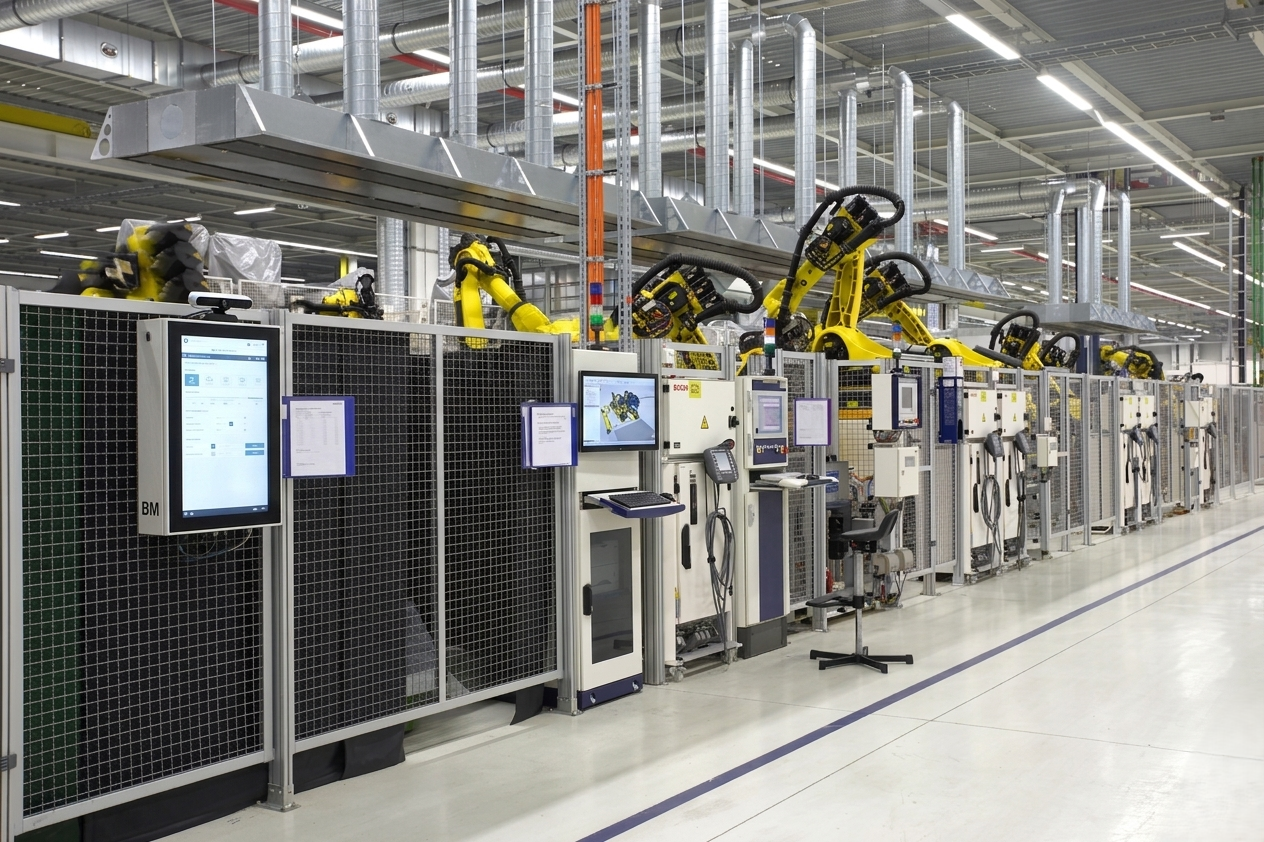
Cobot applications require guarding that supports collaboration — not just containment. Our systems delineate HRC zones while providing the flexibility cobots are designed for.
Physical barriers define the hand-guided, speed-limited, and full-speed zones required by ISO/TS 15066 collaborative operation modes — visible and enforceable.
Lower barrier heights (800mm–1200mm) for hand-guided and power-and-force-limiting modes allow operator access while physically marking zone boundaries.
Clear polycarbonate panels maintain full sightlines into the cobot work area — supporting operator monitoring and cell supervision without blind spots.
Mounting provisions and cable routing channels for SICK, Leuze, and Pilz area scanners that enforce speed reduction and stop zones dynamically.
Cobot applications evolve rapidly. T-slot framing allows panels to be added, removed, or repositioned without tools as collaboration modes change.
System designs reviewed against ISO/TS 15066 biomechanical limits and ANSI/RIA R15.06 requirements for collaborative robot installations.
Cobot workstation guards combine the structural integrity of industrial guarding with the accessibility and visibility collaborative applications require.
Guard layouts designed around Universal Robots, FANUC CRX, KUKA LBR iiwa, ABB YuMi, and Techman cobot models and their specific mounting and reach envelopes.
Pass-through openings and part presentation cutouts positioned at optimal ergonomic heights — reducing operator fatigue in high-cycle assembly applications.
Guard base profiles accommodate safety mat integration for presence-sensing floor zones that reduce cobot speed when operators enter the collaboration area.
T-slot framing doubles as a mounting structure for parts fixtures, bin holders, label printers, and inspection cameras within the cobot work cell boundary.
Minimal-footprint guard designs for benchtop cobots in constrained production areas — full protection in as little as 150mm guard offset from the cobot base.
Integrated cable management channels route cobot power, I/O, tool cabling, and sensor wiring cleanly through the guard structure — no exposed cables in the work area.
Cobot workstation guards support the most common collaborative automation tasks across manufacturing industries.
Representative system parameters — all specifications are custom-engineered to your cobot model and risk assessment outcome.
It depends on the risk assessment. ISO/TS 15066 allows cobots to operate without physical guarding only when a properly documented risk assessment confirms that the robot's speed, force, and contact pressure remain within human physiological limits. If the risk assessment identifies residual risks that exceed those limits, physical guarding is required regardless of the cobot's collaborative designation.
Industrial robot guards are typically full-perimeter enclosures sized to prevent any access to the robot's hazard zone during operation. Cobot workstation guards are often partial barriers — providing physical separation at specific sides while leaving other sides open for operator interaction — designed to ISO/TS 15066 safety distance requirements based on the cobot's risk assessment outcome.
ISO/TS 15066 (Robots and robotic devices — Collaborative robots) provides the technical specification for collaborative robot safety, including speed and separation monitoring (SSM) safety distances used to size physical guards. ISO 10218-1 and ISO 10218-2 also apply to the overall robot system. The guard design must satisfy the minimum separation distances identified in the SSM analysis.
Yes. Cobot workstation guards frequently include polycarbonate windows, open operator access zones, and ergonomically positioned HMI cutouts that allow the operator to interact with the cobot's work area from a defined safe position. The guard geometry is engineered so the operator cannot inadvertently enter the monitored safety zone during normal operation.
ISO/TS 15066 Annex A defines maximum permissible contact forces and pressures by body region. A cobot operating in speed and separation monitoring (SSM) mode must maintain a minimum protective separation distance calculated from the robot speed, operator speed, reaction time, and stopping distance. This distance varies by robot model, load, and speed — typically 300mm to 1000mm. When that distance cannot be maintained, physical guarding is required.
Contact our engineering team for a cobot workstation guard system designed to your collaboration mode, robot model, and operator workflow.
Request a Custom Quote