Robotic Cell Guarding

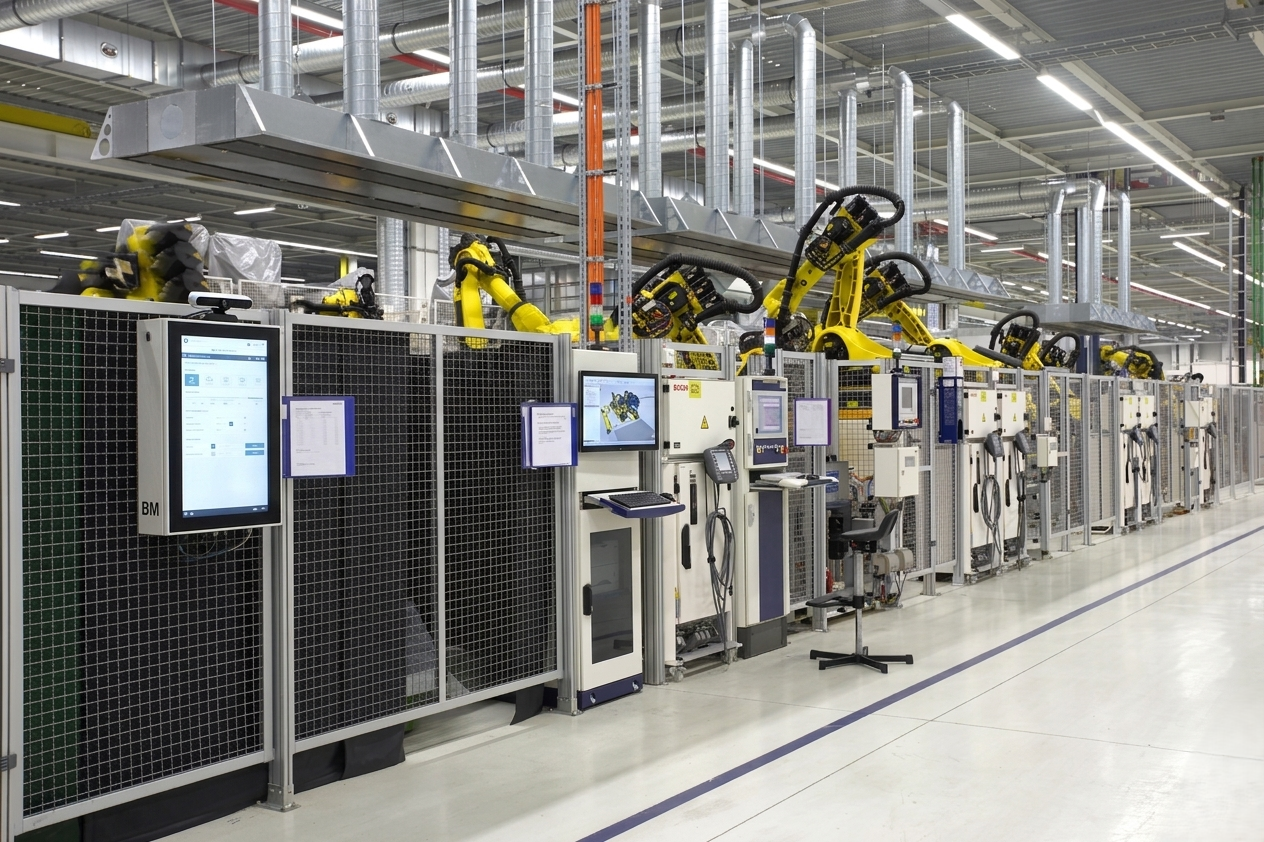
Complete perimeter guarding systems engineered for standard industrial robot cells — 6-axis, SCARA, and delta configurations. Modular Solutions designs each enclosure to the robot's exact reach envelope, providing OSHA-compliant protection with interlocked safety gates and flexible panel options for every production environment.

Request a Quote
Why Choose Modular Solutions for Robotic Cell Guarding?

Our aluminum T-slot framing system is purpose-built for robot cell integration — fast to install, easy to reconfigure, and engineered to every OSHA and ANSI/RIA R15.06 requirement.

Reach Envelope Engineering

Every guard is dimensioned to the robot's maximum reach envelope per ANSI/RIA R15.06 — ensuring no risk of contact through undersized panels or gaps.

Safety Gate Interlocking

Access gates are configured with tongue-and-groove safety interlock switches wired to the robot controller's safety circuit, stopping robot motion on door open.

OSHA 29 CFR 1910.212 Compliant

All systems are designed to comply with OSHA machine guarding standards for point-of-operation and perimeter protection in automated environments.

Polycarbonate & Mesh Options

Choose impact-rated polycarbonate panels for full visibility into the cell, welded wire mesh for ventilation and cost efficiency, or a combination of both.

Modular & Reconfigurable

Bolt-together aluminum framing means future robot upgrades or layout changes are accommodated without replacing the entire guarding system.

Custom Sizing

Non-standard cell footprints, angled corners, elevated platforms, and ceiling height constraints all accommodated through custom-cut framing and panel sizing.

Key Features & Capabilities

Every robotic cell guarding system from Modular Solutions combines robust structural performance with integration-ready safety features.

Aluminum T-Slot Framing

Lightweight, corrosion-resistant 80/20-compatible T-slot extrusions provide rigid panel support while eliminating welding and simplifying field assembly.

Pass-Through Openings

Conveyor in-feed and out-feed openings engineered with correct safety distances per ISO 13857 — no light curtain gaps or reach-over risks.

E-Stop Mounting Provisions

Emergency stop button mounts integrated into gate posts and fence panels at ergonomic heights for immediate operator access on all four sides of the cell.

Panel Height Options

Standard heights from 1500mm to 2400mm. Taller configurations for high-reach robots or overhead gantry systems available on request.

Finish Options

Available in Standard or Black Elite finish — both provide a clean, durable appearance for production floor environments.

Floor Anchor Systems

Concrete anchor, epoxy anchor, and adjustable base foot options for level floors, raised platforms, and facilities requiring non-permanent installation.

Common Applications

Robotic cell guarding from Modular Solutions is deployed across the full spectrum of industrial automation industries.

Specifications

Representative system parameters — all specifications are custom-engineered to your robot model and facility.

6000-SeriesAluminum Frame Material
Mesh or PolyPanel Options
Safety InterlockedGate Type
ANSI/RIA R15.06Design Standard
1500–2400mmStandard Heights
OSHA 1910.212Compliance Basis
Bolt-DownFloor Anchor Method
Standard or Black EliteFinish Options

Frequently Asked Questions

What is the minimum panel height for a robotic cell guard?

ANSI/RIA R15.06 specifies minimum guarding heights based on the robot's maximum reach envelope and the safety distance to the barrier. For most floor-mounted industrial robots, a minimum height of 1800mm (72 inches) is required, with 2100mm or 2400mm common for high-reach 6-axis robots. Modular Solutions calculates each guard height from the specific robot model's reach data.

How is a safety gate interlock wired to a robot controller?

Safety gate interlock switches are wired to the robot controller's dedicated safety I/O in a dual-channel configuration. When the gate opens, both channels simultaneously open the safety circuit, triggering a category 0 or category 1 stop per the robot's safety function. Modular Solutions provides wiring schematics for integration with FANUC, KUKA, ABB, Universal Robots, and other major controllers.

Do robotic cell guards require a machine risk assessment?

Yes. ISO 10218-2 and ANSI/RIA R15.06 both require a risk assessment for robotic systems. The guard design is the primary hazard control measure resulting from that assessment. Modular Solutions designs guards to satisfy the risk reduction requirements identified in the assessment, and can provide engineering documentation to support the risk assessment record.

Can a robotic cell guard include a conveyor pass-through opening?

Yes. Conveyor in-feed and out-feed openings are engineered to ISO 13857 safety distance tables — the opening height and width are sized so that no person can reach through or under the opening to contact the robot's hazard zone. Light curtains or tunnel guards are added where ISO 13857 distances alone cannot satisfy the safety requirement.

How long does installation of a robotic cell guard take?

A standard single-robot cell guard typically installs in one shift (8–12 hours) by two technicians. Complex multi-face guards with conveyor integrations and multiple gates may require 2–3 days. Modular Solutions provides installation drawings and a pre-cut kit so no on-site fabrication is required — all panels and profiles arrive cut to length.

Ready to Guard Your Robot Cell?

Contact our engineering team for a robotic cell guarding system designed to your robot model, reach envelope, and facility requirements.

Request a Custom Quote