Weld Cell Guarding

Complete enclosure systems for robotic MIG, TIG, plasma, and spot welding cells — combining structural safety fencing with UV-blocking welding curtains, spark and spatter containment, fume extraction mounting points, and interlocked safety gate access. Designed to protect personnel and comply with OSHA arc welding and machine guarding standards.

Request a Quote
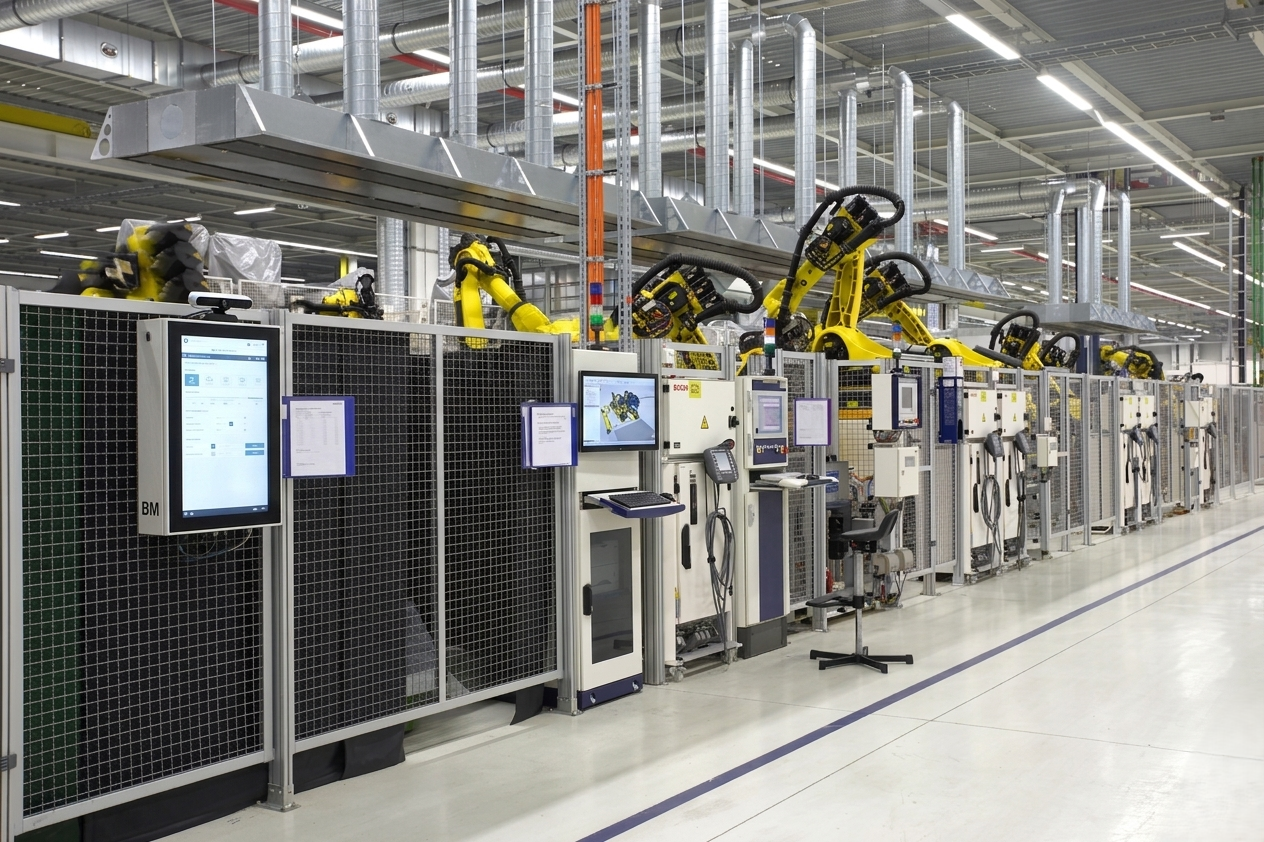
Why Choose Modular Solutions for Weld Cell Guarding?

Robotic welding cells require guarding that addresses arc flash, UV radiation, spark containment, and fume management — not just perimeter safety. We engineer all four into one system.

UV-Blocking Welding Curtains

Flame-retardant, shade-equivalent welding curtain panels (DIN 4 to DIN 8) integrated into the guard perimeter block UV radiation and arc flash from reaching adjacent work areas.

Spark & Spatter Containment

Lower guard sections use solid steel or aluminum infill panels — preventing weld spatter from traveling under the fence and creating fire hazards or floor slip conditions.

Fume Extraction Mounting

Overhead and sidewall mounting provisions for fume extraction arms and duct connections — positioned to capture weld fume at source without obstructing robot movement.

Safety Gate Interlocking

All access doors are fitted with tongue-in-groove safety interlock switches wired to the welding controller's safety circuit — robot and wire feed stop on door open.

Heat-Resistant Materials

Panel materials and frame powder-coat selected for resistance to radiant heat from welding operations — no warping, discoloration, or degradation from repeated weld cycles.

OSHA 1910.252 Compliant

Weld cell guarding designed to comply with OSHA standards for arc welding protection, including eye and face hazard separation from bystander work areas.

Key Features & Capabilities

Weld cell guarding from Modular Solutions integrates all critical safety functions into one engineered enclosure system.

Positioner & Rotary Table Access

Guard openings and safety zones engineered around weld positioners, rotary index tables, and headstock/tailstock fixtures — full access for part load/unload without compromising the enclosure.

Wire Feeder & Gas Line Routing

Cable and gas line pass-throughs built into the guard framing for MIG wire feeders, shielding gas lines, and water-cooled torch connections — no penetrations through curtains.

Tip Change Station Integration

Access provisions and mounting slots for automatic tip change stations, nozzle dip stations, and torch cleaning systems integrated within the guarded perimeter.

Two-Station Cell Layout

Two-station weld cell configurations with internal divider allowing one station to load while the robot welds the other — internal safety interlock separating the zones.

Viewing Windows

Welding-grade polycarbonate viewing windows (shade 5 equivalent) allow supervisor and maintenance observation of robotic welding operations without eye hazard.

Finish Options

Available in Standard or Black Elite finish. Removable spatter guard sheets on lower panels for easy maintenance cleaning.

Common Applications

Weld cell guarding from Modular Solutions is deployed across automotive, heavy equipment, and fabrication industries.

Specifications

Representative system parameters — all specifications are custom-engineered to your welding robot and production environment.

6000-SeriesAluminum Frame Material
Weld-Grade MeshStandard Panel Material
UV CurtainsArc Flash Protection
ANSI/RIA R15.06Design Standard
1800–2400mmStandard Heights
Spark-ResistantPanel Rating
Safety InterlockedGate Type
Exhaust ProvisionsFume Extraction Options

Frequently Asked Questions

What panel material is best for robotic weld cell guarding?

Welding-grade wire mesh panels are the standard choice for robotic weld cells — they resist spatter accumulation, allow heat and fume ventilation, and are significantly more durable than polycarbonate under repeated arc flash and spatter exposure. Welding-grade curtains or strip doors (welding orange or welding green vinyl) are added at personnel access openings to block UV radiation from arc flash.

Do robotic weld cell guards need UV protection for arc flash?

Yes. Arc welding produces intense UV and IR radiation that causes arc eye (photokeratitis) even with brief indirect exposure. All access openings on a robotic weld cell guard must include welding curtains, strip doors, or interlocked doors that remain closed during welding. Modular Solutions integrates welding-grade vinyl curtains at all personnel access points as a standard feature of weld cell guards.

Can weld fume exhaust provisions be built into a weld cell guard?

Yes. Weld cell guard panels can include exhaust collar provisions — pre-cut circular openings with connecting flanges for weld fume extraction ductwork. The guard can also be designed with specific panel gaps or mesh sections to facilitate natural cross-ventilation when forced exhaust is provided from outside the cell perimeter.

What safety interlock is used on weld cell access doors?

Tongue-and-groove or coded safety interlock switches (Schmersal, Pilz, Sick) are standard on weld cell access doors. The switch opens the robot controller's safety circuit when the door opens, triggering a robot stop. For cells with multiple access points, each door has its own switch wired to the safety circuit so opening any single door stops the robot.

How is a weld cell guard sized for spark and spatter containment?

Guard panels are positioned at the minimum safety distance from the robot's hazard zone per ANSI/RIA R15.06, and panel height is selected to fully contain the spatter plume from the highest weld position. Where spatter is expected to travel at low angles, base panel sections are specified as solid aluminum or heavier-gauge mesh rather than standard wire mesh to resist penetration.

Ready to Protect Your Welding Operation?

Contact our engineering team for a weld cell guarding system designed to your robot model, welding process, and facility safety requirements.

Request a Custom Quote