Positive & Negative Pressure Work Cells
Pressure differential is the most reliable mechanism for preventing cross-contamination between a controlled work cell and its surrounding environment. Positive pressure keeps contaminants out — protecting sensitive products, clean processes, and precision assemblies. Negative pressure keeps hazardous materials in — containing airborne pathogens, toxic particles, fumes, and biological agents. Our modular aluminum work cells are engineered for either application with the airtight construction and HVAC provisions required to maintain the pressure differential your process demands.
Request a Quote Talk to an Engineer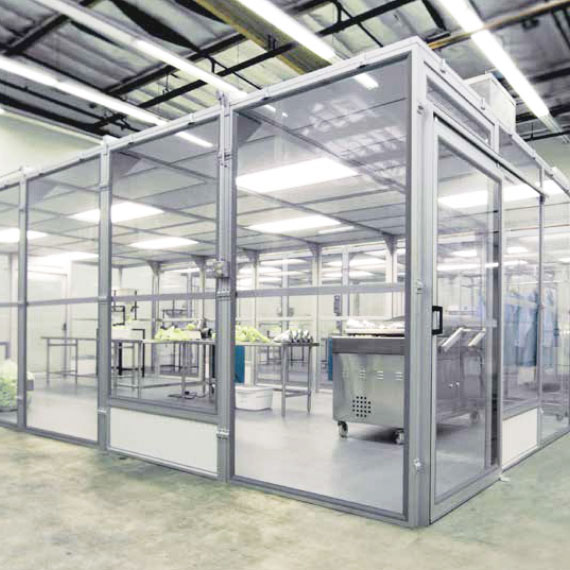
Pressure Work Cell Design Features
Maintaining a sustained pressure differential requires airtight construction, engineered air supply and exhaust provisions, and continuous monitoring — all built into the enclosure from the start.
Airtight Panel & Joint Construction
Continuous EPDM gaskets on all panel-to-frame joints and door frames create the sealed envelope required to sustain a pressure differential against the surrounding plant environment.
HVAC Supply & Exhaust Provisions
Supply air diffuser, exhaust port, and filter housing provisions are engineered into the enclosure structure — sized and positioned to maintain the target pressure differential under operating conditions.
Pressure Monitoring Provisions
Dedicated pass-throughs for differential pressure gauges, manometers, and alarm transmitters allow continuous monitoring and documentation of pressure differential during operation.
Interlocked Entry Vestibule Options
Airlock vestibule provisions prevent pressure equalization during personnel entry and exit — maintaining differential when the primary door is open.
HEPA Filtration Integration
HEPA filter housing provisions in supply and/or exhaust positions provide the particulate control required for positive pressure cleanroom isolation and negative pressure hazardous containment.
Modular & Reconfigurable
Bolted aluminum panel construction disassembles and rebuilds as processes or layouts change — without demolition, without losing the enclosure investment.
Pressure Work Cell Applications
Pressure-controlled work cells are applied wherever protecting a product from the environment — or protecting the environment from a process — is a critical requirement.
- Positive Pressure Clean Assembly — Cleanroom work cells for electronics, optics, and medical device assembly where positive pressure prevents ambient particulate from entering and contaminating sensitive components.
- Positive Pressure Pharmaceutical Processing — Controlled positive pressure enclosures for sterile drug formulation, filling, and packaging operations requiring ISO-classified isolation from plant floor air.
- Negative Pressure Hazardous Material Containment — Containment enclosures for handling toxic powders, carcinogenic materials, biological agents, and radioactive substances where negative pressure prevents outward migration.
- Negative Pressure Fume & Vapor Containment — Work cells for chemical processing, solvent use, and surface treatment operations where hazardous vapors must be contained within the enclosure and directed to exhaust treatment.
- Battery & Energy Storage Assembly — Positive pressure, humidity-controlled work cells for lithium-ion cell assembly and electrode handling requiring both moisture exclusion and particulate contamination control.
- Compounding Pharmacy & Lab Isolation — ISO-compliant pressure-differential enclosures for compounding pharmacy operations, laboratory work, and research applications requiring documented pressure differential control.
Construction & Specification Details
Positive and negative pressure work cells are configured to your process requirements, pressure target, and facility HVAC system.
- Frame: 45–90 mm aluminum T-slot extrusion; anodized or powder-coat finish options.
- Panels: Solid aluminum or insulated composite; polycarbonate observation windows optional.
- Gaskets: Continuous EPDM on all joints and door frames; compression cam-latch doors standard.
- Pressure Differential: Typically 0.03–0.05 in WC (positive); 0.03–0.10 in WC (negative); target range confirmed with HVAC engineer.
- Air Provisions: Supply diffuser, exhaust port, and HEPA filter housing provisions engineered per application.
- Monitoring: Magnehelic gauge port provisions and alarm transmitter pass-throughs standard.
- Lead Time: 4–7 weeks from approved layout and pressure specification.
Design Your Pressure Work Cell
Tell us your process, pressure differential target, and HVAC system details — our engineers will design a work cell that maintains the differential your application requires.
Request a Quote Talk to an Engineer