Equipment Service Platforms
Equipment service platforms provide dedicated, guarded access for the deeper repair, calibration, and component-replacement work that keeps critical assets running. Unlike quick daily tasks, service work often means removing panels, pulling components, connecting instruments, or staging parts and tools around a tank, mixer, robot, or process skid — activities that demand a stable footing, space to work, and safe clearance from the equipment. Reaching this work from ladders or lift baskets is slow, limits what a technician can carry, and raises the risk profile of every job. A fixed service platform surrounds the equipment at the right elevation, giving service crews a guarded, purpose-built working area engineered to the asset's geometry and access points. Built from modular T-slot aluminum, the platform clears agitator drives, piping, valves, and instrumentation while providing room to stage components and tooling. Because it bolts together instead of welding, the structure adapts as equipment is upgraded and integrates lifting rails, tool boards, lighting, and utility drops. For maintenance and reliability teams, that means faster mean-time-to-repair, safer service work, and access that is engineered once and used for the life of the asset.
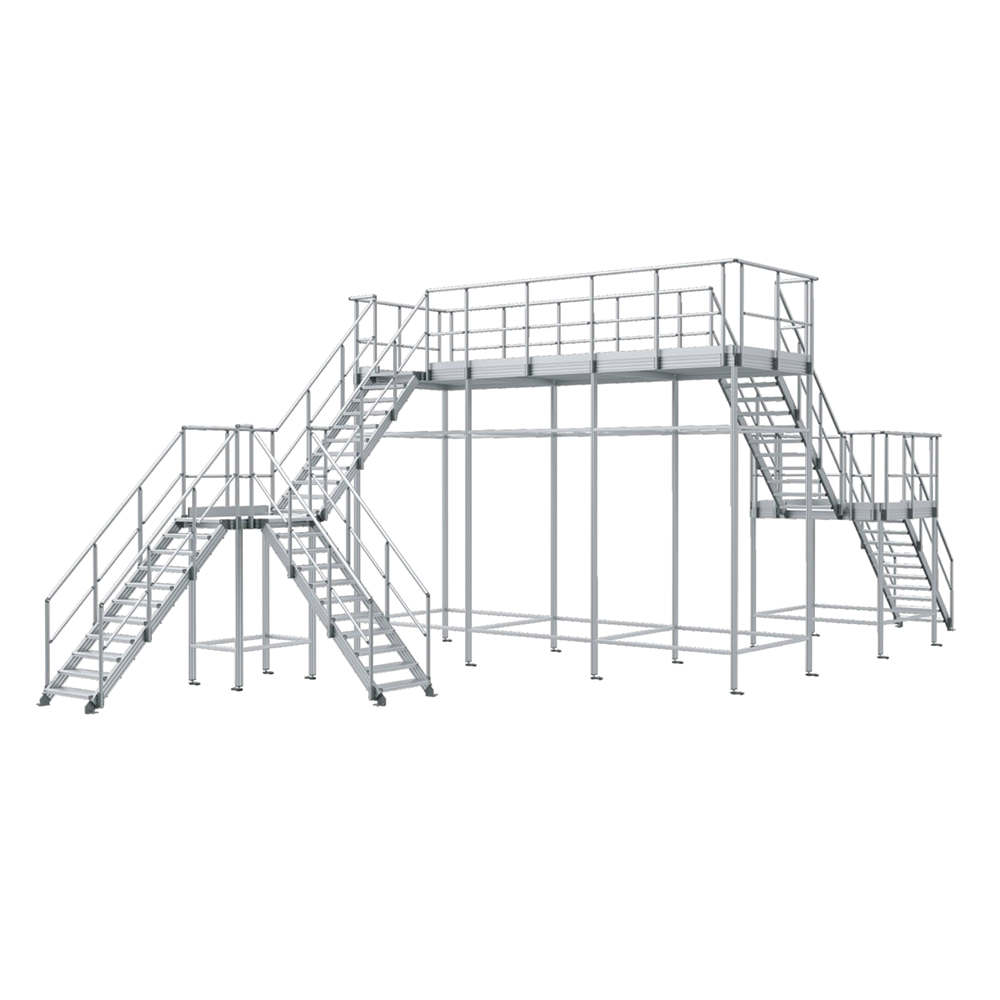
What Are Equipment Service Platforms?
An equipment service platform is a fixed, guarded work structure engineered to surround or approach a specific asset — a tank, mixer, reactor, robot, packaging machine, or process skid — for repair, calibration, and component-replacement work. It provides stable footing, working room, and safe clearance so service crews can perform involved tasks without ladders or lift baskets.
Modular Solutions engineers each platform from the asset geometry and its service access points, building from 45 Series aluminum T-slot extrusion with integrated stairs, guarding, and decking. Lifting rails, tool boards, lighting, and utility drops bolt into the frame, and the structure reconfigures as equipment is upgraded or replaced.
Key Features
Engineered around your equipment, process, and facility — not a catalog template.
Asset-Specific Geometry
Platforms wrap, notch, or cantilever around tanks, drives, piping, and instrumentation to place technicians exactly where service happens.
Working Room for Repairs
Deck footprint is sized to stage removed components, tooling, and test equipment — not just to stand on.
Component-Handling Support
Optional bolt-on jib rails, housekeeping shelves, and part-staging surfaces support component removal and reinstallation.
Instrument & Calibration Access
Stable positioning at gauges, sensors, and control points for connecting instruments and performing calibration.
Reconfigurable Structure
Bolted T-slot framing adapts as equipment is upgraded, moved, or replaced — no cutting or welding.
Clean, Corrosion-Free Frame
Anodized aluminum will not rust or contaminate process areas and holds a professional appearance without repainting.
Common Applications
Configured for the specific access demands of your equipment and environment.
- Tanks, Mixers & Reactors - Guarded access to agitator drives, charging ports, manways, and top-mounted instrumentation.
- Robotic & Automation Cells - Service positions for end-of-arm tooling, controllers, and cell components above guarding.
- Packaging & Process Skids - Working areas for panel removal, component service, and calibration on integrated equipment.
- Pumps, Compressors & Drives - Repair access to elevated rotating equipment, couplings, and seals.
- Test & Environmental Chambers - Access to chamber tops, plumbing, and control hardware for service and validation.
- Utility & Mechanical Systems - Service platforms for chillers, air handlers, and process support equipment.
Benefits
What a purpose-engineered access platform delivers on the plant floor.
- Reduces mean-time-to-repair by giving crews a stable, spacious working area instead of a ladder or basket.
- Lets technicians carry and stage more, cutting trips and keeping tools and parts at the work.
- Lowers service risk with full guarding and safe clearance from the equipment being serviced.
- Protects uptime by making complex service repeatable and predictable on critical assets.
- Adapts to equipment changes without scrapping the access structure.
- Supports contractors and vendors with a safe, ready-made service position for warranty and specialist work.
Industries Served
Trusted for elevated access across demanding industrial and commercial environments.
Customization Options
Every platform is engineered to your equipment, floor space, and access requirements.
- Wrap-around, three-sided, or single-approach layouts engineered to the asset and its service points.
- Deck footprint sized for component staging, tool carts, and test equipment.
- Notched and cantilevered decking to clear drives, piping, valves, and manways.
- Bolt-on jib rails, hoists, tool boards, and utility drops for component handling.
- Removable rail sections or gates where large components must pass to and from the platform.
- Multi-level configurations for equipment serviced from several elevations.
Why Choose Modular Aluminum T-Slot Construction
Modular aluminum T-slot construction bolts together without welding and reconfigures without cutting — giving you a purpose-engineered access structure today that adapts through every equipment change, line re-lay, and facility expansion without scrapping steel. The anodized frame will not rust, flake, or require repainting, presents a clean professional appearance, and integrates directly with our accessory ecosystem for guarding, gates, lighting, tool staging, and utility drops. It is lighter to relocate, faster to install with minimal floor disruption, and engineered and manufactured in-house in Auburn Hills, MI so the platform fits your equipment exactly rather than forcing your process to fit a catalog.
Design & Engineering Considerations
How our engineers approach each access-platform project.
- Asset survey - We model the equipment geometry, service points, and required clearances from your dimensions, photos, or CAD.
- Work envelope planning - Deck size and layout are designed for the actual repair tasks, including component removal paths.
- Lifting and handling - Jib rails, hoist mounts, and staging surfaces are integrated where components must be lifted.
- Load and stability - Framing and footings are sized for personnel plus staged parts and equipment.
- Adaptability - Modular connections allow the platform to change with equipment upgrades and relocations.
Safety & Compliance Considerations
Platforms are engineered to align with OSHA 1910.29 walking-working-surface and guardrail criteria; installed compliance is verified with your safety authority.
- Full-perimeter guardrails, mid-rails, and toe boards engineered to align with OSHA 1910.29.
- Self-closing gates and removable rail sections managed to maintain fall protection during component transfer.
- Slip-resistant decking selected for the process fluids and conditions around the asset.
- Optional anchor points and lockout staging to support safe service procedures.
- Stair and ladder geometry laid out per recognized industrial standards; installed compliance verified with your team.
Specifications & Configurations
Representative configurations — all dimensions and options are custom-engineered to your requirements.
| Specification | Detail |
|---|---|
| Frame Profile | 45 Series T-slot aluminum extrusion; heavy-duty profiles for high loads |
| Configuration | Wrap-around, three-sided, single-approach, or multi-level |
| Deck Options | Serrated aluminum plank, bar grating, perforated plank, or solid diamond plate |
| Guardrail Height | 42-inch top rail with mid-rail and 4-inch toe board |
| Handling Options | Jib rails, hoist mounts, tool boards, utility and air drops |
| Access | Fixed stairs, ships ladder, vertical ladder, or ramp |
Frequently Asked Questions
Common questions about equipment service platforms design, configuration, and compliance.
How is an equipment service platform different from a maintenance platform?
A maintenance access platform is optimized for quick recurring tasks like lubrication and filter changes, while an equipment service platform is engineered for deeper repair, calibration, and component-replacement work — with more working room, component-staging space, and optional lifting support around a specific asset.
Can the platform wrap around a tank or mixer?
Yes. We engineer wrap-around, three-sided, and single-approach layouts that notch and cantilever around agitator drives, piping, valves, and manways so technicians reach charging ports, instrumentation, and drives from a stable guarded surface.
Can component-handling equipment be integrated?
Yes. Bolt-on jib rails, hoist mounts, tool boards, and part-staging surfaces can be built into the structure to support removing and reinstalling components. Removable rail sections or gates allow large parts to pass to and from the platform safely.
Does it support vendor and warranty service work?
Absolutely. A permanent guarded service platform gives your own crews, contractors, and equipment vendors a safe, ready-made working position — reducing setup time and risk on specialist and warranty service.
Can it adapt when we upgrade the equipment?
Yes. The bolted T-slot aluminum structure reconfigures with hand tools, so the platform can be modified, extended, or relocated when the asset is upgraded or replaced rather than being scrapped.
Are these platforms engineered to OSHA standards?
Platforms are engineered to align with OSHA 1910.29 guardrail and walking-working-surface criteria, including 42-inch rails, mid-rails, toe boards, and compliant stair geometry. We design and document to these standards; installed certification is confirmed with your safety authority.
Engineer Your Equipment Service Platform
Share the asset you need to service — dimensions, photos, or CAD — and our engineers will return a guarded service-platform layout with a quote.