Maintenance Access Platforms
Maintenance access platforms turn hard-to-reach service points into safe, repeatable stops on your preventive-maintenance route. Lubrication fittings, filters, drive belts, gearboxes, sensors, and inspection ports are frequently mounted above standing reach — and when technicians service them from ladders or equipment frames, PM tasks take longer, get skipped, or expose the crew to falls. A fixed maintenance platform positions technicians at the working height with both hands free, room for tools and parts, and full guarding, so scheduled service is faster and consistently performed. Engineered from modular T-slot aluminum, each platform is dimensioned around the equipment and the specific service points your PM plan targets, with decking that sheds oil and coolant for secure footing. Because the frame is bolted rather than welded, platforms extend and reconfigure as equipment is added or relocated, and integrate tool trays, lighting, and lube-station accessories directly into the structure. The outcome is measurable: shorter PM windows, fewer deferred tasks, lower reliance on lift equipment, and a documented, defensible approach to elevated-maintenance safety across the facility.
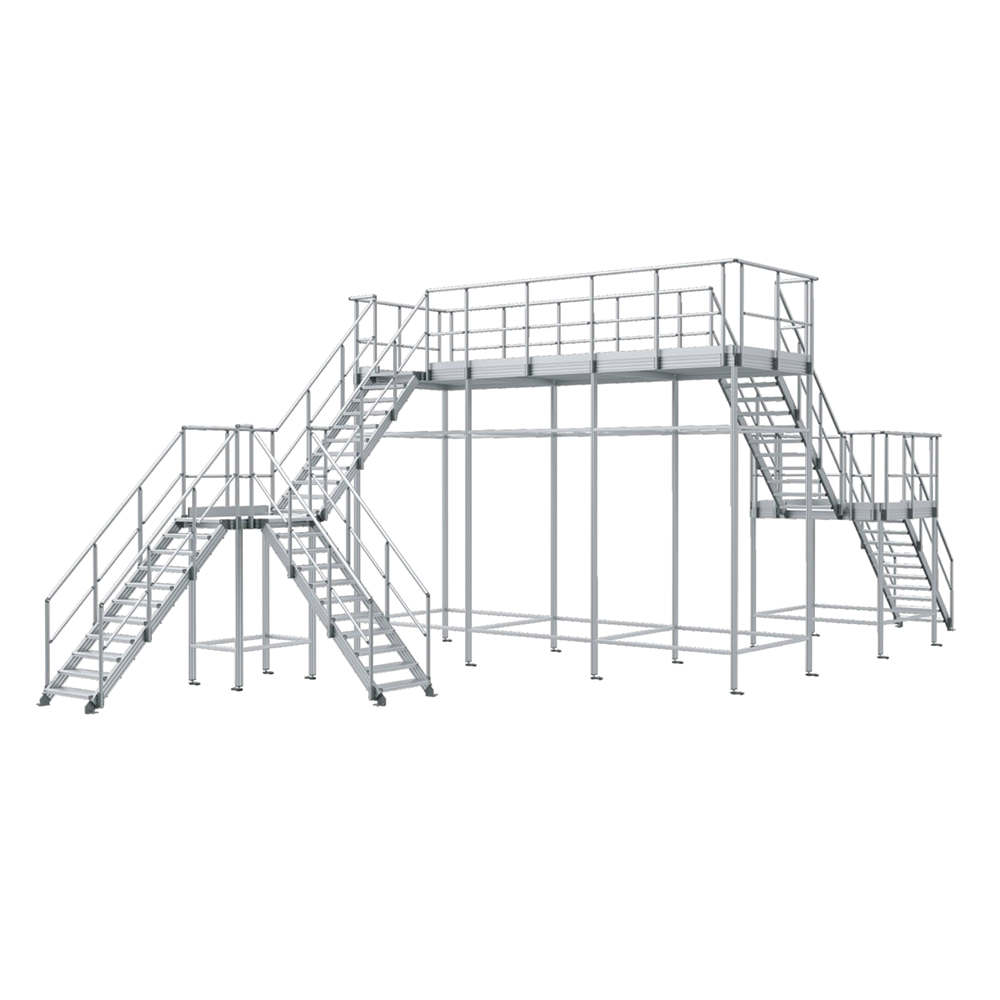
What Are Maintenance Access Platforms?
A maintenance access platform is a permanent elevated work surface engineered to serve the recurring service points on a machine or system — lubrication fittings, filters, belts, gearboxes, sensors, and inspection ports. It gives maintenance technicians a guarded, stable position with room for tools and parts, replacing ladders, scaffolds, and equipment-frame climbing on routine PM tasks.
Modular Solutions engineers each platform from your equipment layout and PM route, building the structure from 45 Series aluminum T-slot extrusion with integrated stairs, guardrails, and decking. Tool trays, lighting, and lube-station accessories bolt directly to the frame, and the whole assembly reconfigures as your equipment and maintenance program evolve.
Key Features
Engineered around your equipment, process, and facility — not a catalog template.
PM-Route Engineering
Platforms are laid out around the specific service points your maintenance plan targets, putting lube fittings, filters, and belts within safe, ergonomic reach.
Oil- & Coolant-Shedding Decking
Serrated or grated decking drains fluids and debris away from the walking surface for secure footing during messy service tasks.
Integrated Tool & Parts Staging
Bolt-on tool trays, shelves, and drip pans keep tools, filters, and lubricants at the point of use so technicians are not climbing up and down.
Full-Perimeter Guarding
42-inch guardrails, mid-rails, and toe boards engineered to align with OSHA 1910.29 keep the crew protected during focused service work.
Tool-Free Reconfiguration
The bolted T-slot frame extends to new equipment and adapts to layout changes with hand tools — no welding or hot work permits.
Low-Maintenance Aluminum
The corrosion-resistant frame requires no repainting and will not shed rust into lubricants, filters, or product zones.
Common Applications
Configured for the specific access demands of your equipment and environment.
- Lubrication & PM Routes - Fixed stations at elevated grease fittings, oilers, and auto-lube reservoirs for fast, repeatable service.
- Filter & Belt Service - Guarded access to air handlers, dust collectors, and drive systems for filter and belt changeouts.
- Gearbox & Drive Maintenance - Working positions at elevated gearboxes, motors, and couplings for inspection and component replacement.
- Conveyor & Material Handling - Access to head/tail pulleys, take-ups, and drive units along elevated conveyor runs.
- HVAC & Utility Equipment - Service positions at rooftop units, fans, and process cooling equipment mounted above the floor.
- Inspection & Condition Monitoring - Stable stops for vibration readings, thermography, and visual inspection on scheduled routes.
Benefits
What a purpose-engineered access platform delivers on the plant floor.
- Shortens PM windows by giving technicians a two-hands-free position with tools and parts staged at height.
- Reduces deferred and skipped tasks that occur when service points are awkward or unsafe to reach.
- Cuts reliance on lifts and scaffolds, freeing that equipment and removing setup time from routine service.
- Improves reliability by making consistent, correct lubrication and inspection practical every cycle.
- Documents your safety approach with an engineered, guarded elevated-access solution for audits and insurers.
- Reconfigures with your plant as equipment is added, upgraded, or relocated.
Industries Served
Trusted for elevated access across demanding industrial and commercial environments.
Customization Options
Every platform is engineered to your equipment, floor space, and access requirements.
- Deck elevation and footprint engineered to the exact service points on your PM route.
- Serrated aluminum, grating, or perforated decking selected for the fluids and debris present.
- Integrated drip pans, tool trays, lube reels, and parts shelving at the working level.
- Stair, ladder, or ramp access positioned for the shortest safe technician approach.
- Multi-level or wrap-around configurations for equipment serviced from several elevations.
- Bolt-on lighting and utility drops to support inspection and powered tools.
Why Choose Modular Aluminum T-Slot Construction
Modular aluminum T-slot construction bolts together without welding and reconfigures without cutting — giving you a purpose-engineered access structure today that adapts through every equipment change, line re-lay, and facility expansion without scrapping steel. The anodized frame will not rust, flake, or require repainting, presents a clean professional appearance, and integrates directly with our accessory ecosystem for guarding, gates, lighting, tool staging, and utility drops. It is lighter to relocate, faster to install with minimal floor disruption, and engineered and manufactured in-house in Auburn Hills, MI so the platform fits your equipment exactly rather than forcing your process to fit a catalog.
Design & Engineering Considerations
How our engineers approach each access-platform project.
- PM point mapping - We identify every recurring service point and elevation so the platform serves the whole route, not one fitting.
- Fluid management - Decking and optional drip containment are specified for the oils and coolants encountered.
- Clearance and access - Guarding and travel paths are laid out to clear rotating equipment and keep egress open during service.
- Load and staging - Structure is sized for technicians plus staged parts, tool carts, and lubricant containers.
- Scalability - Spare T-slot capacity and modular connections let the platform grow with future equipment.
Safety & Compliance Considerations
Platforms are engineered to align with OSHA 1910.29 walking-working-surface and guardrail criteria; installed compliance is verified with your safety authority.
- Guardrails, mid-rails, and toe boards engineered to align with OSHA 1910.29 walking-working-surface criteria.
- Slip-resistant, fluid-shedding decking chosen for oily and wet maintenance conditions.
- Self-closing gates at access openings to maintain continuous fall protection during service.
- Optional lockout staging, anchor points, and lighting to support safe maintenance procedures.
- Stair geometry laid out per recognized industrial standards; installed compliance verified with your team.
Specifications & Configurations
Representative configurations — all dimensions and options are custom-engineered to your requirements.
| Specification | Detail |
|---|---|
| Frame Profile | 45 Series T-slot aluminum extrusion; heavy-duty profiles where load requires |
| Working Height | Custom — single or multi-level to match service-point elevations |
| Deck Options | Serrated aluminum plank, bar grating, perforated plank, or solid diamond plate |
| Guardrail Height | 42-inch top rail with mid-rail and 4-inch toe board |
| Access | Fixed stairs, ships ladder, vertical ladder, or ramp with self-closing gate |
| Accessories | Tool trays, drip pans, lube reels, lighting, utility drops, anchor points |
Frequently Asked Questions
Common questions about maintenance access platforms design, configuration, and compliance.
What is a maintenance access platform?
It is a fixed elevated work surface engineered to serve the recurring service points on a machine or system — lubrication fittings, filters, belts, gearboxes, and inspection ports. It gives technicians a guarded, stable position with room for tools and parts so preventive maintenance is faster and safer than working from ladders.
How does a platform improve preventive maintenance?
By putting service points within safe, ergonomic reach and staging tools and parts at height, the platform shortens PM windows, reduces skipped or deferred tasks, and cuts reliance on lifts and scaffolds. Consistent access makes correct lubrication and inspection practical every cycle, which improves equipment reliability.
Can accessories like tool trays and lube reels be integrated?
Yes. The T-slot aluminum frame accepts bolt-on tool trays, parts shelving, drip pans, lube reels, lighting, and utility drops directly at the working level — so technicians keep both hands on the task instead of climbing up and down.
Will the decking stay safe in oily conditions?
We specify serrated, grated, or perforated decking that sheds oil, coolant, and debris away from the walking surface. The deck material is selected for the specific fluids present at your equipment to maintain secure footing.
Can the platform serve multiple elevations on one machine?
Yes. We engineer multi-level or wrap-around platforms when a machine has service points at several heights, connecting levels with compliant stairs so the entire PM route is served from one integrated structure.
How is safety compliance handled?
Platforms are engineered to align with OSHA 1910.29 guardrail and walking-working-surface criteria, including 42-inch rails, mid-rails, toe boards, and compliant stair geometry. We design and document to these standards; final certification for the installed condition is verified with your safety authority.
Plan Your Maintenance Access Platform
Tell us the equipment and service points on your PM route — we will engineer a guarded platform that makes maintenance faster, safer, and repeatable.