Height-Adjustable Workstations
Modular aluminum height-adjustable workstations engineered for fixed or variable operator heights — manual crank, pneumatic counterbalance, or electric actuator lift mechanisms set the surface exactly where the operator needs it. Built for assembly, test, and inspection operations where one height does not fit every process or every person. Designed and manufactured in Auburn Hills, MI.
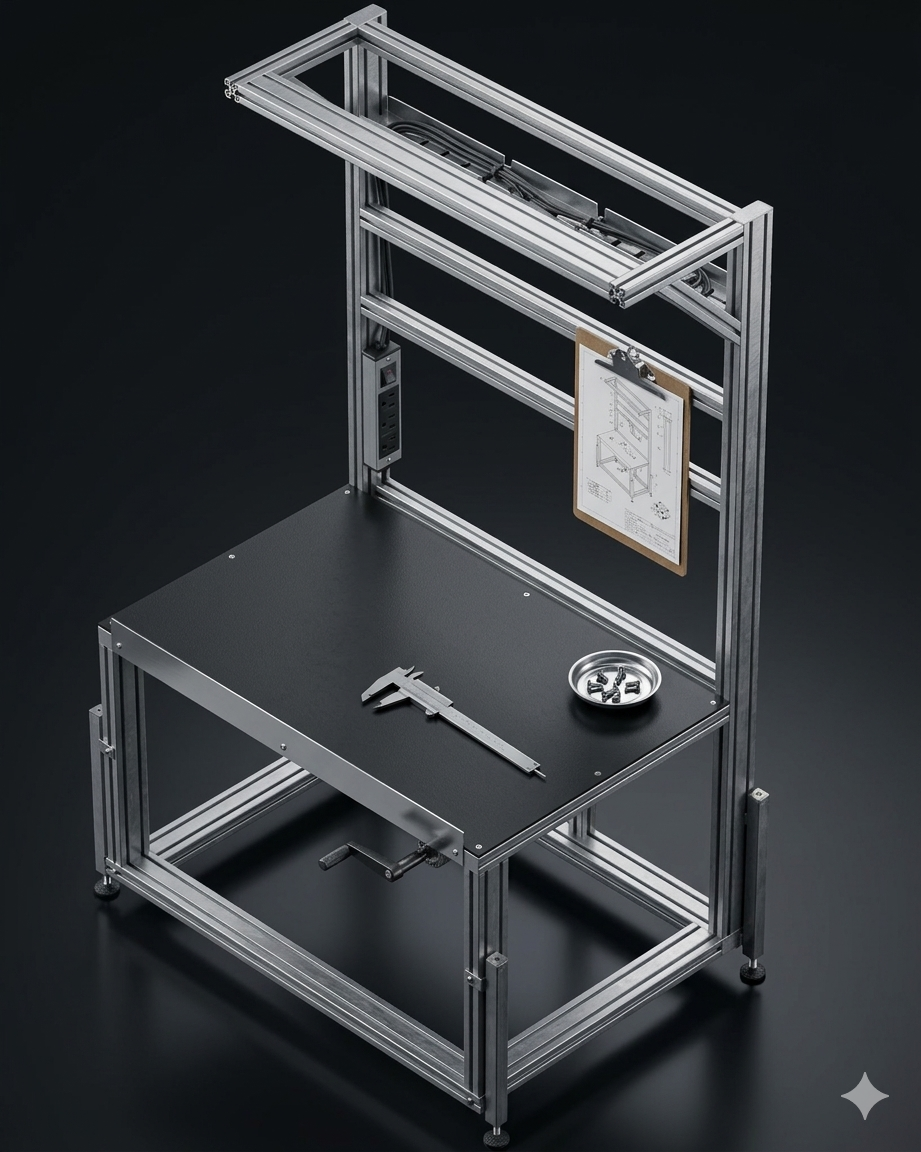
Why Choose Modular Solutions for Height-Adjustable Workstations?
Every bench is designed around your height range, load, and surface requirements — not a standard catalog range.
Modular aluminum T-slot workstations bolt together without welding and reconfigure without tools — giving you a purpose-engineered station today that adapts through every process change, product launch, and kaizen event without capital reinvestment in new furniture.
Manual Crank Adjustment
Worm-gear crank mechanisms provide smooth, precise height adjustment under load with self-locking positioning — no power required, no drift after setting.
Electric Actuator Lift
Dual synchronized electric actuators with digital height readout and programmable preset positions — height recalled at the push of a button for shift changeover.
Pneumatic Counterbalance
Counterbalanced pneumatic columns allow one-finger height adjustment under rated load — ideal for shared workstations with frequent height changes between operators.
Heavy-Duty Surface Options
Steel, stainless steel, aluminum, and laminate work surfaces rated to 1,000 lbs distributed load on adjustable configurations — the frame adjusts, the strength does not.
T-Slot Accessory Compatibility
All height-adjustable frames use T-slot extrusion — shelves, monitor arms, bin rails, and task lighting mount and relocate without tools.
Anti-Fatigue Mat Provisions
Adjustable-height frames include integrated anti-fatigue mat recesses at standard standing height positions to support OSHA ergonomic compliance programs.
Height-Adjustable Workstation Applications
Configured for manufacturing, test, assembly, and inspection operations requiring operator-specific work surface positioning.
- Shared Manufacturing Stations - Multi-shift workstations used by operators of different heights — height presets allow each shift to restore the correct position in seconds.
- Assembly and Sub-Assembly - Adjustable-height assembly benches matched to the part being assembled — set low for large chassis, higher for precision component work.
- Inspection and Measurement - Variable-height inspection benches allowing seated measurement for precision work and standing position for larger part handling.
- Packaging and Kitting - Adjustable packing stations matching conveyor height for one product, repositioning for a taller carton on the next SKU.
- Training Facilities - Instructional workbenches adjusting to accommodate trainees, instructors, and demonstration positions in a single station.
- Ergonomic Retrofit Programs - Replacement for fixed-height furniture in ergonomic improvement programs targeting operator fatigue, musculoskeletal incident rates, and OSHA compliance.
Specifications & Configurations
Standard configurations available — all dimensions and mechanism options are custom-engineered to your requirements.
| Specification | Detail |
|---|---|
| Adjustment Range | Standard 28"–44" (manual crank); 24"–48" (electric); custom ranges available |
| Lift Mechanism | Manual worm-gear crank, dual electric actuator, or pneumatic counterbalance |
| Load Capacity | Up to 1,000 lbs distributed on adjustable configurations |
| Work Surface | Laminate, steel, stainless steel, ESD laminate, or aluminum |
| Height Presets | Electric models: 4 programmable presets with digital display |
| Lead Time | 3–5 weeks from approved drawings |
Frequently Asked Questions
Common questions about height-adjustable workstation design, configuration, and ergonomic compliance.
What height adjustment range is standard for height-adjustable workstations?
Manual crank height-adjustable benches have a standard range of 28 to 44 inches — covering seated assembly (28–32 inches) through standing operations (36–44 inches). Electric actuator models extend the range to 24–48 inches for extreme operators or processes requiring very low or high work positions. Custom ranges are available.
How much weight can a height-adjustable workstation support?
Height-adjustable workstations support up to 1,000 lbs distributed load on the work surface across all height positions. This rating applies to the full adjustment range — the load capacity does not decrease at the lowest or highest positions. Heavy-duty configurations with reinforced columns are available for heavier applications.
What is the difference between manual crank, electric, and pneumatic height adjustment?
Manual crank uses a worm-gear mechanism turned by hand — precise, self-locking, no power required, best for infrequent adjustment. Electric actuators use a motor to raise and lower under load with programmable presets — best for shared stations with frequent changeover. Pneumatic counterbalance uses compressed air to float the surface — one-finger adjustment under load, fast changeover, requires facility air supply.
Can height-adjustable workstations be used on production lines?
Yes. Height-adjustable benches integrate into production lines by matching conveyor height at the operator's ergonomic position. Electric preset models allow the line to be set for one product height and changed to a different height when the product mix changes — without manual re-leveling of individual stations.
Are height-adjustable workstations available with ESD-safe surfaces?
Yes. ESD-safe static-dissipative laminate surfaces (10&sup6;–10&sup9; Ω surface resistance) are available on all adjustable-height configurations. Wrist strap grounding points and frame bonding lugs are standard on ESD configurations. The height adjustment mechanism is electrically bonded to the frame ground to prevent static accumulation on adjustable columns.
Configure Your Height-Adjustable Bench
Send us your height range, load requirements, and surface preference — we'll engineer a bench that fits every operator on every shift.