Lift-Assist Work Tables
Modular aluminum lift-assist work tables with scissor lift, pneumatic, and electric column mechanisms engineered to position heavy parts, dies, assemblies, and tooling at the correct ergonomic work height — eliminating operator lifting injury risk from heavy components and reducing musculoskeletal strain on high-load assembly, repair, and overhaul operations. Built in Auburn Hills, MI.
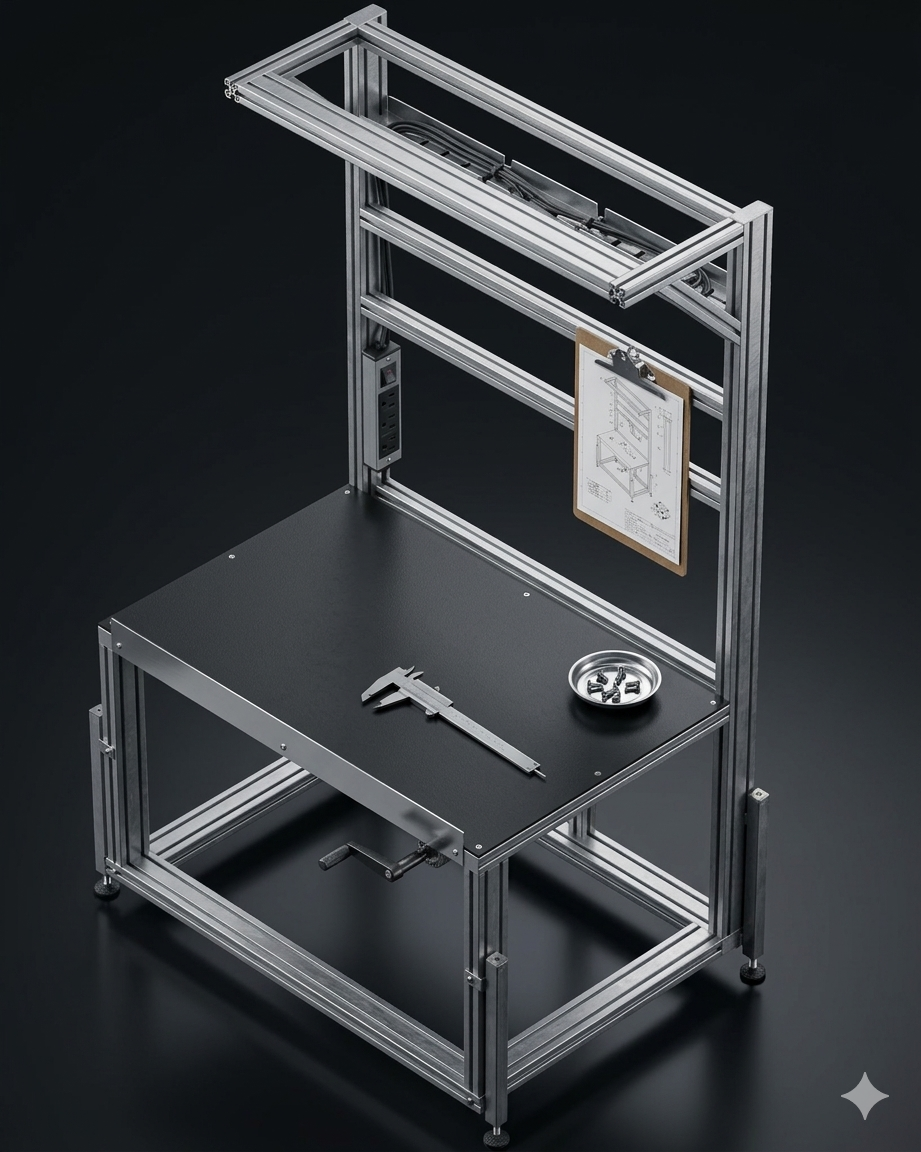
Why Choose Modular Solutions for Lift-Assist Work Tables?
Heavy-load ergonomic positioning without the injury risk — lift-assist tables bring the work to the operator, not the operator to the work.
Modular aluminum T-slot workstations bolt together without welding and reconfigure without tools — giving you a purpose-engineered station today that adapts through every process change, product launch, and kaizen event without capital reinvestment in new furniture.
Scissor Lift Platform
Hydraulic or electric scissor lift platforms for raising heavy parts, pallets, and fixtures to the correct work height — rated to 2,000 lbs with smooth, controlled lifting speed.
Electric Column Lift
Single or dual electric column mechanisms for controlled height adjustment of heavy work surfaces under load — precise positioning with integrated safety lock.
Pneumatic Counterbalance
Counterbalanced pneumatic columns float heavy surfaces with one-finger effort — ideal for frequent height changes in mixed-product assembly operations.
Tilt Provisions
Combined lift-and-tilt mechanisms allow heavy parts to be raised to work height and then tilted toward the operator for optimal access without repositioning the part.
Overload Protection
Built-in hydraulic pressure relief and electric current limiting prevent overloading the lift mechanism — load rating enforced by the lift system, not by operator judgment.
Safety Lock Provisions
Mechanical safety locks engage at any height to support the load independently of the hydraulic or electric system — required for any lift table used as a personnel work platform.
Lift-Assist Work Tables Applications
Deployed across machine shops, maintenance, fabrication, and heavy assembly operations for heavy component ergonomic positioning.
- Heavy Component Assembly - Positioning engines, transmissions, large castings, and heavy weldments at operator work height during build and assembly operations.
- Die and Tooling Maintenance - Raising stamping dies, injection molds, and large fixtures to work height for maintenance, inspection, and repair without crane dependency.
- Machine and Equipment Overhaul - Lift tables positioning heavy motors, gearboxes, and pumps at ergonomic disassembly and rebuild heights for maintenance technicians.
- Receiving and Incoming Inspection - Adjustable-height receiving tables lifting heavy incoming pallets and crates to inspection height without forklift or manual lifting.
- Fabrication Shop Positioning - Lift-assist tables positioning large weldments and structural fabrications at the correct height for welding, grinding, and fitting operations.
- Warehouse and Distribution - Adjustable-height pick stations and pallet positioning tables eliminating repeated bending to floor-level pallets in distribution operations.
Specifications & Configurations
Standard configurations available — all dimensions and mechanism options are custom-engineered to your requirements.
| Specification | Detail |
|---|---|
| Lift Mechanism | Hydraulic scissor lift, electric column, or pneumatic counterbalance |
| Load Capacity | 500 lbs to 2,000 lbs depending on mechanism and configuration |
| Height Range | Floor level to 44" standard; custom ranges available |
| Safety Lock | Mechanical safety lock at any height; required for work-under-load applications |
| Platform Surface | Steel plate, open-grid, or custom T-slot top plate for fixture mounting |
| Lead Time | 3–5 weeks from approved drawings |
Frequently Asked Questions
Common questions about lift-assist work tables design, configuration, and ergonomic compliance.
What is the difference between a lift-assist work table and a standard height-adjustable bench?
A standard height-adjustable bench (manual crank or electric) is designed for loads up to 800–1,000 lbs and operator-controlled positioning. A lift-assist work table uses scissor lift, hydraulic, or high-force electric column mechanisms for loads of 500 to 2,000+ lbs. Lift-assist tables include mechanical safety locks and overload protection required for heavy-load applications — features not present on standard adjustable benches.
How do mechanical safety locks work on lift-assist tables?
Mechanical safety locks are independent of the hydraulic or electric drive system. When engaged, a mechanical positive-stop locks the scissor mechanism or column at the current position — the load is supported by the mechanical lock alone, without relying on hydraulic pressure or electric motor holding force. ANSI B56.1 and OSHA require mechanical safety locks on lift tables used as work platforms.
Can lift-assist tables be used with fixture mounting for die maintenance?
Yes. T-slot top plates with standard fixture-mounting patterns are available for die maintenance, mold repair, and tooling overhaul applications. The T-slot plate provides mounting points for clamp-style fixtures that secure dies or molds to the table surface during maintenance — preventing the part from shifting when the table tilts or the operator applies force.
What is the floor-to-surface height range for lift-assist work tables?
Standard lift-assist tables travel from near floor level (4–8 inches platform height) to 44 inches at full extension — covering the range from floor-level pallet reception to standing work height. Custom ranges are available for applications requiring lower minimum height (flush floor installation) or higher maximum height for tall-operator or tall-part requirements.
Can lift-assist work tables include a tilt function?
Yes. Combined lift-and-tilt tables raise the load to work height and then tilt the top toward the operator for access to the far side of a heavy part without repositioning. Tilt angles of 0–45 degrees are standard. Safety locks engage independently on both the lift and tilt axes. Tilt tables are common for large casting inspection, die face access, and engine assembly operations.
Size Your Lift-Assist Work Table
Send us your part weight, height range, and application — we'll specify a lift mechanism rated for your load with the right safety provisions.