Sit-Stand Industrial Workstations
Industrial sit-stand workstations engineered for manufacturing environments where operators need to alternate between seated and standing positions during long production shifts — reducing musculoskeletal fatigue, improving operator health outcomes, and supporting OSHA ergonomic compliance programs. Production-rated load capacity, durable surfaces, and T-slot accessory compatibility. Built in Auburn Hills, MI.
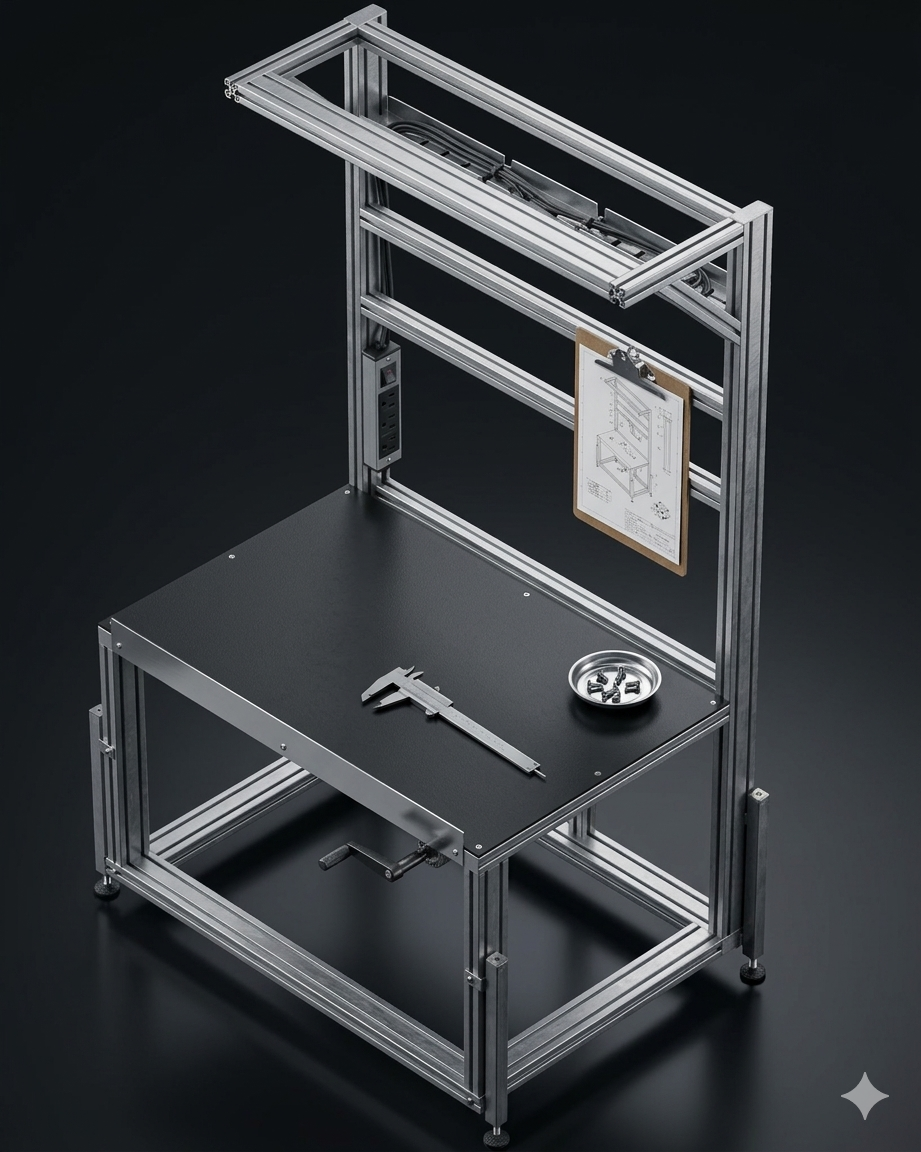
Why Choose Modular Solutions for Sit-Stand Industrial Workstations?
Production-rated sit-stand stations that survive the manufacturing floor — not office furniture carrying an industrial label.
Modular aluminum T-slot workstations bolt together without welding and reconfigure without tools — giving you a purpose-engineered station today that adapts through every process change, product launch, and kaizen event without capital reinvestment in new furniture.
Production-Grade Sit-Stand Mechanism
Industrial electric actuator columns rated for continuous production use — not light-duty office lift mechanisms. Rated for 500+ daily cycles at full load capacity.
Operator Fatigue Reduction
Alternating sit-stand posture throughout the shift reduces lumbar loading by up to 40%, lowers lower-limb fatigue, and extends operator productivity through the full production day.
OSHA Ergonomic Support
Sit-stand workstations directly address OSHA 29 CFR 1910 General Industry ergonomic guidelines for repetitive standing tasks — supporting facility ergonomic compliance programs.
Programmable Height Memory
4-position height memory stores each operator's seated and standing heights — returning to the correct position at the press of a button for shift handover.
Anti-Fatigue Mat Integration
Recessed anti-fatigue mat provisions at the standard standing position keep the mat flush with the floor — eliminating trip hazards while providing cushioning for standing operators.
Full T-Slot Accessory System
Shelves, monitor arms, bin rails, document holders, and task lighting all mount on the T-slot frame and raise with the work surface — accessories stay in position at every height.
Sit-Stand Industrial Workstations Applications
Deployed across manufacturing, quality, electronics, and laboratory operations for operator health and productivity programs.
- Long-Duration Assembly Operations - Stations where operators work 4+ hours in one position — sit-stand cycling reduces musculoskeletal fatigue and lowers injury risk on long-run assembly tasks.
- Electronics and PCB Assembly - ESD-safe sit-stand benches for electronics assembly where operator comfort on long inspection and soldering shifts directly impacts defect rates and concentration.
- Quality Inspection Stations - Inspection benches where sitting is preferred for precision measurement and standing for larger part handling — the same station serves both needs.
- Shared Multi-Operator Stations - Stations used by multiple operators of different heights across shifts — programmable presets eliminate manual adjustment and ensure every operator works at the correct ergonomic height.
- Laboratory Bench Applications - Sit-stand lab benches for analytical and process labs where extended seated work alternates with standing procedures at the same workstation.
- Ergonomic Improvement Programs - Targeted replacement of fixed-height benches in facilities with elevated musculoskeletal injury rates or active OSHA ergonomic compliance programs.
Specifications & Configurations
Standard configurations available — all dimensions and mechanism options are custom-engineered to your requirements.
| Specification | Detail |
|---|---|
| Height Range | Standard 24"–48" (electric); covers all operator percentiles 5th F to 95th M |
| Lift Mechanism | Dual synchronized electric actuators; pneumatic counterbalance option |
| Cycle Rating | 500+ daily cycles at rated load (production-grade, not office-grade) |
| Load Capacity | Up to 800 lbs distributed |
| Height Memory | 4 programmable presets with digital height display |
| Lead Time | 3–5 weeks from approved drawings |
Frequently Asked Questions
Common questions about sit-stand industrial workstations design, configuration, and ergonomic compliance.
How does sit-stand use reduce operator fatigue in manufacturing?
Continuous standing on hard floors compresses lumbar discs, restricts lower-limb circulation, and increases lower-extremity fatigue. Continuous sitting reduces core engagement and increases lumbar flexion. Alternating sit-stand posture every 20–45 minutes shares the load across muscle groups, maintains blood flow, and reduces the cumulative fatigue that leads to errors and injuries on long production shifts.
What makes an industrial sit-stand workstation different from an office sit-stand desk?
Industrial sit-stand workstations use production-rated dual-column electric actuators rated for 500+ daily cycles at 800 lb loads — versus office mechanisms rated for 1–3 daily cycles at 200 lbs. Industrial frames use T-slot aluminum extrusion with load-rated accessories, not clip-on grommet accessories. Industrial surfaces are steel or heavy laminate, not thin MDF. The entire system is engineered for continuous production use.
What height range covers all manufacturing operators?
A range of 24 to 48 inches covers seated height for the 5th percentile female (approximately 26 inches elbow height seated) through standing height for the 95th percentile male (approximately 46 inches elbow height standing). This range ensures correct ergonomic positioning for all operators without custom adjustment.
Can accessories like monitor arms and bin rails adjust with the work surface?
Yes. T-slot accessories mount directly to the frame uprights and move with the work surface as it raises and lowers. Monitor arms, document holders, task lighting, and bin rails all stay in their correct relative position to the work surface — there is no need to readjust accessories when changing height.
Are sit-stand workstations compatible with production conveyor heights?
Sit-stand workstations can be specified with a starting height matched to your conveyor elevation as the baseline standing position. The height range then extends above and below that baseline. For applications where the conveyor height is fixed, the adjustable range is engineered to center on the conveyor height with equal travel above and below for operator comfort.
Design Your Sit-Stand Workstation
Send us your operator height range, shift duration, and process requirements — we'll specify a sit-stand configuration that supports your ergonomic program.