Tilting Workstations
Modular aluminum tilting workstations with 0–45 degree manually or electrically adjustable tilt-top surfaces for angled assembly, welding, inspection, and ergonomic operator positioning — bringing the work face toward the operator instead of requiring the operator to reach over a flat surface. Engineered for the exact tilt angle, surface size, and load your process requires. Built in Auburn Hills, MI.
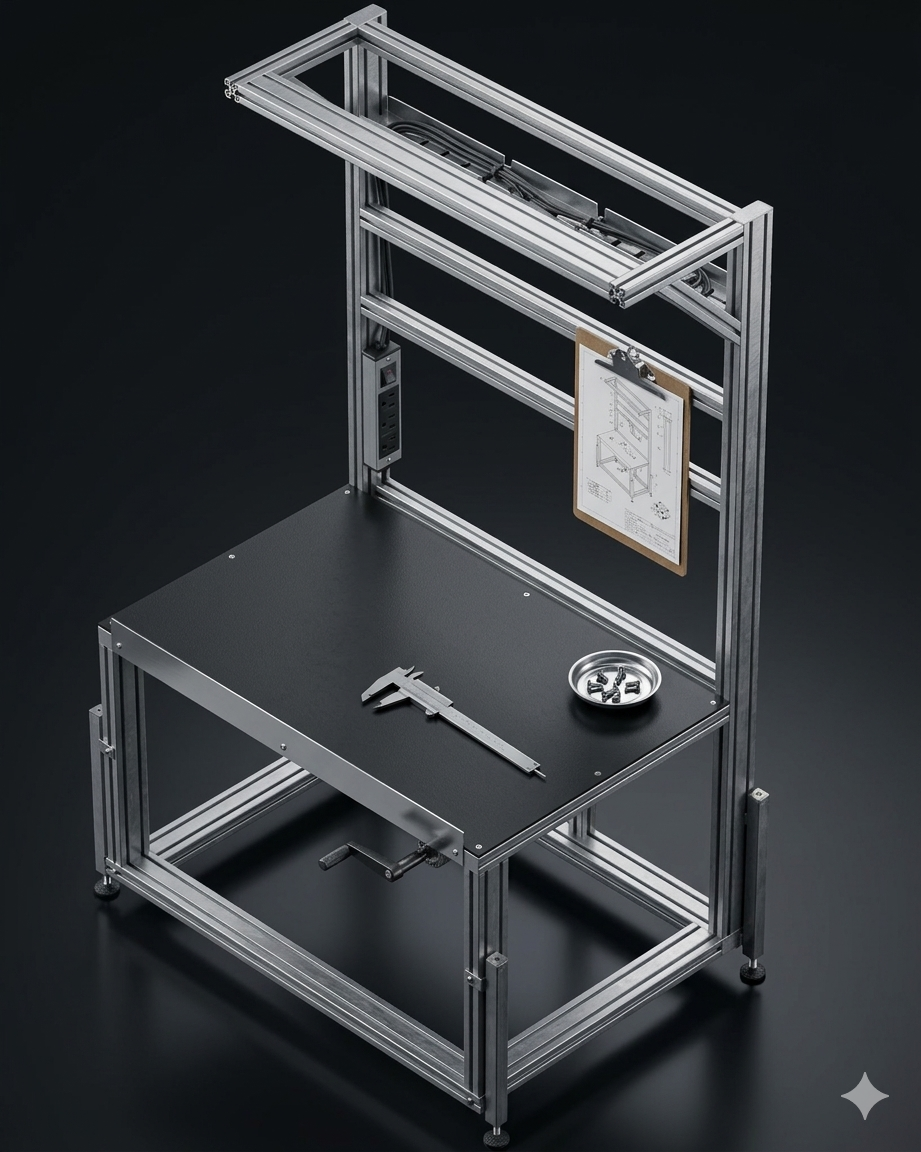
Why Choose Modular Solutions for Tilting Workstations?
Tilt the work to the operator — eliminating forward bending, shoulder elevation, and neck flexion from flat-surface reach operations.
Modular aluminum T-slot workstations bolt together without welding and reconfigure without tools — giving you a purpose-engineered station today that adapts through every process change, product launch, and kaizen event without capital reinvestment in new furniture.
0–45 Degree Tilt Range
Infinitely adjustable tilt angle from flat (0°) to 45 degrees — set for the optimal viewing and access angle for each process without fixed-angle compromise.
Manual or Electric Tilt
Manual gas-spring counterbalanced tilt for light loads with one-hand repositioning, or electric motor tilt with preset angles for heavy parts and shared workstations.
Integrated Parts Retention
Adjustable side rails and stop bars prevent parts from sliding off the tilted surface — critical for electronic assembly, welding setups, and inspection positioning.
Combined Height and Tilt
Combined height-adjustable and tilt-top configurations allow the operator to set both the work height and the viewing angle independently — optimal ergonomics for any operator and any part.
Welding-Compatible Surfaces
Steel top surfaces rated for welding setups with grounding provisions and heat-resistant surface options for MIG, TIG, and spot welding operations.
Inspection Lighting Integration
Integrated articulating task light mounts position illumination perpendicular to the tilted work surface for consistent defect visibility across the full inspection area.
Tilting Workstations Applications
Configured for assembly, welding, inspection, and ergonomic positioning across industrial, electronics, and precision manufacturing.
- Angled Component Assembly - Assembly of panels, circuit boards, and complex sub-assemblies where angled access to all fastener and connector locations reduces reach fatigue.
- Welding Fixture Tables - Tilting weld tables positioning weldments at the optimal puddle angle for flat and horizontal welds — improving weld quality and reducing operator fatigue.
- Visual and Dimensional Inspection - Angled inspection surfaces presenting the part face toward the inspector at optimal viewing angle for consistent surface, edge, and feature evaluation.
- Electronics Board Assembly - Tilted PCB assembly benches presenting the board face at the correct soldering angle for ergonomic through-hole and SMT rework without neck flexion.
- Document and Drawing Reference - Tilted reference surfaces for large-format drawings, schematics, and assembly instructions at reading angle during build operations.
- Painting and Coating Preparation - Tilting part preparation tables positioning parts at optimal spray angle for painting, coating, and surface treatment operations.
Specifications & Configurations
Standard configurations available — all dimensions and mechanism options are custom-engineered to your requirements.
| Specification | Detail |
|---|---|
| Tilt Range | 0°–45° adjustable; fixed angles available for specific applications |
| Tilt Mechanism | Gas-spring counterbalance (light loads) or electric motor (heavy loads/presets) |
| Load Capacity | Up to 500 lbs on tilted surface depending on tilt angle and surface size |
| Combined Adjustment | Combined height-adjustable and tilt configurations available |
| Surface Options | Steel, stainless steel, phenolic, or T-slot aluminum plate with fixture provisions |
| Lead Time | 3–5 weeks from approved drawings |
Frequently Asked Questions
Common questions about tilting workstations design, configuration, and ergonomic compliance.
What tilt angle is correct for assembly and inspection operations?
The optimal tilt angle depends on the task and part size. For electronic assembly and precision inspection, 15–25 degrees brings the part face toward the operator at a natural wrist angle, reducing shoulder elevation and neck flexion. For welding, 30–45 degrees is common for flat-position weld access. For document and drawing reference, 30–35 degrees is standard reading angle. Infinitely adjustable tilt allows each operator to set their preferred angle.
What prevents parts from sliding off a tilted work surface?
Tilting workstations include adjustable side rails and a bottom stop bar that position against the part perimeter at any tilt angle. For PCB and electronic assembly, foam-lined angled holders and clip rails position boards at the correct angle without contact with the board face. For heavy weldments, T-slot surface clamps secure parts positively to the tilted surface during welding.
Can a tilting workstation also adjust in height?
Yes. Combined height-and-tilt configurations use an adjustable-height base column with a tilt-top mechanism mounted at the top. Height and tilt adjust independently — allowing the operator to set the surface to ergonomic height and then dial in the optimal tilt angle for the specific part and task. Electric versions with memory presets can recall both height and tilt simultaneously.
Are tilting workstations available for welding operations?
Yes. Welding-specific tilting tables use 3/8–1/2 inch steel plate surfaces with ground clamp provisions and heat-resistant frame protection. T-slot fixture rails on the top surface accept weld clamps and positioners. The tilt mechanism is rated for weld setup loads with mechanical position locks — the tilt does not drift under welding forces.
How is task lighting positioned on a tilting workstation?
Task lighting mounts on articulating arm rails attached to the upright frame — not to the tilting surface. This allows the light angle to be set independently of the tilt angle, maintaining consistent illumination perpendicular to the work face across all tilt positions. For inspection applications, this is critical for consistent defect visibility regardless of operator tilt preference.
Design Your Tilting Workstation
Send us your part size, tilt angle requirement, and load — we'll engineer a tilt-top configuration that puts the work exactly where your operators need it.