Fixture Mounting Tables
Heavy-duty modular aluminum fixture mounting tables with T-slot surface grids, tombstone provisions, and precision dowel hole patterns. Fixtures clamp, locate, and anchor to the table surface without welding — and reconfigure in minutes as part numbers change.
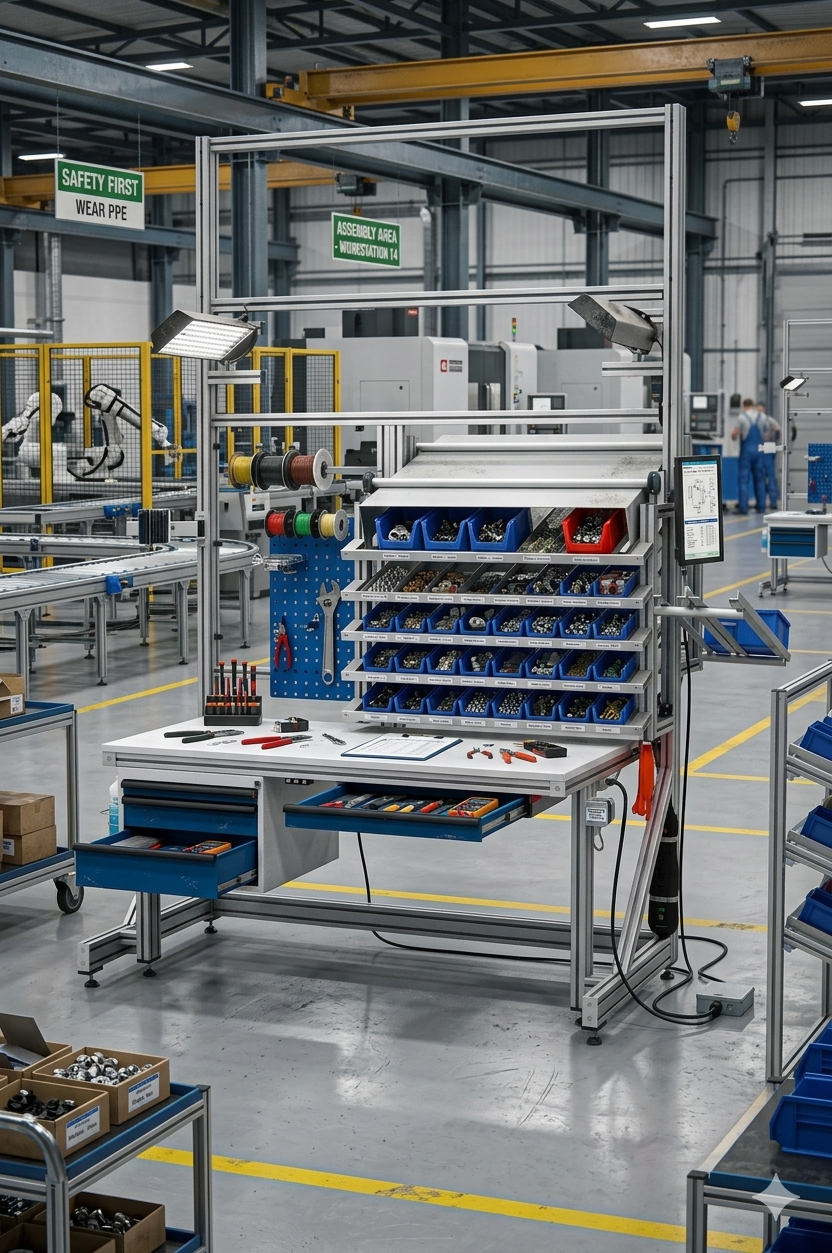
Why Choose Fixture Mounting Tables?
Fixture mounting tables are the foundation of flexible manufacturing. A well-engineered fixture table eliminates the cost of dedicated weld fixtures and delivers setup repeatability that rivals hard tooling.
Modular aluminum T-slot structural tables bolt together without welding and reconfigure without tools — delivering the rigidity and load capacity of a dedicated machine base with the flexibility to adapt through every process change, equipment upgrade, and facility reorganization without replacing the structure.
T-Slot Surface Grid
Precision-machined T-slot channel grid at 50mm or 100mm pitch accepts standard fixture clamps, stop blocks, and locating elements at any position.
Dowel Hole Pattern
Ground dowel hole matrix provides repeatable datum reference for fixtures requiring sub-0.01mm positional accuracy between setups.
Tombstone Mounting
Tombstone receiver provisions on the table surface accept 4-sided vertical tombstones for high-density part fixturing on a single surface.
Flatness Certification
Precision-ground surface flatness to 0.001"/ft or 0.002" overall — supplied with calibration documentation for quality programs.
High Surface Load Capacity
Steel or aluminum tooling plate surface withstands fixture clamping forces, part weight, and machining reaction forces without deflection.
T-Slot Frame Integration
Frame T-slot channels integrate fixturing accessories below the surface — clamp rails, under-table supports, and cable management.
Applications
Fixture mounting tables support flexible part holding in machining, assembly, inspection, and welding environments.
- CNC machining and mill work holding
- Coordinate measuring machine staging fixtures
- Welding and fabrication fixture tables
- Assembly fixture and jig mounting
- Tombstone horizontal machining setups
- Dimensional inspection fixturing
- Prototype and R&D part development fixtures
- Multiple-part pallet fixturing systems
Specifications
Standard specifications for modular aluminum fixture mounting tables.
| Parameter | Detail |
|---|---|
| Surface Material | Aluminum tooling plate (6061-T6511) or steel plate (1018 or A36) |
| T-Slot Pitch | 50mm or 100mm grid standard; custom pitch available |
| Dowel Hole Pattern | 0.5000" ±0.0001" ground dowel holes at 100mm or 150mm grid |
| Surface Flatness | 0.001"/ft standard; 0.0005"/ft precision-ground option |
| Clamping Slots | 5/8"-11 or M16 T-slot standard; other sizes available |
| Standard Sizes | 24"×36" to 60"×120" — custom footprints available |
| Load Capacity | 1,000–5,000 lb depending on surface and frame spec |
| Lead Time | 4–6 weeks from approved drawings |
Frequently Asked Questions
Common questions about fixture table surface materials, T-slot pitch, and flatness specifications.
What is the difference between aluminum tooling plate and steel plate for fixture tables?
Aluminum tooling plate (6061-T6511) is lighter, corrosion-resistant, and easier to machine for custom dowel holes and clamp slots. It is preferred for inspection, assembly, and flexible machining fixtures. Steel plate (1018 or A36) provides higher compressive strength for heavy clamping loads and welding heat resistance. Steel is preferred for welding fixture tables and applications with very high fixture clamp forces. Both materials are available with precision-ground flat surfaces.
What T-slot pitch should I specify for a fixture mounting table?
50mm pitch is standard for general-purpose flexible fixturing — providing fine positioning resolution for most part families. 100mm pitch is used for large fixtures where coarser positioning is acceptable and fewer slots are needed. Custom pitches matching existing fixture inventories are available. Mixed-pitch configurations (50mm in one axis, 100mm in the other) are specified for part families with different positioning resolution requirements in X vs. Y.
How repeatable are tombstone setups on a fixture mounting table?
Tombstone receivers with precision ground datum surfaces and dowel pin location provide setup repeatability of 0.001" to 0.003" between load/unload cycles. For higher repeatability (sub-0.001"), a kinematic coupling mount system (3-ball and 3-groove) provides theoretical exact constraint location to 0.0001". Repeatability documentation is available with precision-ground tables.
Can fixture mounting tables be used outdoors or in wet machining environments?
Steel plate tables should be coated (hard chrome, electroless nickel, or paint) for wet machining environments. Aluminum tooling plate tables are naturally corrosion-resistant to coolants but should be specified with sealed T-slot channels to prevent coolant ingestion into the channel root. Stainless steel 304 table surfaces are available for aggressive coolant or food-grade fixture environments.
What is included with the flatness certification for a precision fixture table?
Precision-ground tables ship with a flatness certification report documenting the measured deviation at a grid of measurement points across the surface. The report includes measurement equipment identification, calibration status, ambient temperature at measurement, and the measured maximum peak-to-valley deviation. Flatness certificates are suitable for ISO 9001, AS9100, IATF 16949, and ISO 17025 quality program documentation.
Ready to Configure Your Fixture Mounting Tables?
Contact our structural engineering team for a no-obligation quote. We design, engineer, and manufacture heavy duty modular tables from our Auburn Hills, MI facility — typically shipping in 3–6 weeks from approved drawings.
Request a Quote