Vibration-Resistant Tables
Modular aluminum vibration-resistant tables with passive elastomeric and active pneumatic isolation systems for precision measurement, optical equipment, and vibration-sensitive instruments. Floor vibration is attenuated before it reaches the work surface — protecting measurement accuracy and instrument performance.
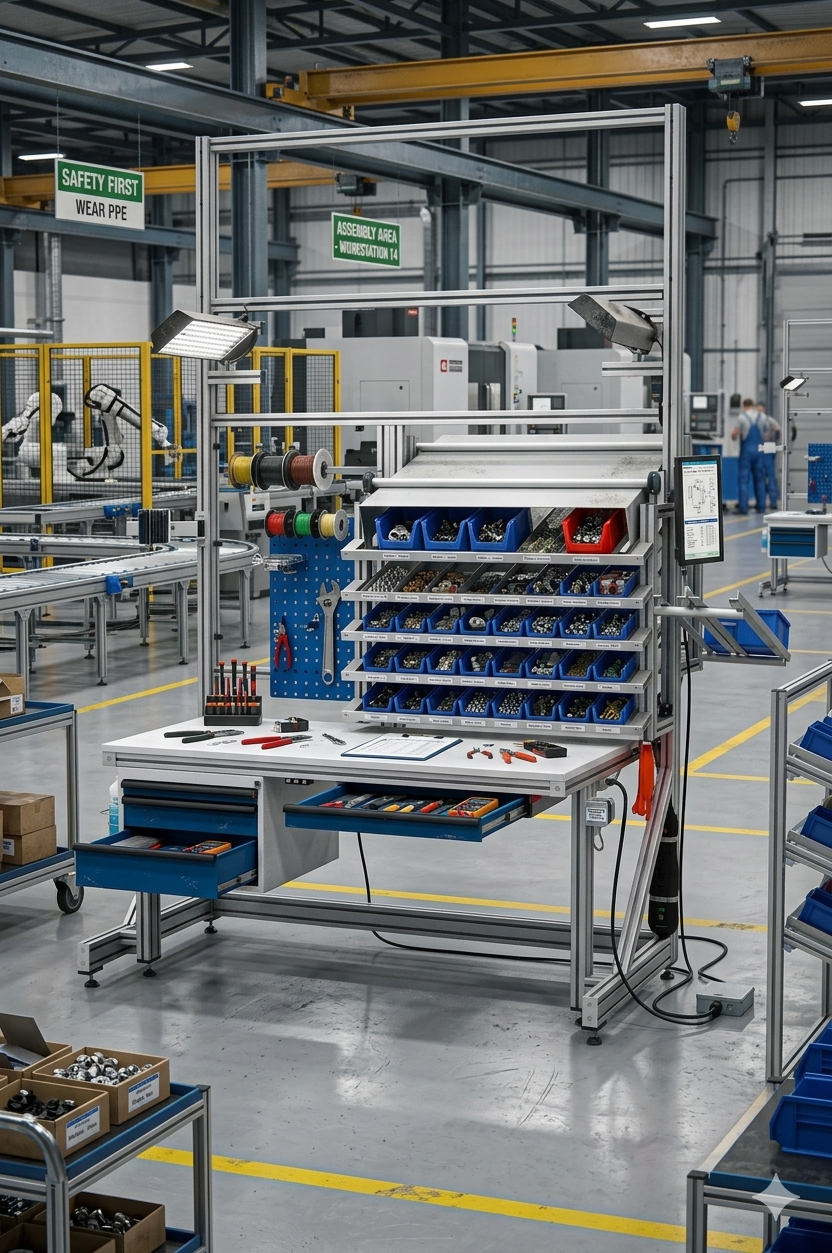
Why Choose Vibration-Resistant Tables?
Vibration-resistant tables are not just about comfort. Unmeasured floor vibration corrupts precision measurements, damages sensitive instruments, and degrades optical system performance. The right isolation table eliminates the problem at the source.
Modular aluminum T-slot structural tables bolt together without welding and reconfigure without tools — delivering the rigidity and load capacity of a dedicated machine base with the flexibility to adapt through every process change, equipment upgrade, and facility reorganization without replacing the structure.
Passive Elastomeric Isolation
Natural rubber or neoprene elastomeric mounts attenuate floor vibration above the system natural frequency (6–12 Hz) by 85–95%.
Active Pneumatic Isolation
Pneumatic air spring isolators (natural frequency 1.5–3 Hz) provide >99% attenuation of floor vibration above 5 Hz for the most demanding applications.
High-Mass Surface
Thick steel or cast iron surface plate provides high inertia that resists excitation from transient disturbances — reducing surface motion amplitude.
Rigid Frame Structure
Heavy-duty 90mm T-slot frame provides a rigid isolation boundary between the surface and the mounts.
Damping System
Tuned viscous dampers reduce ringing and residual oscillation after transient disturbances for faster settling.
Level Sensing
Auto-leveling provisions maintain surface level as loads change — critical for optical and CMM applications.
Applications
Vibration-resistant tables are deployed wherever floor vibration threatens measurement accuracy, instrument performance, or process stability.
- Coordinate measuring machine (CMM) tables
- Optical microscopy and interferometry
- Laser system and optics benches
- Precision balance and microbalance stations
- Surface roughness and profilometer tables
- Scanning electron microscope (SEM) stages
- Semiconductor wafer inspection tables
- Calibration laboratory benches
Specifications
Standard isolation specifications for vibration-resistant table configurations.
| Parameter | Detail |
|---|---|
| Isolation Type | Passive elastomeric (standard) or active pneumatic (premium) |
| Natural Frequency | 6–12 Hz (elastomeric); 1.5–3 Hz (pneumatic) |
| Attenuation at 10 Hz | >85% (elastomeric); >99% (pneumatic) |
| Surface Material | Steel plate (1/4"–2") or cast iron; precision-ground option |
| Surface Flatness | 0.002" overall standard; 0.0005"/ft precision-ground option |
| Damping | Viscous tuned dampers on heavy-duty configurations |
| Standard Sizes | 24"×48" to 60"×120" — custom sizes available |
| Lead Time | 4–8 weeks (pneumatic active systems require longer lead) |
Frequently Asked Questions
Common questions about vibration isolation systems, attenuation performance, and application selection.
What is the difference between passive and active vibration isolation?
Passive isolation uses elastomeric or pneumatic springs with no active control. Performance depends on the ratio of excitation frequency to system natural frequency. At excitation frequencies above 1.4x the natural frequency, isolation begins; above 3x the natural frequency, attenuation exceeds 85%. Active isolation uses servo-controlled pneumatic actuators that actively counteract measured floor motion, providing effective isolation starting at excitation frequencies above 1.1x the natural frequency and achieving >99% attenuation above 5 Hz.
What natural frequency should I specify for my application?
For most production-floor measurement applications (CMM, surface roughness, balances), passive elastomeric isolators with a 6 to 8 Hz natural frequency provide adequate attenuation of typical floor vibration (10–100 Hz range). For optical benches, interferometers, and SEMs in high-vibration environments, pneumatic isolators with 1.5 to 3 Hz natural frequency are required. The disturbing frequency spectrum of the floor should be measured before specifying the isolation system.
Why does a heavy surface plate improve vibration performance?
A heavier surface plate has higher inertia — more force is required to accelerate it. For transient disturbances (footsteps, door slams), the surface motion amplitude is inversely proportional to mass. A 500 lb steel plate moves 10x less than a 50 lb aluminum plate in response to the same transient force. High mass also lowers the system natural frequency when combined with soft isolation mounts, improving passive isolation performance.
Do vibration-resistant tables need to be leveled?
Yes. Passive elastomeric tables are shimmed to level at installation and re-checked periodically. Pneumatic active isolation tables include automatic leveling valves that maintain level continuously as loads change on the surface. Auto-leveling is critical for optical systems where surface tilt changes the beam path. Manual leveling adjustment screws are provided on all configurations.
Can vibration-resistant tables be used on upper floors of a building?
Upper floors typically have lower natural frequencies (3–8 Hz for concrete slab floors) and higher vibration amplitudes than ground-floor slabs. Active pneumatic isolation with 1.5 to 2 Hz natural frequency is required for sensitive instruments on upper floors. A floor vibration survey (velocity and frequency measurement) should be performed before specifying the isolation system to confirm adequate attenuation margin.
Ready to Configure Your Vibration-Resistant Tables?
Contact our structural engineering team for a no-obligation quote. We design, engineer, and manufacture heavy duty modular tables from our Auburn Hills, MI facility — typically shipping in 3–6 weeks from approved drawings.
Request a Quote