Assembly Workstations
Modular aluminum assembly workstations engineered for lean production lines, sub-assembly operations, and manual build stations — configured to your process layout, ergonomic requirements, and tooling access needs. Integrated tool management, parts presentation, and storage at the point of use. Designed and manufactured in Auburn Hills, MI.
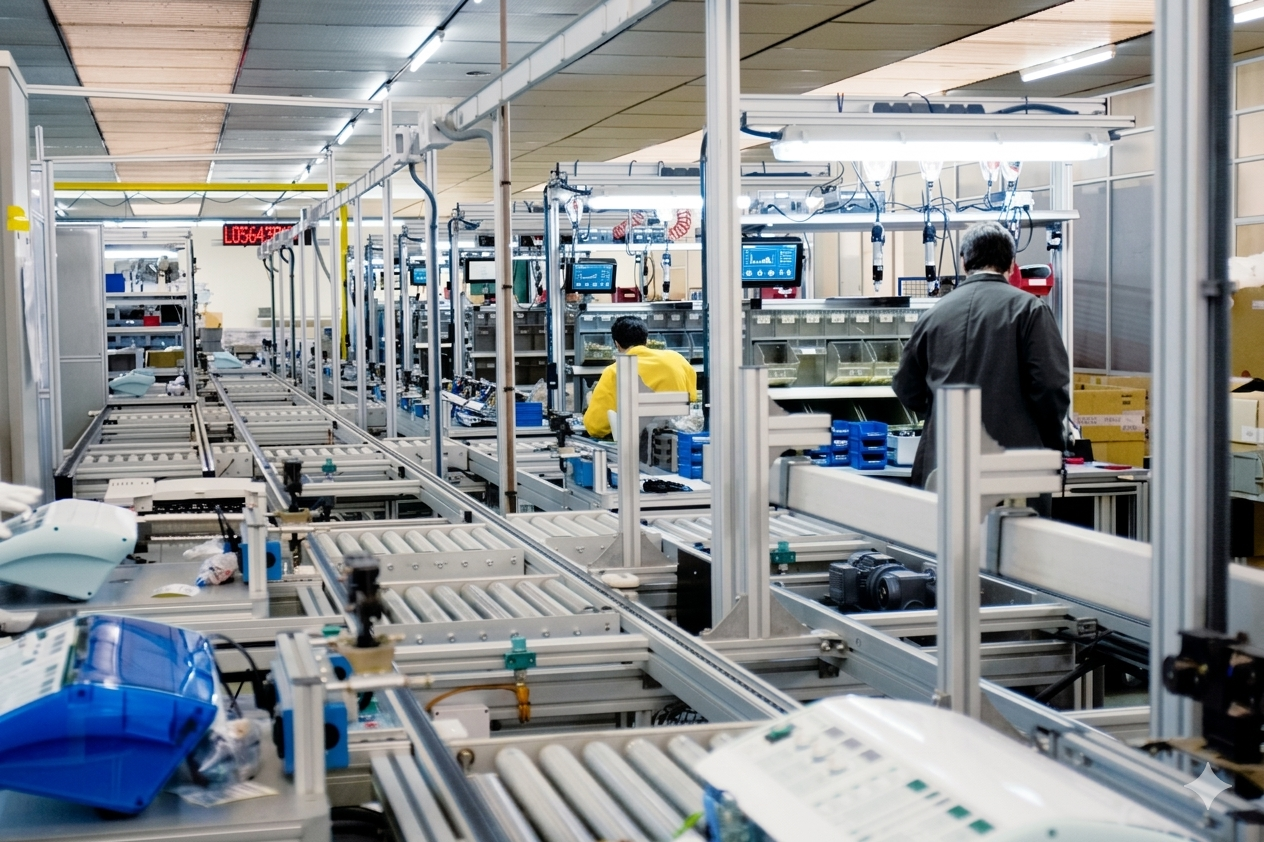
Why Choose Modular Solutions for Assembly Workstations?
Engineered around your process, operator, and facility — not a catalog template.
Modular aluminum T-slot workstations bolt together without welding and reconfigure without tools — giving you a purpose-engineered station today that adapts through every process change, product launch, and kaizen event without capital reinvestment in new furniture.
Ergonomic Work Surface Height
Fixed or adjustable-height surfaces set to optimal operator reach for seated or standing assembly — reducing fatigue and improving cycle time consistency across shifts.
Integrated Tool Management
Pegboard tool boards, drawer units, and bin rail systems keep tools and fasteners at the point of use — eliminating reach time and minimizing line-side clutter.
Parts Presentation
Angled bin rails, flow rack tiers, and gravity-fed parts bins present components at the correct height and angle for one-hand reach access during repetitive assembly cycles.
ESD-Safe Configurations
Static-dissipative work surface options, grounding straps, and conductive caster assemblies for electronics assembly and PCB-handling environments per ANSI/ESD S20.20.
Modular Expansion
T-slot aluminum frame adds shelves, monitor arms, lighting, and accessories without tools or welding — reconfigures as your process changes.
Durable Work Surfaces
Laminate, MDF, steel, stainless steel, and aluminum surface options rated for your load, chemical, and cleanliness requirements.
Assembly Workstation Applications
Configured for the specific demands of your assembly process and production environment.
- Manual Assembly Lines - Line-feed stations for mechanical subassemblies, wiring harnesses, fastener installation, and component kitting sized to takt time with integrated bin lanes and tool shadow boards.
- PCB and Electronics Assembly - ESD-safe assembly benches for circuit board population, SMT rework, and through-hole soldering with grounded surfaces and anti-static component storage.
- Packaging and Kit Preparation - End-of-line packing stations with tape dispenser mounts, scale platforms, label printer shelves, and carton flow tracks for efficient pack-and-ship operations.
- Sub-Assembly Feed Stations - Upstream preparation stations positioned inline with production conveyors for takt-time-controlled sub-assembly feeding.
- Incoming Inspection - Receiving and parts verification stations with measurement tool storage, documentation holders, and reject/accept bin positions.
- Multi-Shift Production - Standardized station layouts with labeled tool locations and consumable storage so every shift starts in the same condition.
Specifications & Configurations
Standard configurations available — all dimensions and surface options are custom-engineered to your requirements.
| Specification | Detail |
|---|---|
| Frame Profile | 45mm or 90mm T-slot aluminum extrusion; mixed frame sizes available within a single station |
| Work Surface Height | Standard 34" (seated), 36" (standing), 40" (tall/sit-stand); custom heights available |
| Work Surface Width | 36" to 96" standard; longer spans with intermediate uprights |
| Surface Materials | Laminate, MDF, 12-ga steel, stainless steel, ESD laminate, solid aluminum |
| Load Capacity | Up to 2,000 lbs distributed depending on surface and frame configuration |
| Lead Time | 3–5 weeks from approved drawings; 2–3 weeks for standard configurations |
Frequently Asked Questions
Common questions about assembly workstation design, configuration, and lead time.
What work surface materials are available for assembly workstations?
Assembly workstations are available with laminate, MDF, 12-gauge steel, stainless steel (304 or 316), ESD-safe static-dissipative laminate, and solid aluminum work surfaces. Material selection depends on the process: standard laminate for light assembly, steel for heavy parts, stainless for washdown environments, and ESD laminate for electronics assembly.
Can assembly workstations integrate with production conveyors?
Yes. Modular Solutions designs workstations with conveyor pass-through openings and height-matched work surfaces that allow parts to transfer from conveyor to work surface without lifting. Workstation height is coordinated with your conveyor elevation and ergonomic operator position.
How are tools and parts managed at modular assembly stations?
Tool management is handled through pegboard panels, drawer units, and shadow board inserts. Parts are presented via angled bin rails, gravity-fed flow rack tiers, and carton flow channels built into the workstation structure — all within ergonomic reach to minimize cycle time waste.
Are ESD-safe assembly workstations available?
Yes. ESD-safe configurations include static-dissipative laminate surfaces (10&sup6;–10&sup9; ohms surface resistance), wrist strap grounding points, bonding lugs on the aluminum frame, and conductive caster options. These support ANSI/ESD S20.20 requirements for electronics assembly environments.
What is the load capacity of a modular assembly workstation?
Standard assembly workstations support distributed loads up to 1,000 lbs on laminate or MDF surfaces and up to 2,000 lbs on steel or aluminum surfaces. Heavy-duty configurations with 90mm extrusion and reinforced top frames support higher loads — specified based on your parts and tooling weight.
Build Your Assembly Workstation
Share your process requirements, sketch, or CAD layout — our engineers will return a quote with ergonomic and lean-optimized layout options.