Electronics Assembly Workstations
ESD-controlled modular aluminum workstations for electronics assembly, PCB handling, SMT rework, and sensitive component operations — with static-dissipative surfaces, ANSI/ESD S20.20 grounding, solder fume extraction integration, and IPC-A-610 compliant lighting. Manufactured in Auburn Hills, MI.
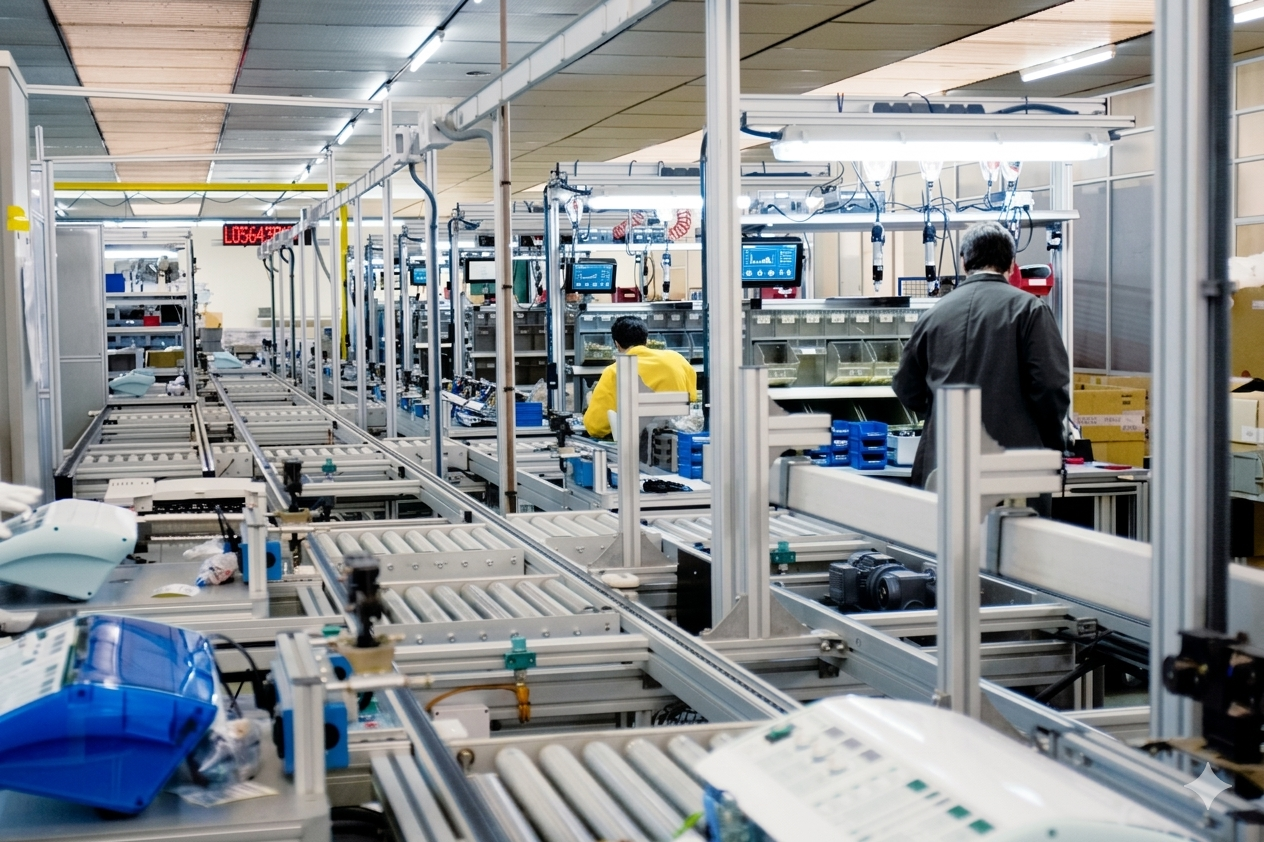
Why Choose Modular Solutions for Electronics Assembly Workstations?
Full ANSI/ESD S20.20 compliance designed in — not added as an afterthought.
Modular aluminum T-slot workstations bolt together without welding and reconfigure without tools — giving you a purpose-engineered station today that adapts through every process change, product launch, and kaizen event without capital reinvestment in new furniture.
ANSI/ESD S20.20 Compliance
Static-dissipative laminate surfaces (10&sup6;–10&sup9; Ω), common-point ground wrist strap connections, frame bonding lugs, and ionizer provisions meeting the electronics industry ESD control standard.
IPC-A-610 Lighting
High-CRI LED task lighting (>90 CRI, 5000K) providing 1,000+ lux at the board surface with shadow-free even illumination for IPC visual inspection compliance.
Solder Fume Extraction
In-frame arm mounts for fume extractor positioning 2–4 inches from the solder joint — adjustable for different board sizes with internal ductwork routing.
Component Organization
Antistatic parts trays, ESD-safe bin rails, and labeled component drawers keep sensitive components organized within the static-protected work zone.
Monitor and Document Management
Dual monitor arm mounts with cable management for assembly instructions, quality checksheets, and traceability systems at the assembly position.
Cleanroom-Compatible Options
Smooth anodized frames, sealed T-slot joints, stainless hardware, and non-outgassing ESD surfaces for ISO Class 7 cleanroom electronics assembly.
Electronics Assembly Applications
Supporting ANSI/ESD S20.20, IPC-A-610, J-STD-001, and ISO 14644 requirements across electronics manufacturing.
- PCB Assembly and SMT Rework - ESD-safe benches for circuit board population, surface mount rework, and through-hole soldering with full grounding and fume extraction.
- Electronics Module Assembly - Modular electronics and cable harness assembly in ANSI/ESD S20.20 controlled environments with component traceability provisions.
- Electronics Repair and Refurbishment - ESD-safe repair benches for electronic equipment requiring static-free handling, solder rework, and component replacement.
- Sensor and Transducer Assembly - Precision assembly and calibration of sensors requiring ESD protection and stable, vibration-free work surfaces.
- Medical Device Electronics - ESD-safe electronics assembly with documentation, device history records, and cleanability requirements for FDA-regulated medical device manufacturing.
- Defense and Aerospace Electronics - ESD and FOD-controlled electronics assembly workstations for MIL-HDBK-263 and AS9100 regulated production environments.
Specifications & Configurations
Electronics assembly workstation specifications — all ESD and compliance options custom to your process and certification requirements.
| Specification | Detail |
|---|---|
| ESD Surface | Static-dissipative laminate, 10&sup6;–10&sup9; Ω surface resistance per ANSI/ESD S4.1 |
| Grounding | Common-point ground wrist strap connections, frame bonding lugs, conductive caster options |
| Lighting | High-CRI LED (>90 CRI, 5000K), adjustable arm, >1,000 lux at bench surface |
| Fume Extraction | In-frame arm mount; ductwork routing to facility extraction or portable unit |
| Compliance Support | Supports ANSI/ESD S20.20, IPC-A-610, J-STD-001, ISO 14644-1 |
| Lead Time | 2–4 weeks from approved drawings |
Frequently Asked Questions
Common questions about ESD control, soldering compliance, and electronics assembly workstation certification.
What ESD specifications do electronics assembly workstations meet?
Electronics assembly workstations are configured to support ANSI/ESD S20.20 — including static-dissipative work surface resistance (10&sup6; to 10&sup9; ohms), personnel grounding through common-point wrist strap connections, ionizer provisions for non-conductors, and frame bonding to the facility ground system. Compliance documentation including surface resistance test results is available on request.
How is soldering fume extraction integrated?
Solder fume extractor arms mount on T-slot rails at the back of the workstation, positioning the capture nozzle 2 to 4 inches from the solder joint for maximum capture efficiency. Arms are adjustable for different board sizes. Ductwork routing within the T-slot frame connects to the facility extraction system or portable extractor without exposed hoses over the work surface.
What lighting specification is correct for IPC visual inspection?
IPC-A-610 specifies minimum illuminance of 1,000 lux for soldered joint inspection. Modular Solutions electronics workstations use high-CRI (>90) LED task lighting at 5000K color temperature, providing shadow-free illumination at the board surface plane. Adjustable arm mounts allow precise positioning for different board heights and operator preferences.
How are sensitive components stored at electronics assembly workstations?
Static-sensitive components are stored in labeled antistatic boxes in ESD-safe bin rail positions within the ESD-protected work zone. Component drawers use antistatic foam inserts for ICs and sensitive devices. Moisture-sensitive devices (MSD) requiring controlled humidity environments have sealed storage provisions within the station.
Can electronics assembly workstations be used in ISO Class 7 cleanrooms?
Yes. Cleanroom electronics workstations use smooth anodized aluminum frames, sealed T-slot joints, stainless hardware, non-outgassing ESD-safe surfaces, and perforated bottom panels for vertical laminar flow pass-through in downflow cleanrooms. All materials are specified for the applicable ISO 14644-1 cleanroom classification.
Configure Your Electronics Assembly Station
Send us your ESD requirements, IPC standard, and board sizes — we'll design a fully compliant electronics assembly workstation.