Maintenance Workstations
Heavy-duty modular aluminum maintenance workstations for industrial repair, preventive maintenance, and toolroom operations — with robust steel work surfaces, organized tool storage, vise mounting provisions, and GFCI-protected electrical outlets for power tool use. Designed and built in Auburn Hills, MI.
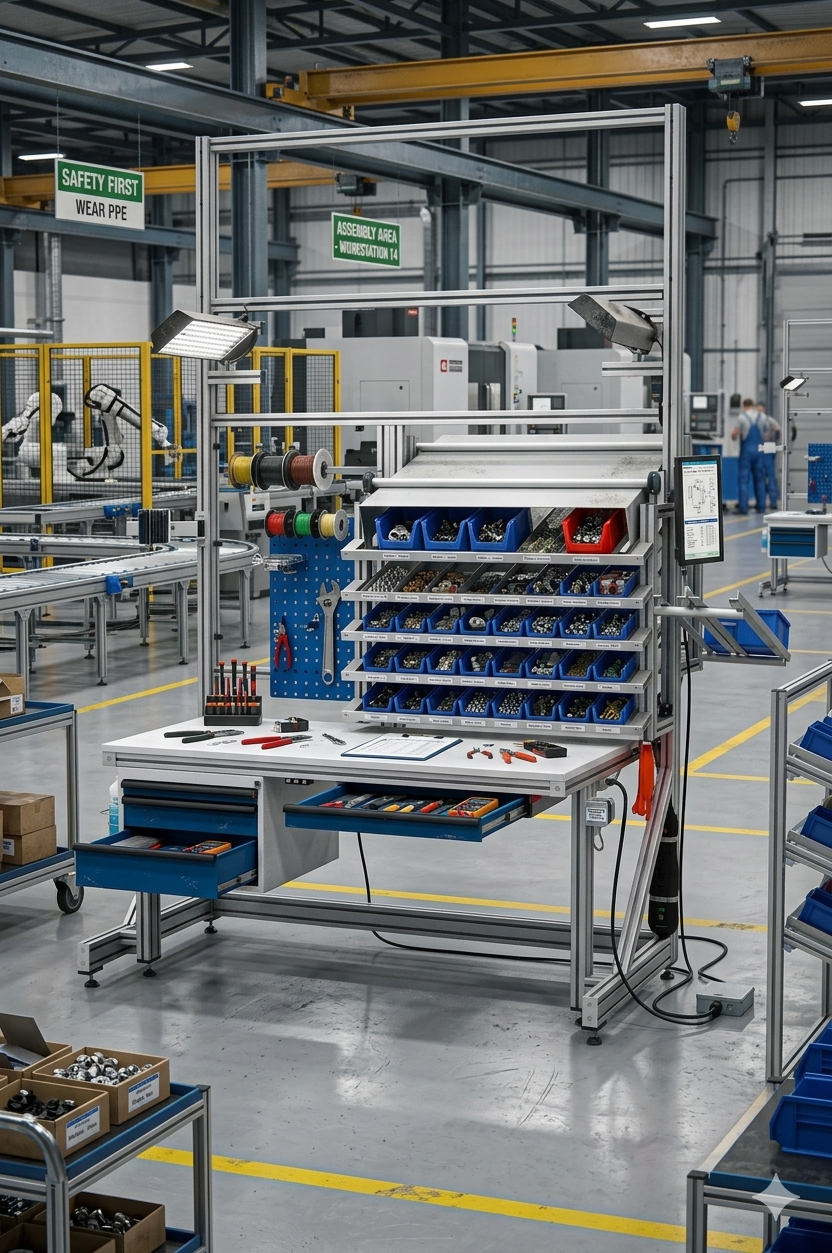
Why Choose Modular Solutions for Maintenance Workstations?
Built for the abuse of industrial repair environments — heavy surfaces, organized tools, and in-frame power for the toughest PM benches.
Modular aluminum T-slot workstations bolt together without welding and reconfigure without tools — giving you a purpose-engineered station today that adapts through every process change, product launch, and kaizen event without capital reinvestment in new furniture.
Robust Tool Storage
Drawers with foam inserts, pegboard tool boards, shadow boards, and bin systems for organized maintenance tool storage — every tool in the same place every time.
Heavy-Duty Steel Surfaces
10-gauge or 12-gauge steel work surfaces rated for heavy parts, impact loading, and machinist-type operations without deflection.
Vise and Fixture Mounting
Reinforced vise mounting plates and T-slot top rails for bench vises, fixture clamps, and workholding equipment used in equipment repair.
GFCI-Protected Power
Grounded outlets with GFCI protection and separate 20A circuits for power tools — in-frame distribution with industrial metal-enclosed strips.
Parts and Documentation Management
Schematic holder rails, parts bin systems for disassembled components, and bag-and-tag provisions for maintenance procedure documentation.
Chemical Resistance
Solvent-resistant surface finishes and sealed frame joints for maintenance environments with cutting fluids, lubricants, and cleaning solvents.
Maintenance Workstation Applications
Built for the demands of industrial maintenance, toolroom, and equipment repair environments.
- Preventive Maintenance Bench - PM benches for mechanical equipment repair, bearing replacement, and lubrication services with foam-insert tool storage for PM kits.
- Toolroom Maintenance - Cutting tool inspection, conditioning, and storage benches with precision surface options and measurement tool storage.
- Hydraulic and Pneumatic Repair - Fluid-resistant surfaces and parts cleaning provisions for hydraulic and pneumatic component repair and rebuild operations.
- Electrical Panel and Motor Repair - Grounded benches with GFCI outlets, insulated mat provisions, and schematic holder rails for electrical equipment repair.
- Plant Maintenance Workshop - General plant maintenance workshop with organized tool storage, parts management, and equipment repair surface for maintenance department operations.
- Mobile Maintenance Cart - Rolling maintenance workstations that deliver tools and repair capability to equipment locations throughout the facility.
Specifications & Configurations
Heavy-duty maintenance workstation specifications — all surface and storage options custom to your maintenance operation.
| Specification | Detail |
|---|---|
| Frame | 45 or 90 Series T-slot aluminum; heavy-duty configuration with diagonal bracing |
| Work Surface | 10 or 12 gauge steel, stainless steel, or ESD-safe laminate; chemical-resistant finish |
| Load Capacity | Up to 3,000 lbs distributed on 90 Series steel-top configuration |
| Vise Mount | Reinforced 3/4" steel vise plate, standard bolt pattern, 6" minimum overhang |
| Power | GFCI-protected outlets, separate 20A circuits for power tools; LED task lighting 1,000 lux |
| Lead Time | 2–4 weeks from approved drawings |
Frequently Asked Questions
Common questions about maintenance workbench configuration, vise mounting, and tool storage.
What distinguishes a maintenance workbench from a production assembly station?
Maintenance workbenches are built for higher impact loads, chemical exposure, and heavy tooling. Key differences include heavier work surface gauge (10 ga vs. 12 ga steel), reinforced vise mounting plates, solvent-resistant surface finishes, GFCI-protected outlets for power tool use, and integrated schematic holders for equipment repair procedures. Maintenance benches also typically include more storage depth for larger hand tools and portable instruments.
How are maintenance tool drawers organized for efficient PM procedures?
Tool drawers use foam inserts with precision-cut silhouettes for each tool in the PM kit — ensuring every tool returns to the same location after use. Shadow boards at the back of the bench show the silhouette of wall-mounted tools. PM kit contents are matched to the specific maintenance procedure to minimize tool search time.
Can maintenance workstations accommodate a bench vise?
Yes. Standard maintenance workstations include a 3/4-inch thick steel vise mounting plate at one end of the bench, with pre-drilled T-nut slots for standard bench vise bolt patterns. Reinforced mounting resists the torque loads of heavy clamping. The vise plate extends 6 inches beyond the bench end to allow full jaw access without frame interference.
What electrical provisions are standard on maintenance workbenches?
Standard maintenance workbenches include 6 to 8 duplex GFCI-protected 120V outlets in-frame, with separate 20A circuits for power tools. LED task lighting (1,000 lux) is standard. 240V single-phase outlets for larger power tools are available on request. All outlets use metal-enclosed power strips with strain-relief anchors.
Are mobile maintenance workstations available?
Yes. Mobile maintenance workstations mount on 5-inch heavy-duty swivel casters (500 lbs each, 2 locking) to support tool delivery to equipment locations throughout the plant. Mobile benches include a retractable power cord reel. Frame rigidity on mobile benches includes diagonal bracing to resist racking under caster loads.
Design Your Maintenance Workbench
Send us your maintenance procedures, tool inventory, and facility layout — we'll design a bench that puts every tool in reach and keeps your PM team organized.