Multi-Station Work Cells
Integrated modular aluminum multi-station work cells combining multiple operator positions, shared utility distribution, and material flow lanes into a single coordinated cell structure — engineered for high-complexity assembly, inspection, and production operations in U-cell, I-cell, and L-cell configurations. Designed and built in Auburn Hills, MI.
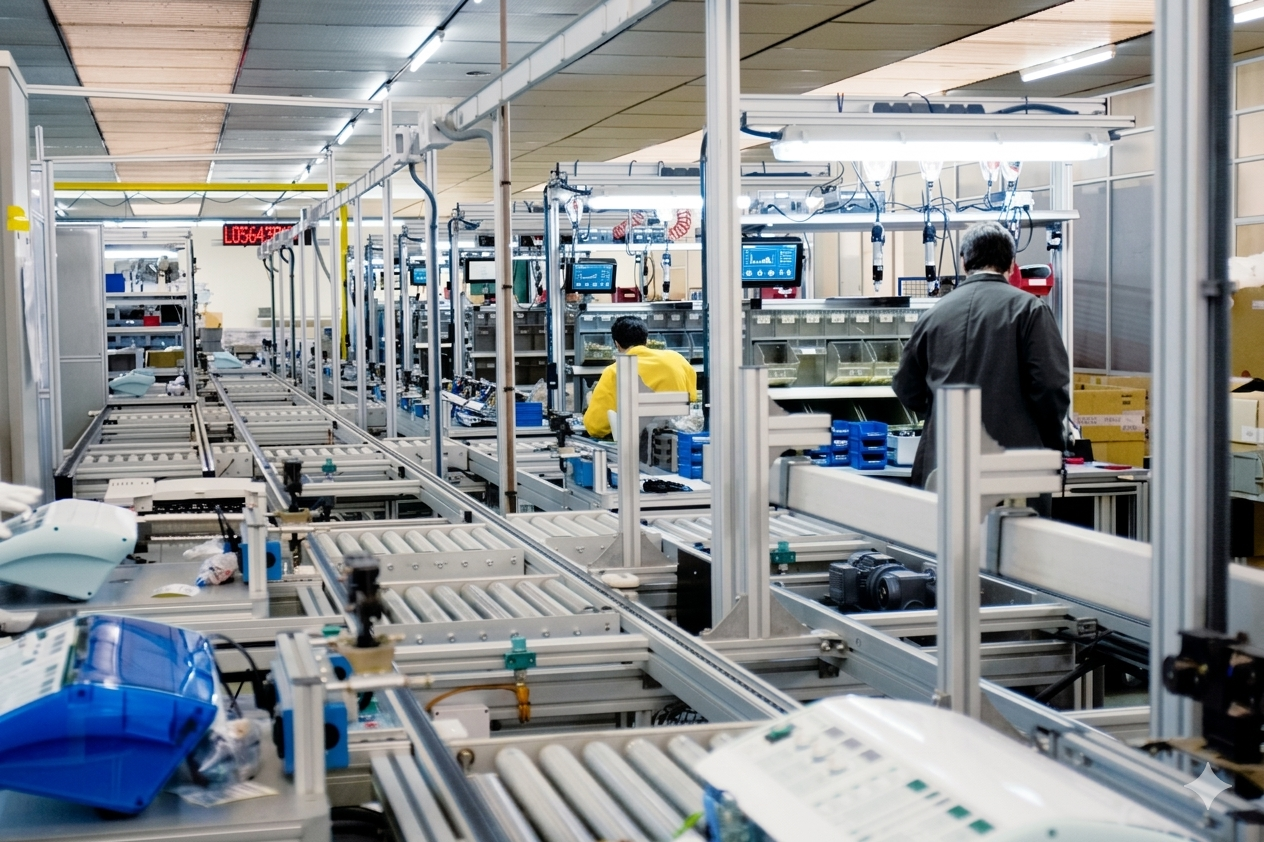
Why Choose Modular Solutions for Multi-Station Work Cells?
Integrated cell structures that put every operator in flow — engineered from your takt time, sequence, and floor layout.
Modular aluminum T-slot workstations bolt together without welding and reconfigure without tools — giving you a purpose-engineered station today that adapts through every process change, product launch, and kaizen event without capital reinvestment in new furniture.
Integrated Cell Structure
Single structural frame ties multiple operator workstations together with coordinated heights, shared overhead utilities, and uniform material flow geometry throughout the cell.
Material Flow Integration
In-cell conveyor sections, gravity flow lanes, and parts presentation systems connecting all stations within the cell for seamless single-piece flow.
Shared Utility Distribution
Single-point utility entry (power, air, data) distributed through the cell frame to all stations — eliminating individual station utility connections and floor cables.
Configurable Operator Count
2 to 12 operator positions in U-cell, I-cell, or L-cell layouts depending on assembly sequence, cycle time balance, and floor space constraints.
Overhead Utility Bridge
Integrated overhead T-slot bridge for shared task lighting, andon lights, fan units, and tooling storage above all operator positions simultaneously.
Rapid Changeover Design
Standardized station hardware across the cell allows operators to rotate between positions without adjustment — supporting mixed-model production and operator flexibility.
Multi-Station Work Cell Applications
Proven across final assembly, lean transformation, kitting, and inspection operations requiring integrated multi-operator flow.
- Multi-Operator Final Assembly Cells - Complex electromechanical product assembly cells with balanced work content, integrated test stations, and controlled material flow.
- U-Cell Lean Manufacturing - Balanced assembly sequences in U-cell layout for minimal operator travel, single-piece flow, and flexible staffing levels based on demand.
- Integrated Inspection and Test Cells - Assembly, functional test, and final inspection combined in one continuous flow cell — eliminating inter-department transfer and WIP accumulation.
- Kitting and Fulfillment Cells - Pick, assembly, and packaging combined in a single coordinated workspace for direct order fulfillment operations.
- Single-Piece Flow Cells - Lean manufacturing cells replacing separate departments with integrated single-piece flow — eliminating batching, queues, and department handoffs.
- Training and Demonstration Cells - Configurable lean training cells for teaching lean manufacturing, standard work, and flow concepts in a working production environment.
Specifications & Configurations
Multi-station work cell specifications — all cell layouts, operator counts, and utility configurations custom-engineered to your assembly sequence.
| Specification | Detail |
|---|---|
| Cell Layouts | U-cell, I-cell (linear), L-cell, or custom T-cell and loop configurations |
| Operator Count | 2 to 12 positions; work content balanced to your takt time per position |
| Utilities | Single-entry power, air, data; distributed in-frame to all stations with per-station circuit breakers |
| Overhead Bridge | Optional T-slot bridge — lighting, andon signals, tooling storage above all positions |
| Material Flow | Integrated gravity lanes, roller tracks, or belt conveyor sections between stations |
| Lead Time | 4–8 weeks from approved drawings; complexity-dependent |
Frequently Asked Questions
Common questions about multi-station work cell layouts, utility distribution, and lean flow design.
What cell layouts are available for multi-station work cells?
Multi-station cells are configured in U-cell (operator faces inward — minimizes walking between stations), I-cell (linear — matches existing production line direction), L-cell (corner turn — adapts to floor space constraints), and custom T-cell or loop configurations. U-cell is the most common lean manufacturing layout as it minimizes operator travel and supports one-piece flow with minimum WIP.
How are utilities distributed across all stations?
A single utility entry point at the cell structure feeds an internal distribution spine running the full length or perimeter of the cell. Each operator position taps from the distribution spine through in-frame drops — eliminating individual station utility connections and floor cable runs. Power distribution includes per-station circuit breakers for individual station isolation during maintenance.
How does a multi-station work cell support lean single-piece flow?
Multi-station work cells are engineered with in-cell gravity flow lanes connecting each station — parts pass station to station by gravity without batching. Station heights are balanced to the assembly takt time, with each station performing exactly one takt-time worth of work. U-cell layout allows operators to walk 3 to 5 steps between stations during multi-process assembly.
Can multi-station cells accommodate different operator heights?
Yes. Multi-station cells are available with height-adjustable stations (manual or electric) set independently per position. This is important for cells with operators of varying heights or mixed sitting/standing stations within the same cell. Height adjustment on individual stations does not affect adjacent positions — each station adjusts independently within the shared cell frame.
How long does it take to install and commission a multi-station work cell?
Modular Solutions delivers work cells partially pre-assembled. A typical 6-station U-cell installs in 1 to 2 days with a 2-person installation crew. Utility connections (power, air, data) are made on the second day. Total installation and commissioning is typically 2 to 3 days for a standard cell — compared to weeks for welded steel cell construction.
Design Your Multi-Station Cell
Send us your assembly sequence, takt time, and operator count — we'll design an integrated cell that puts every operator in flow.