Test & Calibration Workstations
Precision modular aluminum workstations for electrical test, functional test, and instrument calibration operations — engineered with instrument rack integration, structured cable management, EMI grounding, vibration-isolated surfaces, and clean power distribution for test and measurement environments. Built in Auburn Hills, MI.
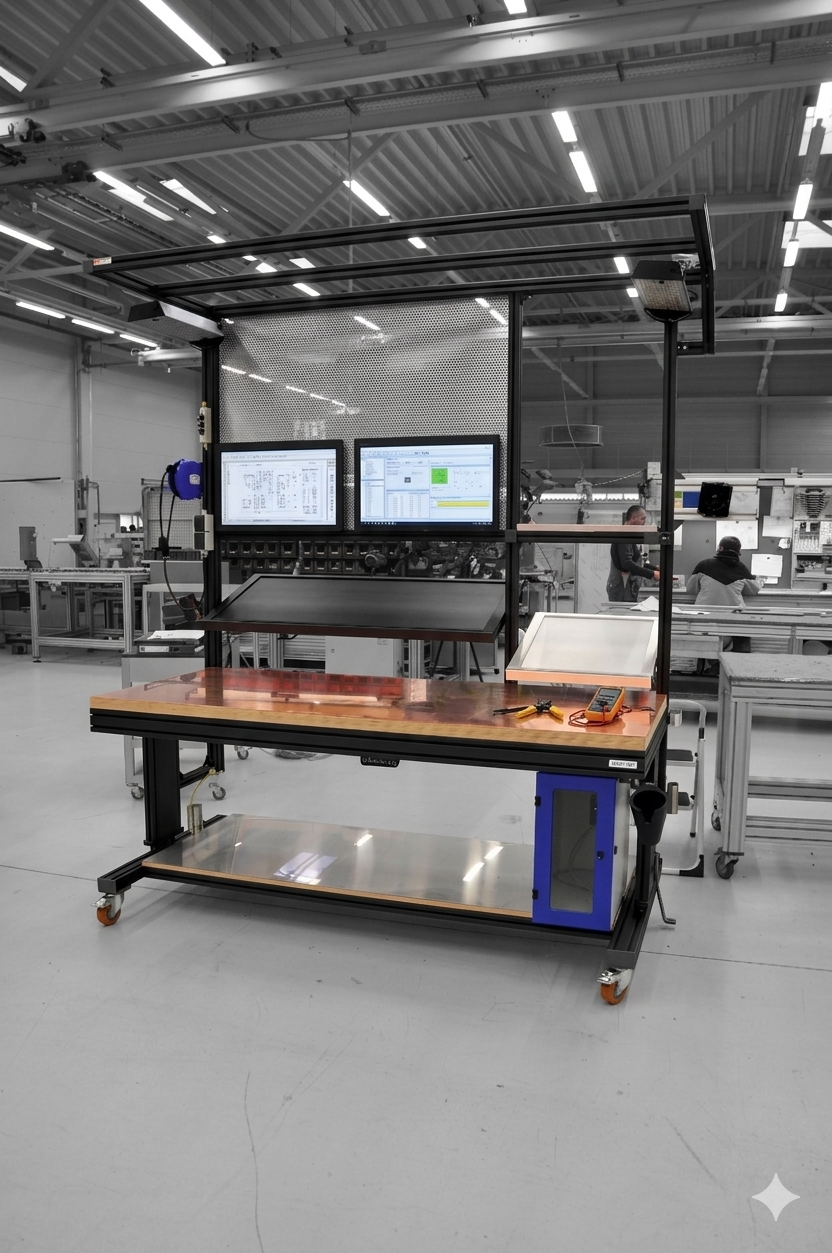
Why Choose Modular Solutions for Test & Calibration Workstations?
Engineered to organize your test instruments, eliminate cable chaos, and provide clean power for sensitive measurement equipment.
Modular aluminum T-slot workstations bolt together without welding and reconfigure without tools — giving you a purpose-engineered station today that adapts through every process change, product launch, and kaizen event without capital reinvestment in new furniture.
Instrument Rack Integration
Built-in 19-inch equipment rack sections, instrument shelf tiers, and panel mount provisions for oscilloscopes, power supplies, signal generators, and data acquisition systems.
Structured Cable Management
T-slot cable trays, vertical cable drops, and numbered tie-down points route power, signal, and ground cables separately — reducing EMI interference and simplifying troubleshooting.
EMI-Controlled Design
Grounded aluminum work surfaces and frame with bonding provisions for EMI-sensitive test environments and RF measurement setups.
Vibration-Isolated Measurement
Leveling mounts and anti-vibration provisions for calibration standards and precision measurement instruments.
Ergonomic Instrument Access
Monitor arms, keyboard trays, and adjustable viewing positions for multi-screen test setups with operators in seated or standing positions.
Safe Power Distribution
In-frame power distribution with separately fused outlets, GFCI protection, and clean power provisions for sensitive test equipment.
Test and Calibration Applications
Configured for electrical test, functional verification, and precision calibration across manufacturing and laboratory environments.
- End-of-Line Functional Test - Production test stations for electrical and functional verification of assembled products with structured instrument and cable management.
- Instrument Calibration Benches - ISO 17025-compliant calibration benches for gauges, sensors, and test instruments with anti-vibration surfaces and calibration documentation systems.
- Circuit Board Test and Programming - PCB functional test and in-circuit programming stations with DUT fixtures, structured cable management, and ESD-safe surfaces.
- RF and EMC Measurement - EMI-controlled test workstations for RF measurement and EMC pre-compliance testing with grounded frames and isolated cable routing.
- Environmental Test Staging - Staging and preparation stations for vibration, temperature, and humidity test chambers with adjacent instrument access.
- Automated Test Equipment (ATE) Integration - Workstations designed around specific ATE platforms with rack integration, harness management, and DUT fixture mounting.
Specifications & Configurations
Test and calibration workstation specifications — all instrument integration and cable management options custom to your test setup.
| Specification | Detail |
|---|---|
| Frame | 45/90 Series aluminum with grounded bonding provisions and EMI considerations |
| Instrument Integration | 19" rack sections, adjustable shelf rails, panel mounts for front-panel access |
| Cable Management | Internal T-slot cable trays, numbered drop points, separate signal and power routes |
| Power Distribution | In-frame fused outlets (8–12 positions), main breaker, GFCI, UPS provisions |
| Vibration | Anti-vibration leveling mounts for calibration instruments and precision equipment |
| Lead Time | 3–5 weeks from approved drawings |
Frequently Asked Questions
Common questions about test workstation instrument integration, cable management, and power distribution.
How are test instruments organized at test workstations?
Test instruments mount in 19-inch rack sections built into the workstation frame, on dedicated instrument shelves at ergonomic viewing heights, or on adjustable tilt-mount panels for front-panel control access. Power supplies, oscilloscopes, signal generators, and data acquisition systems each have assigned locations connected through structured cable management routes.
How is cable management handled in test and calibration workstations?
Signal cables, power cables, and ground cables are routed separately through dedicated T-slot cable channels. Vertical drops from upper instrument shelves to the DUT position are managed with numbered cable ties and strain relief anchors. All cable routes are documented in the workstation engineering drawing.
Can test workstations support EMC or RF measurement setups?
Aluminum frame workstations with grounded bonding straps provide a reference ground plane for RF measurement setups. Cable management separates signal and power to reduce EMI coupling. Shielded cable drop enclosures are available for sensitive RF measurement setups requiring additional isolation.
What power distribution is standard for test workstations?
Standard test workstations include in-frame power distribution with 8 to 12 separately fused duplex outlets (120V or 240V), a main circuit breaker, and GFCI protection. UPS provisions (battery backup socket and communication port) are included. Clean power conditioning for sensitive analog measurement equipment is available as an option.
How are test workstations designed for different DUT sizes?
Work surface height and clearance are engineered for your largest DUT dimensions. Adjustable-height platforms and T-slot-mounted raised surfaces accommodate different product heights without operator bending. Fixture rails with T-slot mounting accept product-specific nests and fixtures for repeatable DUT positioning at the test interface.
Design Your Test Workstation
Send us your instrument list, DUT dimensions, and test sequence — we'll engineer a station that organizes your test setup and eliminates cable chaos.