Technical Office Workstations
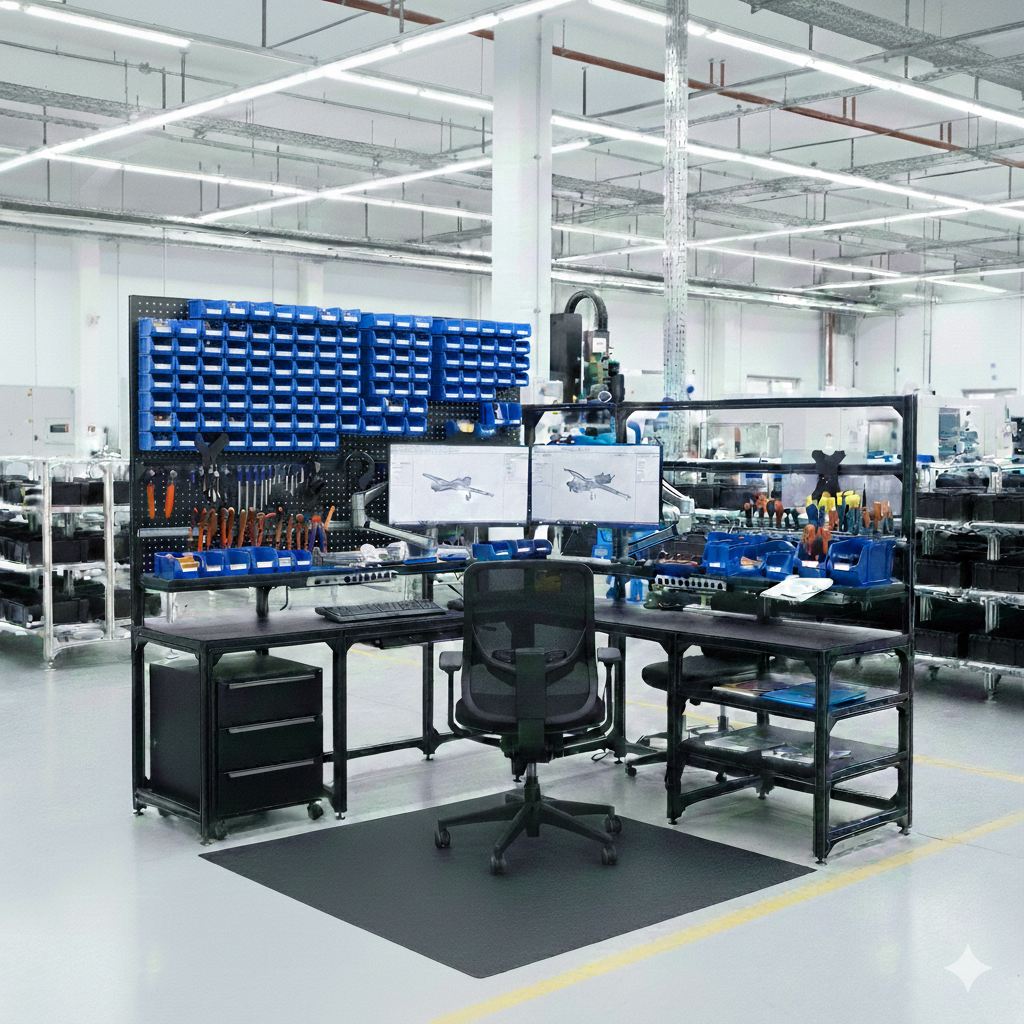
Purpose-built modular aluminum workstations for technical staff — engineers, programmers, analysts, and design teams. Integrated monitor arm rails, in-frame clean power, structured cable management, and vertical storage keep every tool at hand and every cable hidden.
Why Choose Technical Office Workstations?
Technical office workstations go beyond a desk. They integrate power, data, monitor mounting, and peripheral storage into a single structured system — eliminating the clutter that degrades technical worker focus and productivity.
Modular aluminum T-slot office furniture assembles without welding and reconfigures without tools — giving you a purpose-built workspace today that adapts through every headcount change, technology upgrade, and office reorganization without capital reinvestment in new furniture.
Multi-Monitor Rail System
Overhead horizontal rails accept monitor arms at any position — supporting up to 6 monitors per workstation on a single beam.
In-Frame Clean Power
Integrated power strips, USB-C charging, and dedicated circuit options deliver clean, managed power to every device.
Structured Cable Management
Vertical spine channels and horizontal raceways route power and data cables invisibly from source to device.
Accessory Integration
CPU towers, KVM switches, docking stations, UPS units, and speakers mount inside the frame structure, off the work surface.
Surface Area Maximized
Overhead storage and underbench pedestal drawers free the work surface for active work — not storage.
Ergonomic Compliance
BIFMA-tested frame, height-adjustable surface options, and monitor position flexibility support OSHA ergonomic guidelines.
Applications
Technical office workstations are deployed for high-intensity knowledge work across engineering, IT, and analytics environments.
- CAD and engineering design workstations
- Software development and programming stations
- Network operations center (NOC) consoles
- Data analytics and GIS workstations
- Security operations center (SOC) stations
- Trading floor multi-monitor desks
- Video and audio production workstations
- Technical support and help desk stations
Specifications
Configuration options for technical office workstations.
| Parameter | Detail |
|---|---|
| Frame Material | Anodized aluminum T-slot extrusion, natural or black anodize |
| Monitor Capacity | 2–6 monitors on overhead rail (arm dependent) |
| Power Integration | 8–12 outlet power strips, USB-C PD, 20A dedicated circuit option |
| Surface Material | HPL standard; ESD-safe laminate for sensitive electronics work |
| Standard Widths | 60", 72", 84", 96" — custom widths available |
| Overhead Bridge | Accessory rail at 18"–24" above surface on adjustable uprights |
| Underbench Storage | Pedestal drawers, CPU tower cradles, and shelf modules |
| Lead Time | 3–5 weeks from approved drawings |
Frequently Asked Questions
Common questions about technical office workstation design, power, and multi-monitor integration.
How many monitors can a technical office workstation support?
The overhead accessory rail system supports up to 6 monitors using individual monitor arm mounts spaced along the rail. Arms are adjustable for tilt, swivel, and height. For 4+ monitor configurations, a dual-tier overhead rail layout positions secondary monitors above primary monitors at a different viewing distance.
What power options are available for technical workstations?
Standard configurations include an 8-outlet, 15A power strip in the in-frame cable channel. Upgrades include 12-outlet 20A strips, USB-C PD (60W or 100W) charging at the work surface, dedicated 20A circuit drops, and UPS battery backup mounting inside the frame structure.
How is cable management handled for multi-monitor setups?
Power cables, video cables (DisplayPort, HDMI, USB), and network cables are routed inside vertical spine channels within the frame uprights. At the work surface, cables exit through surface-level grommets. All channels are accessible without disassembly for adds, moves, and changes.
Can technical workstations be networked or daisy-chained?
Yes. Benching configurations connect adjacent workstation frames with shared uprights, reducing floor space and material cost. Networked cable management runs as a continuous raceway across the benching run. Power is distributed from a single feed with individual strip outlets at each workstation position.
Are technical office workstations compatible with sit-stand lift mechanisms?
Yes. Electric dual-motor lift columns integrate into the same T-slot frame as fixed-height configurations. The overhead accessory rail and cable management system are engineered to travel with the surface through the full height range without binding or tangling.
Ready to Configure Your Technical Office Workstations?
Contact our workspace specialists for a no-obligation quote. We design, engineer, and manufacture modular office furniture from our Auburn Hills, MI facility — typically shipping in 2–4 weeks from approved drawings.
Request a Quote