Calibration Tables
Modular aluminum calibration tables for ISO 17025 accredited calibration laboratories and in-house gauge calibration programs — with anti-vibration provisions, controlled-access reference standard storage with NIST-traceable documentation, environmental monitoring integration, and calibration record management systems. Every design decision supports measurement uncertainty reduction and traceability chain integrity. Manufactured in Auburn Hills, MI.
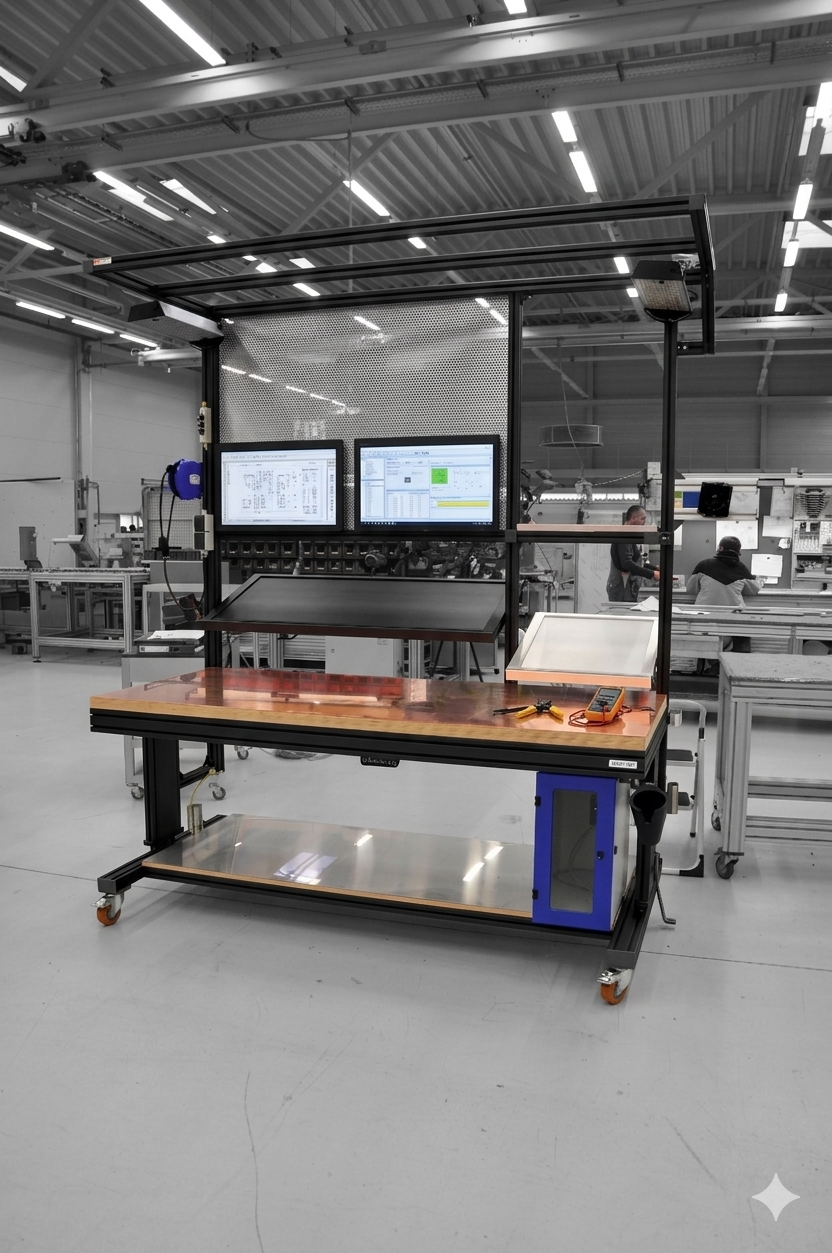
Why Choose Modular Solutions for Calibration Tables?
Calibration tables where every design feature reduces measurement uncertainty — vibration, temperature, reference storage, and documentation are all engineered in.
Modular aluminum T-slot benches bolt together without welding and reconfigure without tools — giving you a purpose-built technical station today that adapts through every process change, instrument upgrade, and compliance revision without capital reinvestment in new furniture.
Anti-Vibration Surface Isolation
Precision anti-vibration leveling mounts and pneumatic isolation table provisions reduce floor-transmitted vibration to sub-micron levels at the calibration surface — critical for mass, force, and dimensional calibration accuracy.
Reference Standard Storage
Locked, controlled-access drawers with foam inserts and NIST-traceable calibration certificate holders for primary and working reference standards — enforcing access control and traceability documentation at the point of use.
Environmental Monitoring Integration
Provisions for temperature and humidity data loggers at the calibration surface level — recording environmental conditions during calibration for measurement uncertainty calculation and ISO 17025 records.
Dimensional Reference Surfaces
Grade A granite surface plates (ASME B89.3.7) on vibration-isolated mounts for dimensional calibration with flatness certification and repeat measurement documentation.
Calibration Record Management
Document holders, monitor arm mounts for calibration software systems, and printer shelves for calibration certificates at the calibration position.
Cleanable and Low-Contamination Design
Sealed frame joints, stainless hardware, and smooth anodized frame minimize particle and contamination generation at precision calibration positions.
Calibration Tables Applications
Supporting ISO 17025 accredited calibration laboratories and in-house calibration programs across manufacturing and testing industries.
- Dimensional Calibration - Calibration tables for calipers, micrometers, gauges, and length standards with granite reference surfaces and anti-vibration mounts.
- Force and Torque Calibration - Anti-vibration tables for force transducer, torque wrench, and load cell calibration with reference standard storage and dead-weight provisions.
- Electrical and Electronic Calibration - Calibration benches for DMMs, oscilloscopes, power supplies, and signal sources with clean power provisions and reference standard access.
- Pressure and Temperature Calibration - Calibration tables for pressure gauges, thermocouples, RTDs, and process transmitters with utility connections and environmental monitoring.
- Mass and Balance Calibration - Ultra-vibration-isolated calibration tables for analytical balance, precision scale, and mass standard calibration in ISO-controlled laboratory environments.
- In-House Gauge Calibration Programs - In-house calibration tables for production gauge management programs maintaining traceability without outsourcing all calibration activities.
Specifications & Configurations
Standard configurations available — all surface, utility, and compliance options custom-engineered to your requirements.
| Specification | Detail |
|---|---|
| Vibration Isolation | Anti-vibration leveling mounts; pneumatic isolation table provisions for mass and dimensional calibration |
| Reference Storage | Locked foam-lined drawers with NIST certificate holders; access log provisions |
| Environmental Monitoring | Temperature/humidity data logger mounting provisions at calibration surface level |
| Reference Surface | Grade A granite (ASME B89.3.7) option; precision steel plate option |
| Compliance Support | ISO 17025, ISO 10012, ANSI/NCSL Z540 calibration program documentation |
| Lead Time | 3–5 weeks from approved drawings |
Frequently Asked Questions
Common questions about calibration tables design, compliance, and configuration.
What features are required for an ISO 17025 calibration table?
ISO 17025 calibration tables require anti-vibration provisions appropriate to the measurement uncertainty budget, controlled-access reference standard storage with calibration certificate records accessible at the point of use, environmental monitoring provisions for temperature and humidity logging during calibration, and documentation management for calibration records. Modular Solutions provides an ISO 17025 design checklist with each calibration table specification.
How is reference standard storage controlled on calibration tables?
Reference standards are stored in locked foam-lined drawers with NIST-traceable calibration certificate holders at each storage position. Calibration due date labels are mounted adjacent to each standard. Access control is enforced by the locking drawer mechanism. An access log provision (sign-in sheet holder or barcode reader mount) documents each standard removal for calibration activities — supporting ISO 17025 Clause 6.4 equipment requirements.
What anti-vibration provisions are appropriate for mass calibration?
Mass and analytical balance calibration requires the highest level of vibration isolation due to the sensitivity of precision balances to micro-vibration. Pneumatic isolation tables (natural frequency 1–2 Hz) are specified for analytical balance calibration, providing greater than 99% isolation above 10 Hz. Standard anti-vibration elastomeric mounts (natural frequency 5–15 Hz) are appropriate for dimensional and force calibration. The correct specification is determined from your balance resolution and measurement uncertainty requirement.
How does environmental monitoring support ISO 17025 measurement uncertainty?
ISO 17025 Clause 6.3 requires that facilities document environmental conditions that influence results. Temperature and humidity at the calibration surface affect all dimensional, mass, and electrical calibration values through thermal expansion, air density, and instrument temperature coefficients. Data loggers at the calibration surface record actual conditions during each calibration event — enabling environmental correction in the measurement uncertainty calculation and providing the ISO 17025-required environmental monitoring records.
Can calibration tables be configured for both dimensional and electrical calibration?
Yes. Calibration tables with separate dimensional and electrical calibration zones on the same frame use different surface sections (granite for dimensional, laminate or phenolic for electrical) with separate utility provisions (clean AC power and data drops for electrical; vibration-isolated reference surface for dimensional). Reference storage drawers are organized by calibration discipline. This dual-discipline configuration is common in in-house calibration labs serving both mechanical and electrical calibration needs.
Design Your Calibration Table
Send us your calibration scope, reference standard list, and ISO 17025 requirements — we'll engineer a table that supports your measurement uncertainty budget.