Electronics Test Benches
Modular aluminum electronics test benches for PCB debug, board bring-up, functional verification, and electronics failure analysis — ESD-safe static-dissipative surfaces, structured cable management separating signal and power, instrument rack integration, and GFCI-protected clean power distribution for electronics test environments. Manufactured in Auburn Hills, MI.
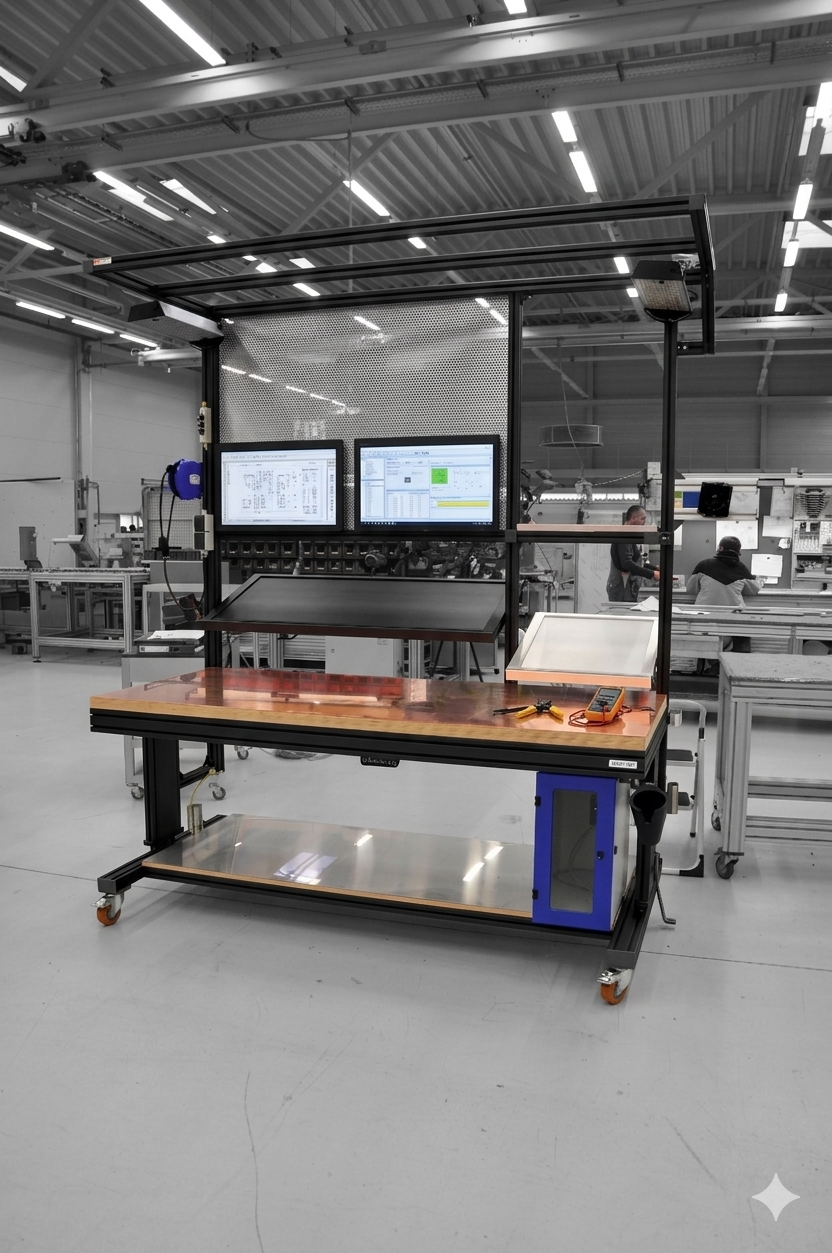
Why Choose Modular Solutions for Electronics Test Benches?
Electronics test benches engineered to organize your instruments, eliminate cable chaos, and protect sensitive electronics from ESD and power quality problems.
Modular aluminum T-slot benches bolt together without welding and reconfigure without tools — giving you a purpose-built technical station today that adapts through every process change, instrument upgrade, and compliance revision without capital reinvestment in new furniture.
ESD-Safe Work Surface
Static-dissipative laminate surfaces (10&sup6;–10&sup9; Ω) with common-point ground wrist strap connections and frame bonding — fully compliant with ANSI/ESD S20.20 for ESD-sensitive electronics handling.
Instrument Rack Integration
19-inch rack sections, adjustable instrument shelf tiers, and panel-mount provisions for oscilloscopes, power supplies, signal generators, DMMs, and data acquisition systems at ergonomic access height.
Structured Cable Management
Separate T-slot cable trays for power, signal, and ground cables — reducing EMI coupling, simplifying troubleshooting, and preventing cable damage from tangled test setups.
Clean Power Distribution
In-frame fused power distribution with GFCI protection, separate circuits for instruments and DUT power, and UPS provisions for sensitive analog and RF measurement equipment.
DUT Fixture Mounting
T-slot work surface rails with fixture mounting provisions for product-specific DUT nests, bed-of-nails fixtures, and test interface connectors at repeatable positions.
Monitor and Documentation
Dual monitor arm mounts with full cable management for test software, schematic display, and traceability systems at the engineer's or technician's work position.
Electronics Test Benches Applications
Configured for electronics engineering, production test, failure analysis, and ESD-controlled lab environments.
- PCB Debug and Bring-Up - Board bring-up benches for new hardware engineers with full instrument access, ESD protection, and cable management for simultaneous multi-instrument debug sessions.
- Production Functional Test - Production test benches for board-level functional verification with structured cable management, DUT fixture rails, and clean power for consistent test results.
- Electronics Failure Analysis - FA benches combining ESD-safe handling, controlled lighting, and full instrument access for root cause analysis of electronic component and PCB failures.
- RF and EMC Pre-Compliance - Grounded test benches with separate signal and power cable routing for RF measurement and EMC pre-compliance testing at the bench level.
- Prototype Development - Engineering prototype benches combining ESD-safe electronics assembly and test functions with rapid instrument reconfiguration for fast hardware development cycles.
- Repair and Refurbishment - ESD-safe repair benches for electronic equipment rework, component replacement, and functional reverification with full instrument and soldering tool integration.
Specifications & Configurations
Standard configurations available — all surface, utility, and compliance options custom-engineered to your requirements.
| Specification | Detail |
|---|---|
| ESD Surface | Static-dissipative laminate 10&sup6;–10&sup9; Ω per ANSI/ESD S4.1; grounding provisions |
| Instrument Integration | 19" rack sections; adjustable shelf rails; panel-mount provisions |
| Cable Management | Separate T-slot trays for power, signal, ground; numbered tie-down points |
| Power | In-frame fused distribution, GFCI, separate DUT and instrument circuits, UPS provisions |
| DUT Mounting | T-slot surface rails with fixture mounting for product-specific test interfaces |
| Lead Time | 2–4 weeks from approved drawings |
Frequently Asked Questions
Common questions about electronics test benches design, compliance, and configuration.
What ESD protection is built into electronics test benches?
Electronics test benches include static-dissipative laminate work surfaces (10&sup6;–10&sup9; ohms surface resistance per ANSI/ESD S4.1), common-point ground wrist strap connections at each operator position, ionizer provisions for non-conductor ESD control, and aluminum frame bonding to the facility ground system. Together these elements form an ANSI/ESD S20.20 compliant ESD Protected Area (EPA) at the test bench.
How is cable management structured on electronics test benches?
Three separate cable management systems run in parallel: power cables (AC and DC) route in the bottom cable tray, signal and measurement cables route in a center tray, and ground cables route at the highest position. Vertical drops from each tier are managed with numbered strain-relief anchors. This separation reduces EMI coupling between power and signal cables — a common source of measurement noise in test setups.
What power distribution is included in electronics test benches?
In-frame power distribution includes 8 to 12 separately fused duplex outlets (120V or 240V), a main circuit breaker, and GFCI protection. DUT power and instrument power are on separate circuits to prevent instrument supply disturbance during DUT switching events. UPS provisions include a bypass socket and battery communication port for uninterruptible power to sensitive analog measurement instruments.
How are test instruments organized on electronics test benches?
Instruments mount in 19-inch rack sections at ergonomic viewing and control height, on adjustable shelf rails at precise instrument-to-instrument spacing, or on panel-mount rails for front-panel control access. Power supply stacks, oscilloscopes, and signal generators each have assigned positions with cable routes documented in the bench drawing.
Can electronics test benches be used for RF measurement setups?
Yes. Electronics test benches with grounded aluminum frames and separate signal cable management provide the ground reference and signal isolation needed for RF measurement. Shielded cable enclosures and RF-absorptive cable trays are available for setups requiring additional isolation above 1 GHz. Frame bonding straps tie the bench ground to the facility ground system for a consistent RF reference.
Configure Your Electronics Test Bench
Send us your instrument list, DUT dimensions, and power requirements — we'll design a test bench that organizes your setup and eliminates cable chaos.