Engineering Prototyping Stations
Modular aluminum engineering prototyping stations for hardware product development — combining assembly, test, and debug functions in a single reconfigurable workstation with mixed work surfaces, in-frame power and data, organized tool storage, and the flexibility to change with every design iteration. From concept to pilot production, one station adapts through every phase. Designed and manufactured in Auburn Hills, MI.
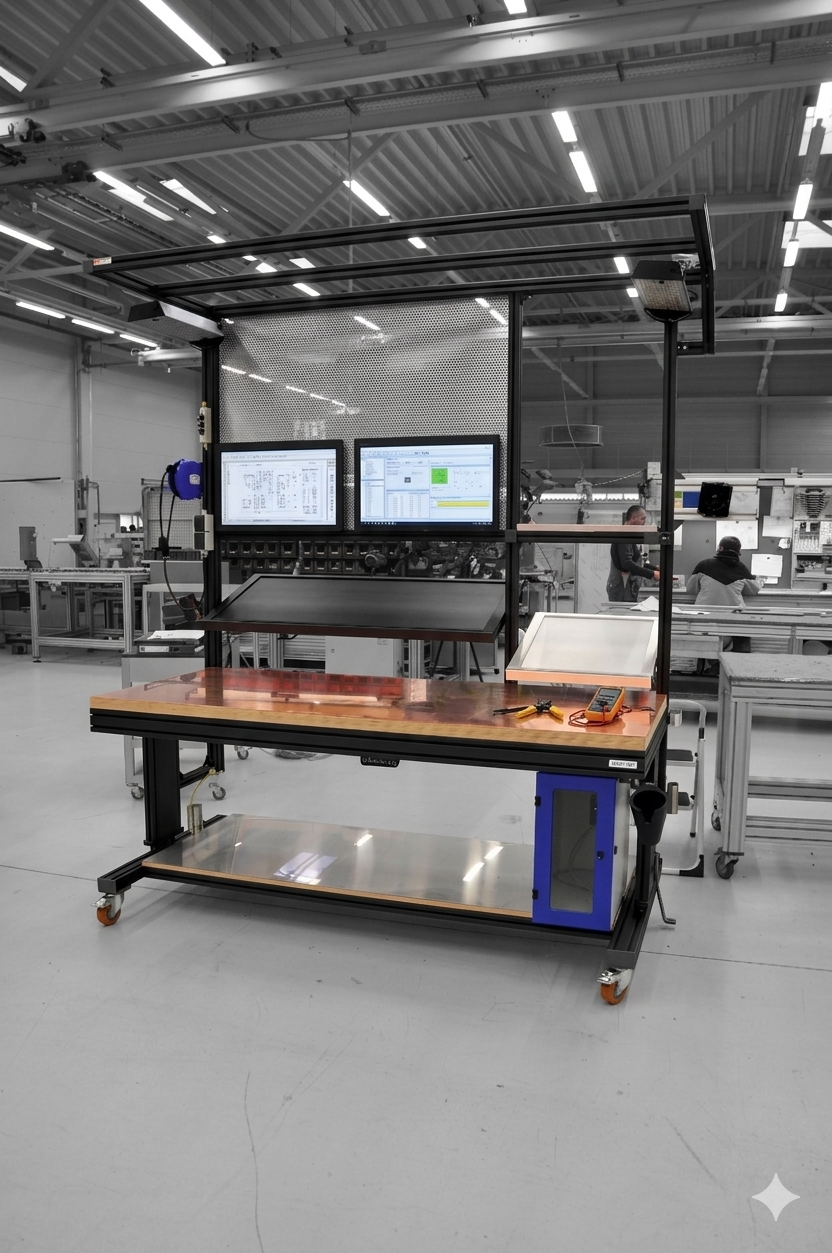
Why Choose Modular Solutions for Engineering Prototyping Stations?
Prototyping stations that evolve with the development program — not furniture that becomes a constraint halfway through design verification.
Modular aluminum T-slot benches bolt together without welding and reconfigure without tools — giving you a purpose-built technical station today that adapts through every process change, instrument upgrade, and compliance revision without capital reinvestment in new furniture.
Mixed Assembly and Test Surfaces
Combined mechanical assembly and electronics test surface sections in one bench — ESD-safe laminate for electronics adjacent to steel for mechanical assembly, without the inefficiency of separate stations.
In-Frame Power and Data
Factory power outlets, USB hubs, and data ports in-frame at the work surface level — no extension cords or power bricks on the bench surface during prototype debugging.
Rapid Iteration Configuration
T-slot frames reconfigure in hours — new instrument layout for a different test phase, additional surface for a larger prototype, or different utility positions for a new development stage.
Tool and Component Organization
Foam-insert drawers, pegboard tool boards, and labeled bin rails keep prototype tooling, test equipment, and development components organized through multi-revision development cycles.
Overhead Bridge for Instruments
Integrated overhead T-slot bridge positions oscilloscopes, monitors, power supplies, and cameras above the work surface — freeing the bench surface for prototype handling.
Documentation and Reference
Monitor arm mounts for design documentation, schematic display, and revision tracking at engineer's work position — reducing reference document paper on active build surfaces.
Engineering Prototyping Stations Applications
Built for the organized chaos of hardware development — from first prototype through design verification and pilot production.
- Embedded Systems Development - Combined electronics assembly and software debug benches for embedded hardware engineers with full instrument access, ESD protection, and structured cable management.
- Mechanical and Electromechanical Prototyping - Mixed-surface benches for prototype mechanical assembly, functional test, and design iteration across multiple hardware revisions.
- IoT and Connected Device Development - Benches combining electronics assembly, wireless test provisions, and software integration for IoT hardware development programs.
- Robotics and Automation Prototyping - Large-format prototyping benches for robotics sub-assembly, controller integration, and functional bring-up with provisions for larger prototype footprints.
- Hardware Design Verification (DVT) - Design verification benches organized for systematic DVT test protocols with instrument access, DUT mounting, and test documentation management.
- Pilot Production Staging - Prototyping stations that transition to pilot production assembly benches as programs advance from development to initial production runs.
Specifications & Configurations
Standard configurations available — all surface, utility, and compliance options custom-engineered to your requirements.
| Specification | Detail |
|---|---|
| Surface | Mixed ESD laminate and steel sections; additional surface types available per iteration |
| Power and Data | In-frame outlets, USB hubs, data ports — no bench-top power strips |
| Overhead Bridge | T-slot bridge for monitors, instruments, cameras above work surface (optional) |
| Tool Storage | Foam-insert drawers, pegboard boards, labeled bin rail systems |
| Reconfiguration | Full reconfiguration in 2–4 hours without tools or construction |
| Lead Time | 2–3 weeks standard; expedited for active development programs |
Frequently Asked Questions
Common questions about engineering prototyping stations design, compliance, and configuration.
How does an engineering prototyping station differ from a standard assembly bench?
A standard assembly bench is optimized for a stable, defined process. An engineering prototyping station is optimized for change — with mixed surface sections for different work types, reconfigurable instrument mounting, in-frame power and data that reposition with the bench layout, and overhead bridge provisions for instruments above the work surface. The design assumption is that the process will change with every hardware revision.
Can the same station be used for both mechanical assembly and electronics test?
Yes. Mixed-surface prototyping stations place an ESD-safe static-dissipative laminate section for electronics handling adjacent to a steel section for mechanical assembly and prototype fabrication. Separate work zone utilities provide ESD-grounded power outlets in the electronics zone and ungrounded heavy-duty outlets in the mechanical zone. A single bench serves both functions without process interference between zones.
How is an overhead bridge useful for prototyping?
The overhead T-slot bridge positions monitors, oscilloscopes, power supplies, cameras, and reference displays above the work surface — freeing the bench surface entirely for prototype handling. For complex hardware bring-up sessions with multiple instruments, this prevents the bench surface from becoming cluttered with instruments competing for space with the device under development.
Can prototyping stations transition to pilot production use?
Yes. As programs advance from development to pilot production, the prototyping station reconfigures from a mixed development station to a standardized pilot production bench — removing development instrument positions, adding production-specific fixtures and bin lanes, and standardizing the surface layout for repeatable assembly. The T-slot frame investment carries forward through the full product development lifecycle.
How are prototype components and tooling organized across multiple hardware revisions?
Foam-insert drawers with revision-labeled sections organize components by hardware revision. Pegboard tool boards with shadow board inserts keep prototype tooling in defined positions across all team members. Bin rail systems labeled by component type and revision maintain inventory at the bench. Documentation monitor arms display current BOM and assembly instructions at the bench position.
Build Your Prototyping Station
Tell us your development phase, prototype size, and instrument list — we'll design a station that supports your hardware program from first build to pilot.