ESD-Safe Workstations
ANSI/ESD S20.20 compliant modular aluminum ESD-safe workstations for electronics manufacturing, PCB assembly, component handling, and repair operations — static-dissipative surfaces, common-point grounding systems, ionizer provisions, wrist strap monitoring options, and frame bonding meeting the full scope of ESD protective area requirements. Every workstation is an engineered ESD Protected Area, not just a bench with a mat. Manufactured in Auburn Hills, MI.
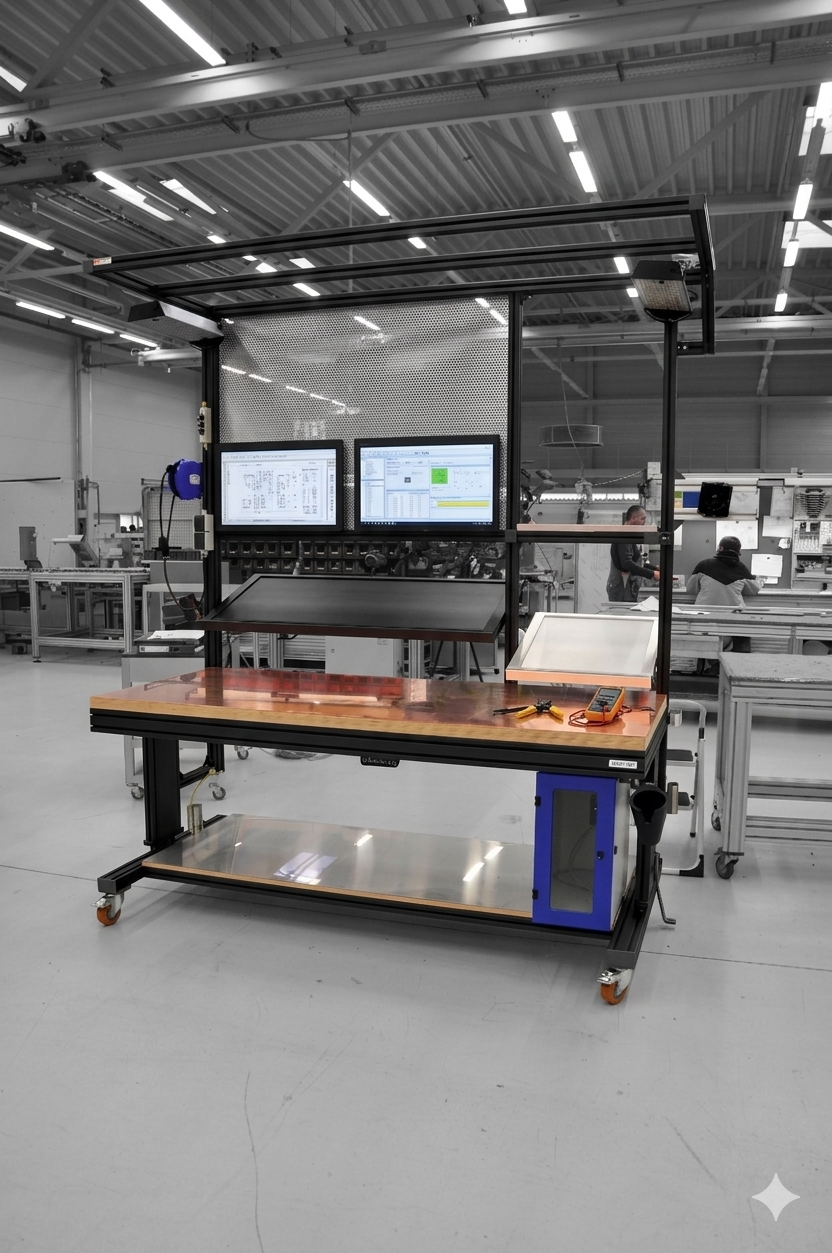
Why Choose Modular Solutions for ESD-Safe Workstations?
Full ANSI/ESD S20.20 ESD Protected Area compliance engineered in from the design stage — not a mat added to a standard bench.
Modular aluminum T-slot benches bolt together without welding and reconfigure without tools — giving you a purpose-built technical station today that adapts through every process change, instrument upgrade, and compliance revision without capital reinvestment in new furniture.
Static-Dissipative Work Surfaces
ESD-safe laminate with 10&sup6;–10&sup9; Ω surface resistance per ANSI/ESD S4.1 — measured and certified at the factory. Dissipative surfaces provide controlled charge decay without the latent damage risk of conductive surfaces.
Common-Point Ground System
Common-point ground connections for wrist straps at each operator position, chassis bonding lugs throughout the frame, and a single-point facility ground connection — the complete common-point ground architecture per ANSI/ESD S6.1.
Ionizer Provisions
Overhead and bench-level ionizer mounting rails with power and ground provisions — essential for neutralizing charges on non-conductor items (PCB substrates, plastic packaging, tape) that cannot be grounded by contact.
Wrist Strap Monitoring
Continuous wrist strap monitor provisions with alarm outputs, compliance logging, and operator status display at the workstation — enforcing wrist strap use without relying on operator discipline alone.
Conductive Caster Option
ESD-compliant conductive casters for mobile ESD workstations — maintaining the continuous ground path through the caster stem and floor when the bench moves on ESD flooring.
ESD Compliance Documentation
Surface resistance test certificates, wiring diagrams for the common-point ground system, and ANSI/ESD S20.20 design compliance summary provided with each workstation.
ESD-Safe Workstations Applications
Supporting ANSI/ESD S20.20 ESD Protected Areas across electronics manufacturing, repair, calibration, and regulated production environments.
- PCB Assembly and SMT Rework - ESD-safe assembly benches for circuit board population, surface mount rework, and through-hole soldering — full ANSI/ESD S20.20 EPA at every operator position.
- Component Handling and Kitting - ESD-safe component handling benches for ESDS device kitting, tape-and-reel processing, and tray transfers with ionizer provisions for non-conductor surfaces.
- Electronics Inspection and Test - ESD-safe inspection and functional test benches for ESDS assemblies with controlled handling environments through the full production flow.
- Electronics Repair and Depot - Depot repair benches for consumer, commercial, and military electronics with full ESD control and documentation for regulated repair programs.
- Medical Device Electronics - ESD-safe electronics assembly for FDA-regulated medical device manufacturing with IEC 61340-5-1 and ANSI/ESD S20.20 compliance documentation.
- Defense and Aerospace Electronics - ESD and FOD-controlled electronics workstations for MIL-HDBK-263B and AS9100-regulated defense and aerospace production environments.
Specifications & Configurations
Standard configurations available — all surface, utility, and compliance options custom-engineered to your requirements.
| Specification | Detail |
|---|---|
| ESD Surface | Static-dissipative laminate; 10&sup6;–10&sup9; Ω surface resistance per ANSI/ESD S4.1; factory-certified |
| Grounding | Common-point wrist strap connections; frame bonding lugs; single-point facility ground |
| Ionizer Provisions | Overhead and bench-level mount rails with power and ground for any ionizer brand |
| Wrist Strap Monitoring | Continuous monitor provisions with alarm output and compliance logging capability |
| Mobile Option | ESD-compliant conductive casters for ESD flooring environments |
| Lead Time | 2–4 weeks from approved drawings; ESD compliance documentation included |
Frequently Asked Questions
Common questions about esd-safe workstations design, compliance, and configuration.
What is the difference between a conductive and a static-dissipative ESD work surface?
A conductive surface (surface resistance <10&sup5; Ω) discharges charge instantly — fast enough to damage sensitive components through a sudden ESD event. A static-dissipative surface (10&sup6;–10&sup9; Ω) discharges charge in 1 to 10 milliseconds — fast enough to prevent tribocharging buildup but slow enough to avoid the rapid energy discharge that causes latent or hard ESD damage. ANSI/ESD S20.20 specifies static-dissipative surfaces for ESD workstations, not conductive.
What is a common-point ground and why is it required?
A common-point ground (CPG) connects all conductive and dissipative elements in the ESD Protected Area — work surface, wrist strap, ionizer chassis, and equipment chassis — to a single facility ground point. This ensures all elements are at the same electrical potential, eliminating voltage differences between items that could cause ESD events when they contact each other. ANSI/ESD S6.1 requires common-point grounding for all ESD protective areas.
Why are ionizers necessary if the work surface is already ESD-safe?
ESD-safe work surfaces and wrist straps control charge on conductive and dissipative items through ground contact. Non-conductors — PCB base materials, plastic bags, tape, packaging — cannot be grounded by contact and retain triboelectric charge indefinitely. Ionizers neutralize these non-conductor charges by flooding the area with balanced positive and negative ions. Without ionization, non-conductor items in the EPA are uncontrolled charge sources.
How does continuous wrist strap monitoring improve ESD compliance?
Periodic (start-of-shift) wrist strap testing catches failed straps but does not detect failures that occur during the shift. Continuous monitoring detects wrist strap failures — broken ground cord, loose fit, degraded wrist band resistance — immediately and alerts the operator and supervisor. For ANSI/ESD S20.20 compliance programs, continuous monitoring provides documented compliance evidence and removes reliance on operator discipline for ESD protection enforcement.
Can ESD-safe workstations be used in cleanroom environments?
Yes. Cleanroom ESD-safe workstations combine ISO 14644-1 cleanroom material requirements (non-outgassing, particle-free, sealed joints) with ANSI/ESD S20.20 ESD control requirements (static-dissipative surfaces, common-point grounding, ionizers). The two sets of requirements are compatible — ESD-safe laminate surfaces meet cleanroom outgassing requirements, and the aluminum frame with sealed joints meets cleanroom cleanliness standards. These are the standard configuration for Class 6/7 electronics cleanrooms.
Design Your ESD-Safe Workstation
Send us your ESD requirements, IPC standard, and production environment — we'll design a fully ANSI/ESD S20.20 compliant workstation with documentation.