Instrumentation Tables
Modular aluminum instrumentation tables for precision measurement instruments, sensor systems, data acquisition hardware, and process instrumentation — engineered with anti-vibration provisions, structured signal and power cable management, clean power distribution, and organized instrument access for sensitive measurement system environments. Manufactured in Auburn Hills, MI.
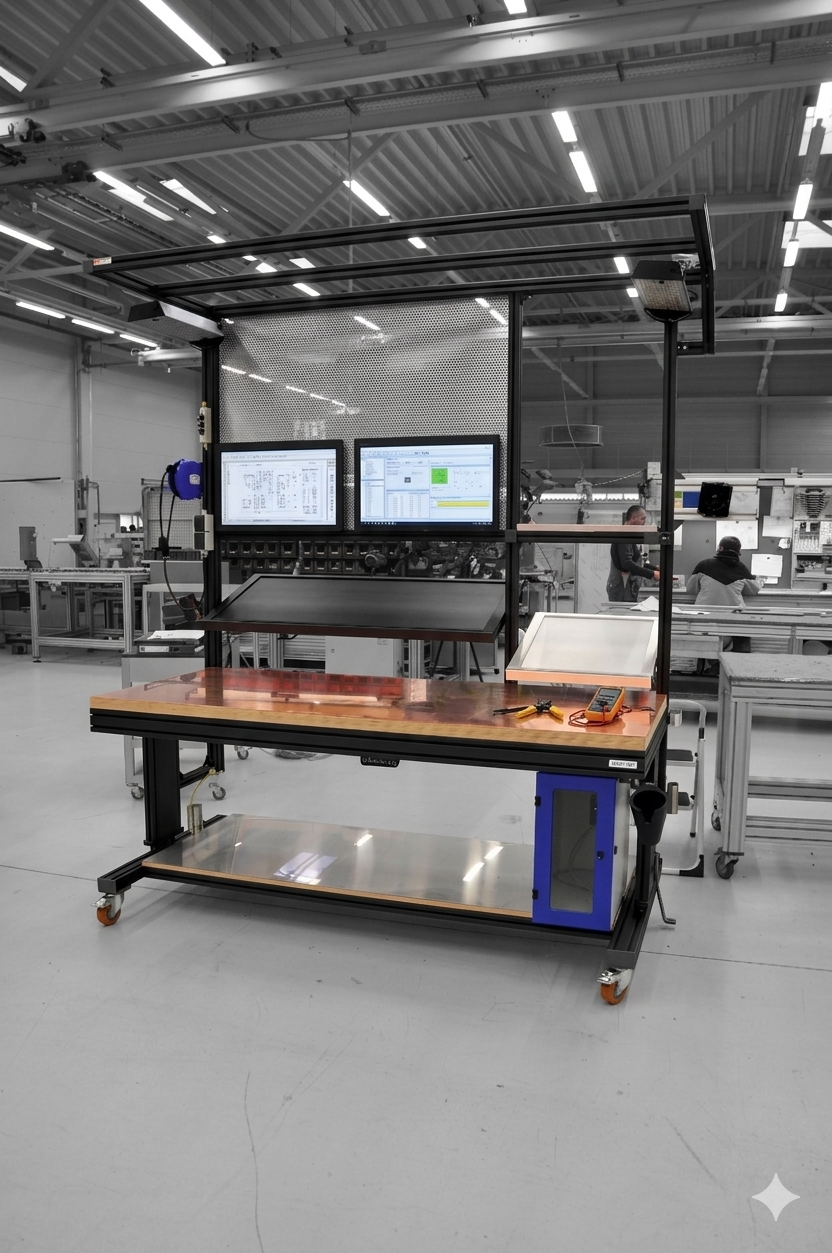
Why Choose Modular Solutions for Instrumentation Tables?
Instrumentation tables that protect your measurement signals from vibration, EMI, and power quality — the physical environment of the instrument is part of the measurement system.
Modular aluminum T-slot benches bolt together without welding and reconfigure without tools — giving you a purpose-built technical station today that adapts through every process change, instrument upgrade, and compliance revision without capital reinvestment in new furniture.
Anti-Vibration Provisions
Adjustable leveling feet with anti-vibration elastomeric pads isolate instrument tables from floor-transmitted vibration — reducing baseline noise in vibration-sensitive sensors, accelerometers, and precision force transducers.
Structured Signal Cable Management
Dedicated signal cable trays separated from AC power routes — reducing capacitive and inductive coupling between power cables and sensitive analog signal cables for lower measurement noise floors.
Clean Power Distribution
Isolated transformer provisions and line conditioning options for sensitive analog instrumentation requiring low-noise, low-impedance power supply references.
Instrument Rack Integration
19-inch equipment rack sections, adjustable instrument shelf tiers, and DIN rail mounting provisions for rack-mount instruments, signal conditioners, and data acquisition modules.
Sensor and Transducer Mounting
T-slot top plate provisions for direct sensor mounting, calibration fixture integration, and transducer positioning fixtures at defined reference positions on the table.
Grounding and Shielding
Single-point ground busbar provisions, chassis bonding lugs, and shielded cable enclosure options for instrumentation requiring controlled ground reference impedance.
Instrumentation Tables Applications
Configured for precision measurement, process instrumentation, sensor calibration, and data acquisition system integration.
- Data Acquisition System Setups - Tables organizing multi-channel DAQ systems, signal conditioners, amplifiers, and associated instrumentation for structural test, environmental monitoring, and process measurement programs.
- Sensor Calibration Benches - Calibration tables for force, pressure, temperature, displacement, and acceleration sensors with reference standard mounting and traceability documentation provisions.
- Process Instrumentation Integration - Benches for loop controller setup, transmitter calibration, valve positioner configuration, and field instrument programming in process industries.
- Structural Test Instrumentation - Test setup tables for structural analysis instrumentation including strain gauge systems, load cells, and modal analysis hardware.
- Vibration and Acoustic Test Setup - Anti-vibration tables for accelerometer calibration, vibration reference measurements, and acoustic emission sensor setup requiring stable, low-noise baselines.
- Medical Instrument Calibration - Cleanable instrumentation tables for medical device sensor calibration and measurement system verification in ISO 13485 regulated environments.
Specifications & Configurations
Standard configurations available — all surface, utility, and compliance options custom-engineered to your requirements.
| Specification | Detail |
|---|---|
| Frame | 45 or 90 Series T-slot aluminum; anti-vibration leveling mounts standard |
| Signal Cable Management | Dedicated T-slot signal cable trays; separated from AC power routes |
| Power | In-frame distribution with GFCI; line conditioning provisions for sensitive instrumentation |
| Instrument Integration | 19" rack sections; DIN rail provisions; T-slot sensor mount rails |
| Grounding | Single-point ground busbar; chassis bonding lugs throughout |
| Lead Time | 3–5 weeks from approved drawings |
Frequently Asked Questions
Common questions about instrumentation tables design, compliance, and configuration.
How does vibration isolation affect instrumentation accuracy?
Precision force transducers, accelerometers, and displacement sensors are affected by vibration at the measurement surface. A 10-micron vibration amplitude at the table surface appears as a noise signal indistinguishable from the measured quantity in high-resolution systems. Anti-vibration mounts reduce floor-transmitted vibration by 80–95% at frequencies above the mount resonance (typically 5–15 Hz), reducing the noise floor in affected measurement systems.
Why should signal and power cables be separated on instrumentation tables?
AC power cables carry 50/60 Hz current that induces voltage in adjacent signal cables through capacitive and inductive coupling. In high-impedance or low-level signal circuits (mV range), this induced voltage appears as noise or hum in the measurement. Separation of signal and power cable routes reduces coupling by increasing the physical distance and removing the parallel run length between the cables.
What grounding provisions are standard on instrumentation tables?
Instrumentation tables include a copper ground busbar attached to the aluminum frame at one end — the single-point ground reference for all instruments on the table. Chassis bonding lugs on each frame section tie all frame members to the busbar. Individual instrument chassis ground to the busbar through star-topology connections — preventing ground loop currents that cause low-frequency noise in sensitive DC measurement systems.
Can instrumentation tables support DIN rail mounted signal conditioners?
Yes. DIN rail mounting brackets attach to T-slot extrusion at any position in the frame, supporting 35mm DIN rail sections for signal conditioners, I/O modules, terminal blocks, and relay bases. DIN rail sections can be positioned vertically in the frame interior or horizontally on shelves depending on the access and wiring requirements of the specific instrument modules.
Are instrumentation tables available in mobile configurations?
Yes. Mobile instrumentation tables on 4-inch locking casters deliver instrument setups to the measurement location — test cells, pilot plants, or field measurement positions. Anti-vibration pads are mounted under the caster bases for vibration isolation when stationary. A power cord reel with GFCI outlet provides instrumentation power at any facility location.
Configure Your Instrumentation Table
Send us your instrument list, measurement frequencies, and signal types — we'll design a table that supports the measurement system, not just the instruments.