Metrology Stations
Precision modular aluminum metrology stations for dimensional measurement, coordinate measuring machine (CMM) staging, and instrument calibration — engineered with vibration-isolated granite reference surfaces, temperature-controlled staging provisions, and clean instrument storage for ASME B89 and ISO 10012 measurement system compliance. Designed and manufactured in Auburn Hills, MI.
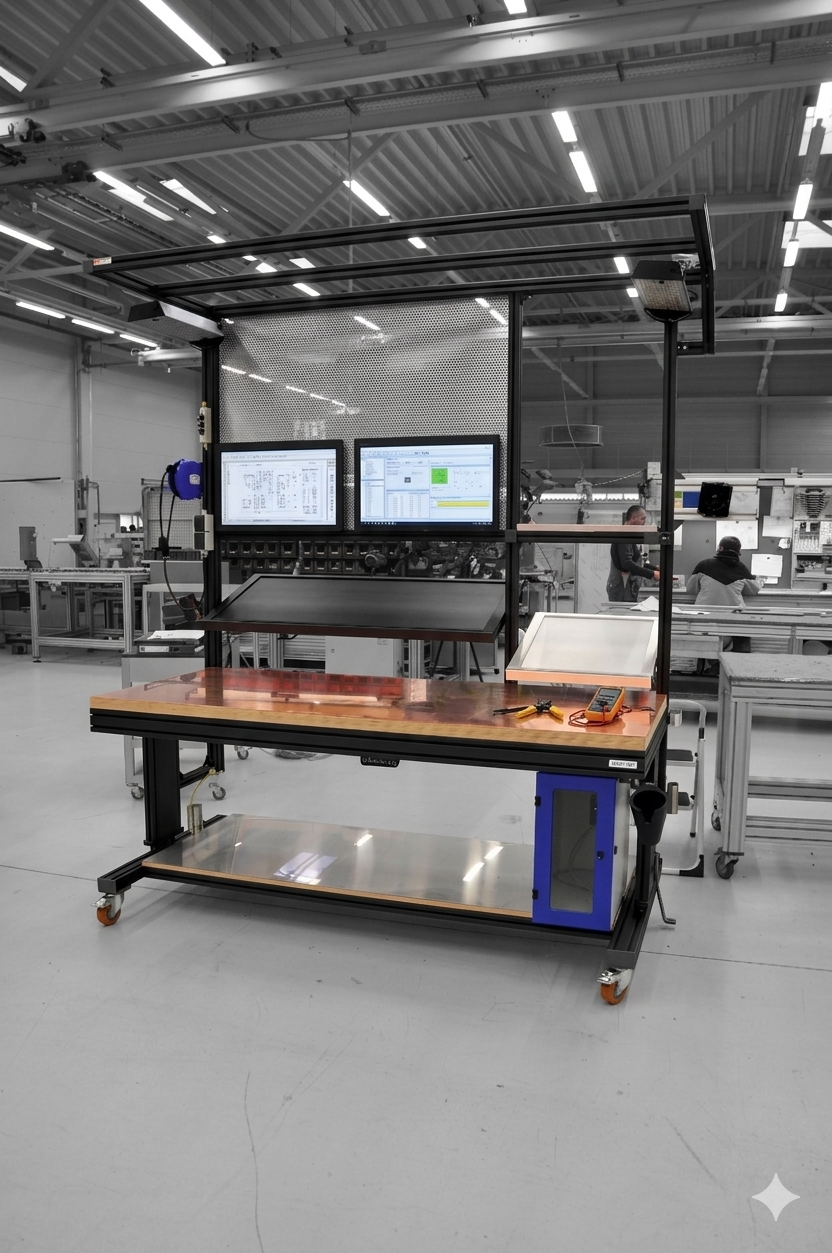
Why Choose Modular Solutions for Metrology Stations?
Every dimension of a metrology station is a measurement decision — vibration, temperature, surface, and instrument access all affect measurement uncertainty.
Modular aluminum T-slot benches bolt together without welding and reconfigure without tools — giving you a purpose-built technical station today that adapts through every process change, instrument upgrade, and compliance revision without capital reinvestment in new furniture.
Vibration-Isolated Reference Surfaces
Grade A/B granite surface plates (ASME B89.3.7) on anti-vibration isolation mounts — reducing floor vibration transmission to the measurement surface for sub-micron dimensional work.
Temperature Stabilization Provisions
Staging areas for part temperature stabilization adjacent to the measurement surface — allowing parts to reach 20°C equilibrium before measurement per ASME B89.6.2 requirements.
Precision Instrument Storage
Foam-lined drawers with calibration tag holders for calipers, micrometers, height gauges, and surface plates — protecting precision instruments and maintaining calibration status at the storage location.
CMM Staging Integration
Pre- and post-CMM staging surfaces height-matched to CMM table elevation with part handling provisions and vibration damping between the CMM and staging surfaces.
Clean Room Compatible Options
Smooth anodized frames, stainless hardware, and ESD-safe or anti-static surface options for metrology stations in ISO-classified measurement rooms.
Documentation and Traceability
NIST-traceable calibration record holders, measurement procedure documentation rails, and data entry provisions for complete measurement traceability chain management.
Metrology Stations Applications
Supporting ASME B89, ISO 10012, ISO 17025, and VDA measurement system requirements across manufacturing metrology labs.
- CMM Staging and Pre-Conditioning - Part staging and temperature stabilization adjacent to coordinate measuring machines with height-matched surfaces and anti-vibration provisions.
- Dimensional Inspection Benches - Manual dimensional inspection stations for calipers, micrometers, height gauges, and optical comparators with granite reference surfaces.
- Gauge Calibration Stations - Calibration benches for workshop gauges, plug gauges, ring gauges, and thread gauges with reference standards and traceability documentation.
- Surface Plate Workstations - Dedicated surface plate workstations for surface roughness measurement, flatness verification, and angular measurement with premium anti-vibration mounting.
- Optical Measurement Staging - Staging and setup benches adjacent to optical CMMs, vision systems, and laser scanners with clean, vibration-free part handling surfaces.
- ISO 17025 Calibration Labs - Accredited calibration laboratory benches with full traceability documentation, anti-vibration provisions, and temperature-stabilized measurement environments.
Specifications & Configurations
Standard configurations available — all surface, utility, and compliance options custom-engineered to your requirements.
| Specification | Detail |
|---|---|
| Reference Surface | Grade A/B granite (ASME B89.3.7); precision-ground steel plate option |
| Vibration Isolation | Anti-vibration leveling mounts; pneumatic isolation table provisions for ultra-precision |
| Temperature | Part staging area provisions for 20°C equilibration per ASME B89.6.2 |
| Instrument Storage | Foam-lined, lockable drawers with calibration tag holders |
| Compliance Support | ASME B89, ISO 10012, ISO 17025, VDA 5 measurement system documentation |
| Lead Time | 3–5 weeks from approved drawings |
Frequently Asked Questions
Common questions about metrology stations design, compliance, and configuration.
What granite grade is correct for a metrology station surface plate?
ASME B89.3.7 defines three grades for granite surface plates. Grade A (laboratory grade, flatness tolerance 0.000050" per foot diagonal) is specified for calibration laboratory reference surfaces. Grade B (inspection grade, 0.000100" per foot) suits production inspection. Grade AA (master grade) is for primary reference standards and national measurement institutes. Modular Solutions specifies Grade A or B based on your measurement uncertainty requirements.
Why is vibration isolation important for metrology stations?
Vibration from HVAC systems, foot traffic, adjacent machinery, and building structure reaches the measurement surface through the floor and bench structure. At measurement resolutions of 0.001mm and finer, vibration amplitudes in the 1–10 micron range introduce measurement errors that exceed the tolerance being measured. Anti-vibration mounts isolate the measurement surface from floor-transmitted vibration, reducing this error source to an acceptable level.
What is temperature stabilization in the context of dimensional measurement?
All materials expand and contract with temperature at defined coefficients of thermal expansion (CTE). ASME B89.6.2 specifies 20°C (68°F) as the standard reference temperature for dimensional measurement. A steel part at 25°C is measurably longer than the same part at 20°C. Metrology stations include staging areas where parts reach thermal equilibrium at 20°C before measurement — eliminating thermal expansion as a measurement error source.
How are metrology stations configured for ISO 17025 accredited calibration labs?
ISO 17025 accredited calibration laboratory metrology stations include NIST-traceable calibration record displays for each reference standard, environmental monitoring provisions (temperature, humidity), controlled-access instrument storage, and documented measurement procedures at each position. The station layout is included in the quality management system documentation supporting scope of accreditation evidence.
Can metrology stations be positioned adjacent to CMM equipment?
Yes. Metrology stations are designed to height-match CMM table elevation for direct part transfer from staging surface to CMM table without lifting. Anti-vibration provisions on the staging surface prevent handling impacts from transmitting to the CMM. Temperature stabilization staging adjacent to the CMM allows parts to equilibrate before measurement without leaving the controlled measurement room environment.
Design Your Metrology Station
Send us your measurement uncertainty requirements, instrument list, and compliance standard — we'll engineer a station that minimizes every controllable measurement error source.