Kitting Work Carts
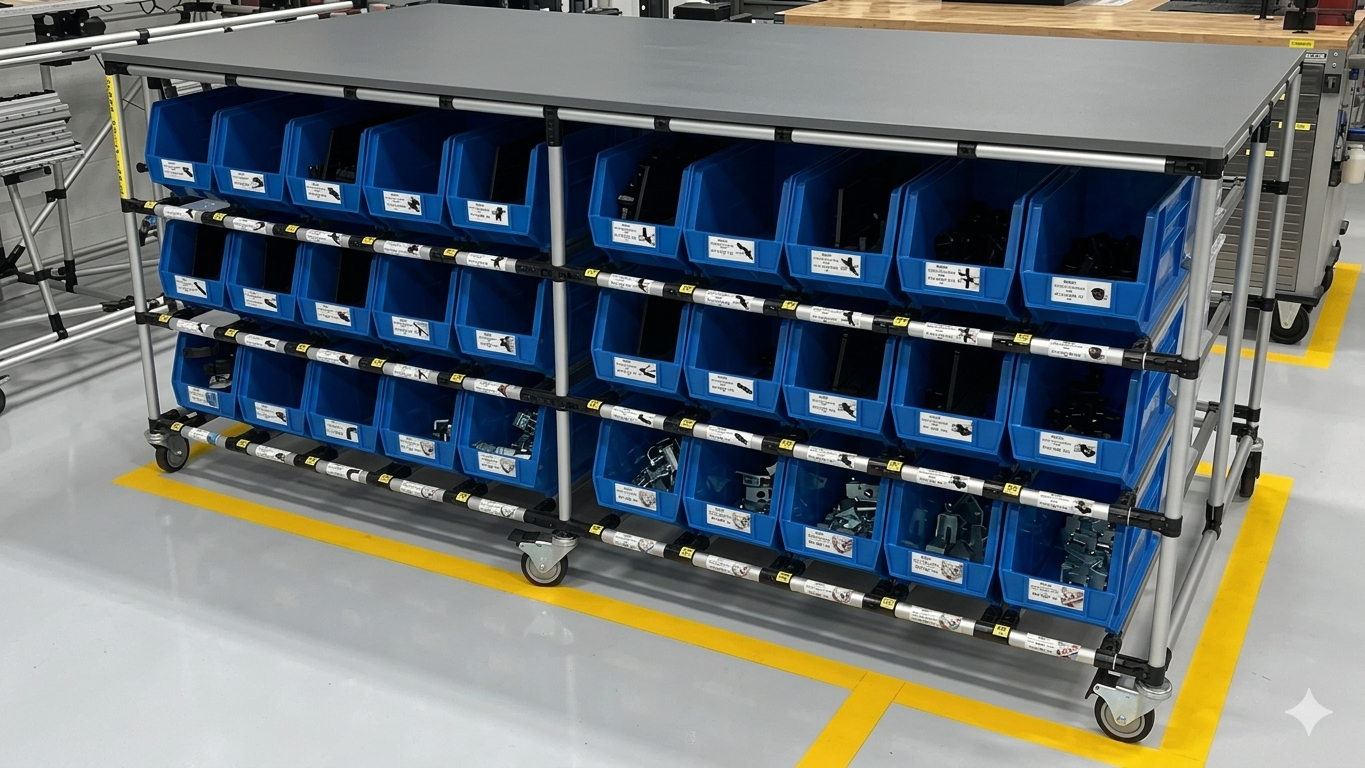
Assembly kitting carts engineered for building, verifying, and delivering complete part kits to production cells — with bin positions mapped to the kit component list, visual verification provisions for kit completeness checking, and cart geometry matched to the delivery route and line-side docking position. Reduces assembly line shortages, mixed-part errors, and material handler travel time on every kit cycle.
Why Choose Modular Solutions for Kitting Work Carts?
A kitting cart designed around your kit structure eliminates the errors and shortages that generic carts create.
Bin Layout Maps Directly to Kit Component List
Kitting cart bin positions are laid out to match your specific kit component list — not a generic bin arrangement. Each bin position has a fixed address, a labeled part number, and a quantity indicator. Kitting operators fill each position from the supermarket in sequence, not from memory.
Visual Kit Completeness Verification
Shadow board outlines, bin position indicators, and count verification labels allow kit completeness to be verified visually before the cart leaves the kitting area. A partially assembled kit is immediately obvious from the empty bin positions without counting individual parts.
Reduces Assembly Line Shortages
Kitting carts designed to carry exactly one kit cycle's worth of components — neither more nor less — prevent both shortages (too few parts delivered) and overproduction (extra parts at the assembly station) by making the correct quantity a physical constraint of the cart layout.
Supports Mixed-Model Production
Kitting carts for mixed-model assembly lines are configured with separate kit zones per model variant, with clear visual separation and part number identification that allows kitting operators to assemble the correct kit for each production sequence without reference to paper documentation.
JIT Delivery Without Line Interruption
Kitting carts are sized and configured for JIT delivery cycle time — delivering a complete kit to the assembly cell, exchanging the empty kit return, and departing without requiring the assembly operator to stop work, search for parts, or verify quantities during the delivery.
Standardized Across the Kit Fleet
Identical kitting cart dimensions, bin rail positions, and delivery docking geometry across a fleet allow any cart to serve any kit delivery route without reconfiguration, simplifying routing, maintenance, and replacement cart management.
Key Features & Benefits
Design details that make kitting carts reliable and error-resistant in high-volume assembly environments.
Zoned Bin Layout per Kit Structure
Bin positions are organized into zones that correspond to the kit assembly sequence or component groups. Zone boundaries are clearly marked with color coding or divider panels. Operators fill each zone in sequence, which naturally organizes the pick walk and reduces pick errors.
Label Holder and Part Number Integration
Part number labels, bin quantity indicators, and Kanban card holders are factory-installed at every bin position. Labels are at a consistent location on every cart in the fleet so kitting operators and assembly operators use the same visual reference regardless of which cart is in use.
Multiple Bin Size Compatibility
Kitting carts are designed to accept the range of bin sizes in your component inventory — from small parts trays to medium totes — with rail spacing and shelf depth matched to your bin footprint dimensions. Bins are interchangeable across all cart positions of the same size class.
Return Bin Position for Empty Containers
A dedicated lower tier or separate bin rail section provides a fixed position for empty containers returned from the assembly station. Return containers are isolated from full kit positions to prevent mixing of empty returns with components during the kitting cycle.
Work Surface for Kit Assembly
A fold-out or fixed work surface mounted to the T-slot upright provides a staging area for kit assembly operations — sub-assembly steps, labeling, inspection, or wrapping that occur before the kit is sealed for delivery.
Docking Rail for Line-Side Interface
Precision docking rails and bumpers position the kitting cart at the line-side delivery point consistently on each delivery cycle. Docked position aligns bin faces with line-side operator reach zone for direct bin-to-bin transfer without lifting.
Common Applications
Kitting carts are deployed in any assembly environment where pre-kitted component delivery reduces assembly time, improves quality, and supports mixed-model production.
- Automotive Assembly Cell Kitting - Kitting carts delivering pre-assembled component kits to automotive final assembly cells, with bin positions matching the assembly sequence and kit verification provisions before each delivery cycle.
- Electronics Assembly Kit Delivery - Kitting carts for PCB and electronics assembly kits, with ESD-safe bin options and component-specific bin sizing for through-hole, SMT, and mechanical hardware components in a single kit delivery.
- Medical Device Kit Assembly - Kitting carts in FDA-regulated medical device assembly environments, with lot traceability provisions, batch record document holders, and complete kit verification before delivery to the assembly cell.
- Aerospace Fastener and Hardware Kitting - Hardware kitting carts for aerospace assembly operations, with FOD-prevention provisions, captive fastener bins, and kit verification against engineering bill of materials before delivery.
- Maintenance Part Kit Delivery - Kitting carts preloaded with all parts, tools, and consumables for a specific planned maintenance work order — delivered to the equipment location before the maintenance window begins.
- Appliance and Consumer Product Assembly - High-volume kitting carts for appliance and consumer product assembly lines, configured for rapid kit exchange at takt time-aligned delivery intervals with standardized bin positions across the kit fleet.
Specifications & Configurations
Standard design ranges. All specifications are configurable to your kit structure, bin inventory, and delivery route.
| Specification | Detail |
|---|---|
| Frame Profile | 45 Series T-slot aluminum uprights and cross rails |
| Bin Positions per Cart | 6 to 30 positions depending on kit size and bin dimensions |
| Bin Rail System | Euro pitch standard; compatible with standard plastic bin families |
| Kit Zones | Color-coded zone separation; 1 to 6 zones per cart |
| Return Bin Provision | Dedicated lower tier or separate rail section for empty returns |
| Work Surface | Optional fold-out or fixed surface; phenolic laminate standard |
| Cart Width | 18 in. to 36 in.; standardized per kit delivery route |
| Cart Height | 48 in. to 66 in. overall |
| Caster Diameter | 3 in. or 4 in.; swivel with 2 brake casters standard |
| Visual Management | Part number labels, bin count indicators, Kanban card holders |
| Lead Time | 3 to 5 weeks from approved drawings |
Frequently Asked Questions
Common questions about kitting work carts from Modular Solutions.
What is the difference between a kitting cart and a standard shelf cart?
A standard shelf cart has fixed shelves for general storage transport. A kitting cart has bin positions laid out specifically to match your kit component list, with labeled positions, zone separation per kit structure, empty return provisions, and visual verification features that enforce kit completeness before delivery. Kitting carts eliminate the pick verification step that operators otherwise perform manually at the assembly station on each kit delivery.
How is the bin layout determined for a kitting cart?
The bin layout is derived from your kit component list — specifically the number of part numbers in the kit, the quantity per part per kit, and the bin size required for each quantity. We map bin positions to your pick sequence and ergonomic reach zone, placing highest-frequency or heaviest picks at the primary reach zone height. You review and approve the bin layout before fabrication.
Can kitting carts be used with SAP or ERP-based kitting systems?
Yes. Barcode scan targets, RFID bracket positions, and label holder locations that align with your ERP kitting transaction workflow are integrated into the cart frame. Cart identification tags link the physical cart to the kit work order in your system. If your ERP system generates pick labels per bin position, we design the label holder format and position to match your label output.
How do you prevent kitting errors on a high-mix production line?
Error-proofing on high-mix kitting carts uses several layered methods: physical bin size matching (only the correct bin fits each position), part number labels at every position, zone color-coding per model variant, kit completeness shadow boards, and pick-to-light or scan-verify provisions for the highest-risk mix points. The combination of physical constraints and visual management reduces kitting errors without relying on operator concentration alone.
Can a kitting cart be reconfigured for a new product introduction?
Yes. T-slot bin rail positions, zone dividers, and label holders all reposition without tools beyond a hex key. A new product introduction requiring different bin sizes or a different number of kit positions is accommodated by repositioning existing hardware and adding or removing bin rails. The structural cart frame is not replaced.
Ready to Design Your Kitting Cart Fleet?
Share your kit component list, bin inventory, production volume, and delivery route. Our engineers will design a kitting cart that eliminates shortages and mix errors.
Modular Solutions - 4280 Giddings Rd, Auburn Hills, MI 48326