Assembly & Workstation Carts
Mobile assembly stations, maintenance service carts, kitting and staging carts, and operator support carts built from T-slot aluminum framing. Designed to bring tools, parts, and work surfaces to the point of use - rather than moving the operator or interrupting the production line.
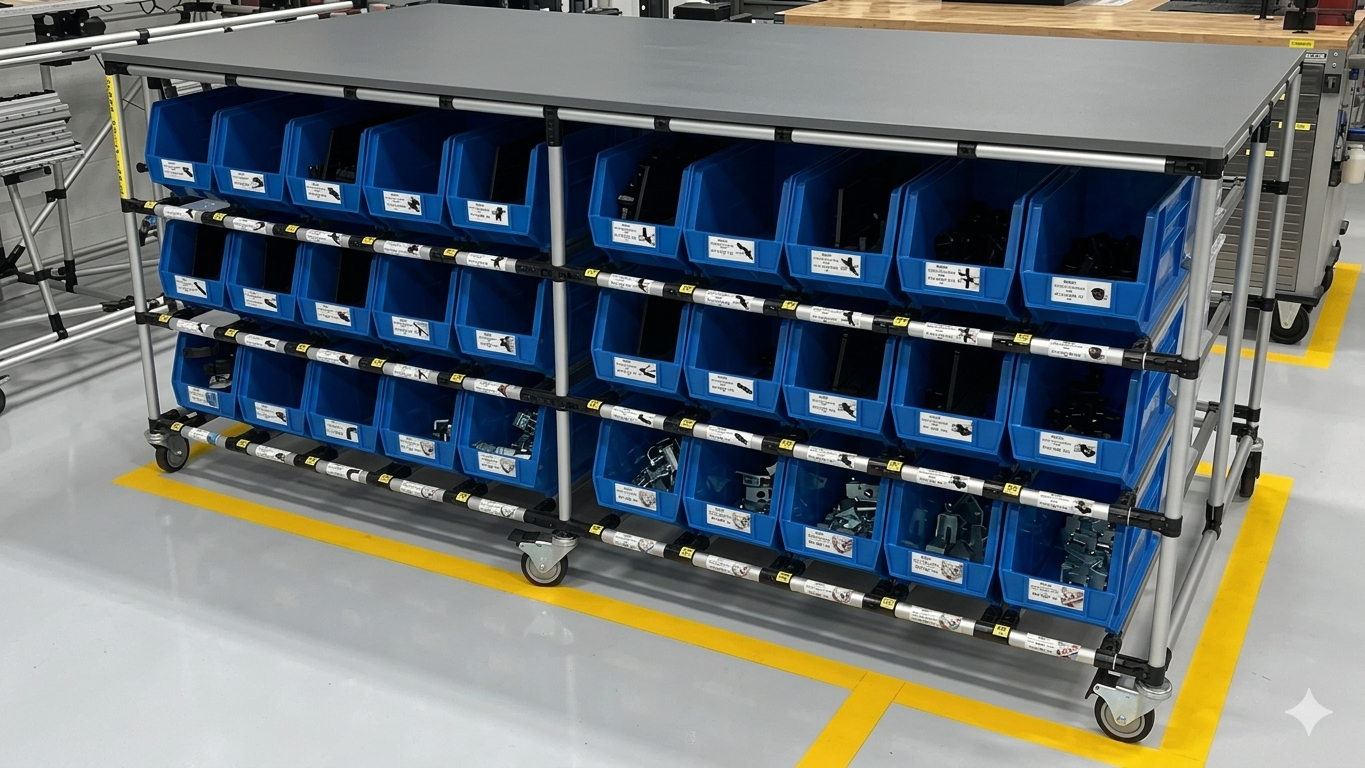
Assembly & Workstation Cart Types
Select the cart type that matches your application, or contact our engineers for a recommendation based on your task, tool inventory, and workflow requirements.
Mobile Workstation Carts
Rolling work surfaces with integrated tool organization, bin storage, and utility provisions for production and maintenance tasks at the point of use.
Kitting Work Carts
Assembly kit staging and delivery carts with bin positions mapped to the kit component list and visual completeness verification before each delivery cycle.
Operator Support Carts
Line-side consumable supply, PPE storage, and documentation carts that keep operators at the workstation through full production shifts.
Maintenance Service Carts
Shadow board tool-organized rolling maintenance stations with spare parts bins, work surfaces, and utility provisions for PM and reactive maintenance.
Drawer-Integrated Work Carts
T-slot work carts combining open bin storage with enclosed foam-lined drawer modules for precision instruments, calibrated tools, and lockable small parts storage.
End-of-Line Packing Carts
Finished goods packing, labeling, documentation, and shipping preparation carts at assembly line exit points — every material in place for each unit packed.
Why Choose Modular Solutions for Assembly and Workstation Carts?
Faster deployment, lower total cost, and the flexibility to reconfigure as your processes evolve.
Configured Around Your Process
Assembly and service carts are designed around the specific task: the tools needed, the parts consumed, the work surface required, and the operator reach envelope. Unlike catalog carts with fixed dimensions, T-slot designs reflect your actual process requirements.
Work Surfaces at the Right Height
Fold-out work surfaces, fixed benchtops, and tilting work panel options are built into the cart frame at the correct ergonomic height for seated, standing, or mixed-use operations. Surface height is set during design, not estimated.
Tool and Part Organization Built In
Pegboard upright panels, bin rails, tool holder strips, and shadow board provisions are integrated into the T-slot upright frame. Tools are at point of use on the cart, not scattered across a workbench or stored separately.
Power and Utility Provisions
Outlet strips, USB charging rails, pneumatic manifold mounts, and cable management channels are integrated at the design stage. Carts that require power tools, inspection equipment, or electronic diagnostic devices are designed with utility provisions from the start.
Mobility Without Compromise
Caster packages are selected for the specific floor surface and maneuverability requirement. Maintenance carts that need to navigate tight aisles use swivel-all caster configurations. Assembly carts that dock at fixed stations use directional casters with precision docking provisions.
One Cart, Multiple Technicians
Assembly and service carts designed for shared use have standardized tool positions, consumable locations, and work surface heights so any trained technician can use any cart in the fleet with the same workflow. Consistency reduces setup time and error rates.
Key Features & Benefits
Engineered details that separate T-slot aluminum carts from catalog alternatives and generic welded-steel options.
Integrated Work Surfaces
Fixed and fold-out work surface options mount directly to the T-slot frame. Surface materials include hardboard, phenolic laminate, ESD-safe surfaces, and stainless steel for cleanroom or food-grade applications. Surface height is engineered per task.
Pegboard and Panel Uprights
Pegboard, perforated steel, and slotted panel uprights mount to the T-slot frame and accept standard hook and holder accessories. Shadow board outlines for critical tools provide visual confirmation that all tools are present.
Bin Rail and Parts Storage
Horizontal bin rails accept standard plastic bins in multiple sizes. Rail height and bin positions are set per the specific parts and consumables used in the task. Kanban labels and part number holders integrate with the bin rail standard.
Power Strip and Cable Management
Outlet strip mounts, cable management clips, and conduit routing brackets are available as T-slot accessories. Power and data cables route through the frame interior rather than hanging externally, improving safety and appearance.
Pneumatic Manifold Mounting
Pneumatic manifold brackets, hose reel mounts, and regulator panels mount directly to the T-slot upright using standard fasteners. Air-powered maintenance and assembly carts are designed with integrated pneumatic provisions, not external hose clamps.
Locking Caster and Brake Options
Swivel lock and directional lock casters prevent the cart from moving during in-position operations. Pedal-operated brakes on rear casters are standard on all work surface carts to ensure stability while the operator is using the work surface.
Common Applications
Proven in manufacturing, warehousing, and distribution environments across multiple industries.
- Mobile Maintenance Carts - Tool-organized service carts for maintenance technicians performing scheduled or reactive maintenance tasks, with integrated shadow boards, consumable bins, and work surfaces.
- Kitting and Staging Carts - Carts configured to carry pre-kitted parts and fasteners to assembly stations, with bin positions matching the kit structure and visual management provisions for kit completion verification.
- Line-Side Assembly Support - Mobile support carts that dock at assembly stations and provide tools, consumables, and reference materials for a specific assembly operation without interrupting the main line flow.
- Toolroom Service Carts - Heavy-duty carts for transporting and staging cutting tools, fixtures, and tooling inserts between toolroom, presetter, and machine tool.
- Quality and Inspection Carts - Mobile inspection stations with work surfaces, measurement tool storage, and documentation holders for in-process and final inspection operations.
- Operator Utility Carts - Multi-purpose support carts that carry consumables, PPE, cleaning supplies, and facility tools for operators who cover multiple stations or areas.
Specifications & Configurations
Standard design ranges. All specifications are available custom to your exact requirements.
| Specification | Detail |
|---|---|
| Frame Profile | 45 Series or 90 Series T-slot aluminum extrusion |
| Work Surface Size | 12 in. x 18 in. to 24 in. x 48 in.; fixed or fold-out configurations |
| Work Surface Height | 32 in. to 42 in. standard; custom heights available |
| Storage Tiers | 1 to 4 shelves or bin rail rows; adjustable on T-slot uprights |
| Upright Panel Options | Pegboard, perforated steel, slotted panel; custom heights |
| Cart Width | 18 in. to 36 in. standard |
| Cart Length | 24 in. to 60 in. standard |
| Caster Size | 3 in. to 6 in. diameter; swivel, locking swivel, or fixed-directional |
| Power Options | Outlet strip mount, USB charge rail, pneumatic manifold mount |
| Lead Time | 3 to 5 weeks from approved drawings |
Frequently Asked Questions
Common questions about assembly and workstation carts from Modular Solutions.
What is the difference between an assembly cart and a standard utility cart?
An assembly cart is engineered for a specific task or workflow. It has a work surface at the correct ergonomic height, tool organization designed around the exact tools used in the operation, part bins positioned for the specific parts consumed, and utility provisions for any power or pneumatic tools required. A standard utility cart is a general-purpose transport tool with fixed, non-task-specific shelves. Assembly carts reduce setup time, tool searching, and error rates because everything is in a fixed, designed location.
Can the work surface height be adjusted after the cart is built?
The work surface is fixed at the specified height during fabrication. If you anticipate needing different heights for different tasks or operators, we can design the cart with a manually adjustable surface mechanism or provide multiple surface height options during the design review. Field adjustment of surface height is possible but requires partial disassembly.
How do shadow boards work on a T-slot cart?
Shadow boards are panels with outlines of each tool in its designated position. They mount to the pegboard or perforated upright panel on the cart. When a tool is removed, the empty outline is immediately visible, providing visual confirmation of what is missing. Shadow boards are particularly useful on shared maintenance carts where multiple technicians use the same cart across shifts.
Can you integrate power outlets and pneumatic connections into the cart?
Yes. Outlet strip mounts, cable management channels, and pneumatic manifold brackets are all standard T-slot accessory options. We route power and air supply cabling through the frame interior and terminate at organized connection points on the cart. If your facility uses a specific power outlet or pneumatic connector standard, we design to match.
What is the typical turnaround time for a custom assembly cart?
Most custom assembly and workstation carts ship within 3 to 5 weeks from approved drawings. Complex carts with multiple work surfaces, integrated power provisions, or large fleet quantities may require additional time. Contact our engineering team for a specific timeline based on your requirements.
Ready to Design Your Assembly or Service Cart?
Share your task requirements, tool list, and part inventory with our engineering team. We will design a cart that puts everything at the point of use.
Modular Solutions - 4280 Giddings Rd, Auburn Hills, MI 48326