Maintenance Service Carts
Tool-organized rolling maintenance stations that bring all required tools, spare parts, consumables, and documentation to the equipment being serviced — eliminating multiple trips to the tool crib during each maintenance operation and reducing time-to-repair through standardized tool organization and shadow board verification. Built from T-slot aluminum with shadow board panels, bin rails, work surfaces, and integrated utility provisions designed around your specific PM and reactive maintenance task library.
Why Choose Modular Solutions for Maintenance Service Carts?
Maintenance efficiency starts with the cart — standardized tool location, complete spare parts, and shadow board accountability on every service call.
Shadow Board Tool Accountability Built In
Shadow board panels with tool outlines provide visual confirmation that every tool is present before leaving the tool crib and after completing the service call. Missing tools are immediately visible without conducting a manual count, supporting TPMF audit requirements and tool accountability programs.
Designed Around Your PM Task Library
Maintenance cart layout is derived from your planned maintenance task library — the specific tools, spare parts, and consumables required for each scheduled PM. High-frequency PM tools are at primary reach zone height. Spare parts are in labeled bins with quantity indicators.
Reduces Mean Time to Repair
When every required tool and spare part is on the cart before the technician arrives at the equipment, repair time is determined by the repair task — not by the time required to locate tools, return to the tool crib, and stage parts. Standardized carts reduce MTTR by eliminating non-repair travel.
Consistent Across the Maintenance Fleet
Identical cart designs across the maintenance team allow any technician to use any cart and find every tool in the expected location. This consistency is especially critical when multiple technicians share a cart or when a technician works outside their usual equipment area.
Utility Provisions for Powered Equipment
Outlet strips, USB charging rails, pneumatic manifold mounts, and diagnostic equipment brackets are integrated at the design stage for carts that support electrically-powered maintenance tools, diagnostic instruments, and electronic calibration equipment.
Durable for Industrial Use
T-slot aluminum maintenance carts are designed for the physical demands of industrial maintenance — heavy tool loads, repeated rolling over rough floors, and exposure to cutting fluids, lubricants, and cleaning chemicals — without the surface degradation, drawer slide failures, or wheel binding common on commercial-grade tool chests.
Key Features & Benefits
Structural and organizational features that make maintenance service carts reliable in demanding industrial environments.
Shadow Board Panel System
Shadow board panels with tool outlines are mounted to T-slot pegboard or perforated upright frames. Outlines are cut or printed for each tool in its designated position. Missing tool positions are visible at a glance from the aisle or at the tool crib checkout point.
Labeled Spare Parts Bin Storage
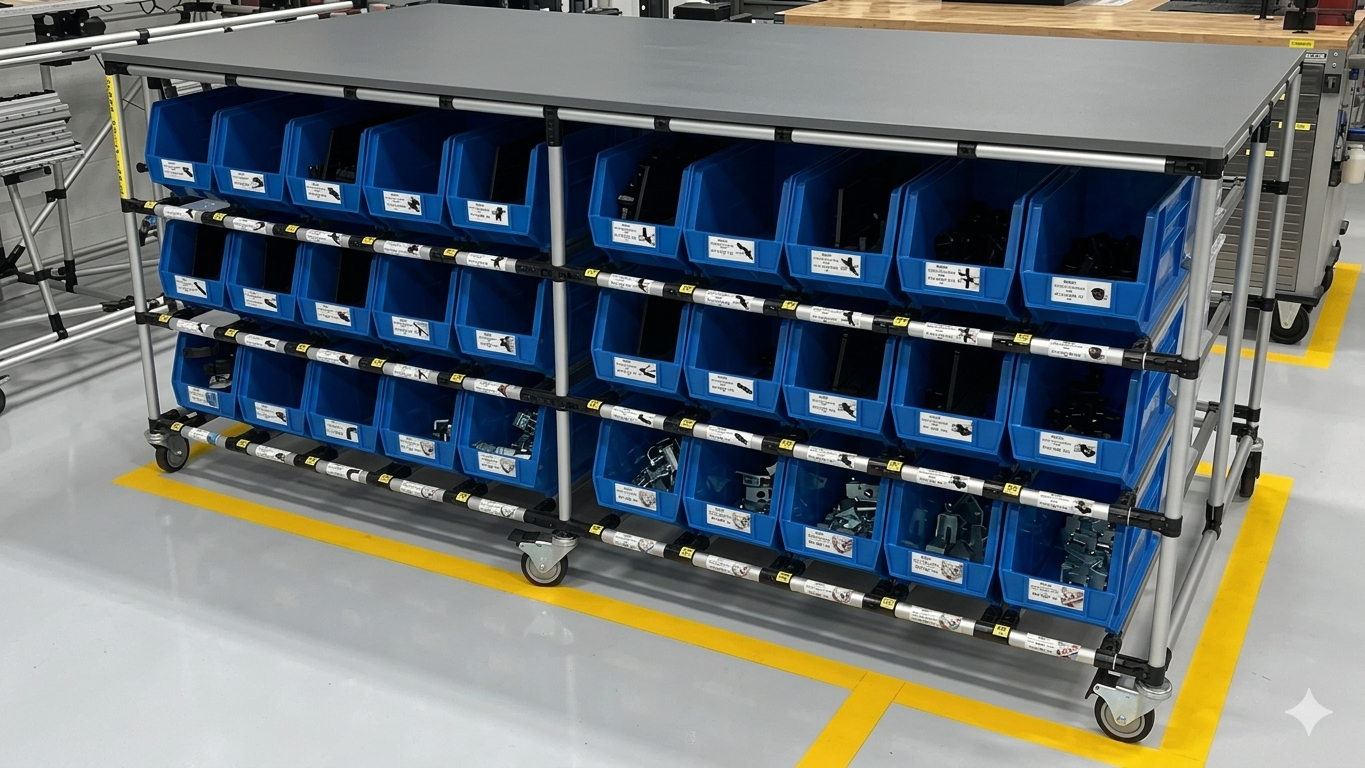
Euro-style bin rails with labeled plastic bins carry spare parts, fasteners, O-rings, filters, and consumables at positions specified by the PM task requirements. Minimum quantity indicators are set per part based on PM frequency and lead time.
Heavy-Duty Tool Holders and Brackets
Wrench rails, screwdriver holders, plier brackets, and ratchet organizers mount directly to the T-slot upright frame using standard hardware. Heavy tools — torque wrenches, impact drivers, breaker bars — are at lower, accessible positions. Light tools are at upper positions.
Work Surface for Field Repair
A fixed or fold-out work surface at 34 to 38 inches from the floor provides a stable field repair surface for disassembly, inspection, and sub-assembly tasks at the equipment location without returning to the maintenance shop.
Pneumatic Tool Provisions
Air hose reel mounts, pneumatic manifold brackets, and quick-disconnect provisions are integrated for carts used with air-powered maintenance tools. Air supply connection is at a standardized position on the cart for consistent connection at any air drop in the facility.
Lockable Panel and Drawer Options
Lockable panel covers and drawer inserts are available for carts that require tool inventory security when the cart is unattended in the production area. Locks use a common key system for maintenance supervisor access to all carts.
Common Applications
Maintenance service carts are deployed across planned and reactive maintenance programs in manufacturing, utilities, and facility management operations.
- Planned Preventive Maintenance Kits - Dedicated PM carts preloaded with all tools, spare parts, lubricants, and documentation for a specific equipment PM interval — dispatched to the equipment location at the scheduled PM window start.
- Reactive Maintenance Response Carts - General-purpose maintenance response carts carrying the most commonly required repair tools and spare parts for reactive maintenance call-outs across a production area.
- Mechanical Maintenance Stations - Mechanical maintenance carts with precision hand tools, bearing pullers, coupling installation tools, and mechanical spare parts for rotating equipment maintenance.
- Electrical and Controls Maintenance - Electrical maintenance carts with test meters, insulated hand tools, wire management tools, terminal connectors, and fuse and relay spare parts for electrical panel and control system maintenance.
- Hydraulic and Pneumatic Service Carts - Service carts for hydraulic and pneumatic system maintenance with hose assembly tools, fitting inventory, seal kits, filter elements, and pressure measurement equipment.
- Facilities Maintenance Rounds - Facility maintenance carts for technicians performing daily rounds — lighting checks, HVAC filter service, building systems inspection — carrying the tools and consumables for all items on the daily route.
Specifications & Configurations
Standard design ranges. All specifications are configurable to your PM task library and maintenance tool inventory.
| Specification | Detail |
|---|---|
| Frame Profile | 45 Series T-slot aluminum uprights and cross rails |
| Tool Organization | Shadow board panels, wrench rails, screwdriver holders, ratchet organizers |
| Upright Panel | Pegboard or perforated steel; shadow board overlay; custom tool outlines |
| Spare Parts Storage | Euro-style bin rails; 8 to 24 bin positions; labeled with part number and min qty |
| Work Surface | Fixed or fold-out; hardboard or phenolic laminate; 34 in. to 38 in. height |
| Cart Width | 18 in. to 30 in. |
| Cart Length | 24 in. to 48 in. |
| Caster Size | 4 in. to 5 in.; heavy-duty swivel with 2 locking brakes |
| Power Options | Outlet strip mount, USB charge rail, pneumatic manifold mount |
| Security | Lockable panel covers and drawer inserts optional |
| Lead Time | 3 to 5 weeks from approved drawings |
Frequently Asked Questions
Common questions about maintenance service carts from Modular Solutions.
What is a shadow board and why is it used on maintenance carts?
A shadow board is a panel with an outline or silhouette of each tool in its designated storage position. When a tool is removed, its outline remains visible on the panel. When the tool is returned, it fills the outline. Shadow boards make missing tools immediately visible without counting, providing a daily accountability check at tool crib checkout and check-in. They are a standard element of TPM and 5S tool management programs.
How do I define the tool inventory for a maintenance cart?
Start with your PM task library — the list of tasks performed by the maintenance team and the tools required for each task. Identify the tools used in the highest percentage of tasks and put them on the cart. Secondary tools used for specific equipment can go on a separate specialized cart. Our engineers will help you rationalize the tool list to the cart capacity and layout the shadow board for your final tool set.
Can maintenance service carts be used with computerized maintenance management systems?
Yes. Barcode labels for cart identification, QR code scan targets for work order confirmation, and RFID provisions for electronic tool accountability can be integrated into the T-slot frame. Cart checkout and check-in scanning, work order association, and tool inventory status can all be linked to your CMMS through these provisions.
How are spare parts replenished on maintenance carts?
Spare parts bins use Kanban minimum quantity indicators — when a bin reaches the minimum quantity label, the technician or material handler generates a replenishment request. For CMMS-integrated carts, bin quantity status can be updated electronically at the point of use. Standard practice is to replenish carts at the end of each shift or at the tool crib check-in, so the cart is fully stocked before the next PM dispatch.
What caster type is recommended for maintenance carts in industrial environments?
Heavy-duty 4 or 5 inch swivel casters with polyurethane treads are recommended for maintenance carts that navigate rough concrete floors, oil film floors, and threshold transitions. Polyurethane provides good rolling resistance, chemical resistance to oils and cleaning agents, and adequate grip without marking coated floor surfaces. Two locking brake casters are standard to prevent cart movement during work surface use.
Ready to Build Your Maintenance Cart Fleet?
Share your PM task library, tool inventory, spare parts list, and floor environment. Our engineers will design maintenance carts that reduce your MTTR and support tool accountability.
Modular Solutions - 4280 Giddings Rd, Auburn Hills, MI 48326