Mobile Workstation Carts
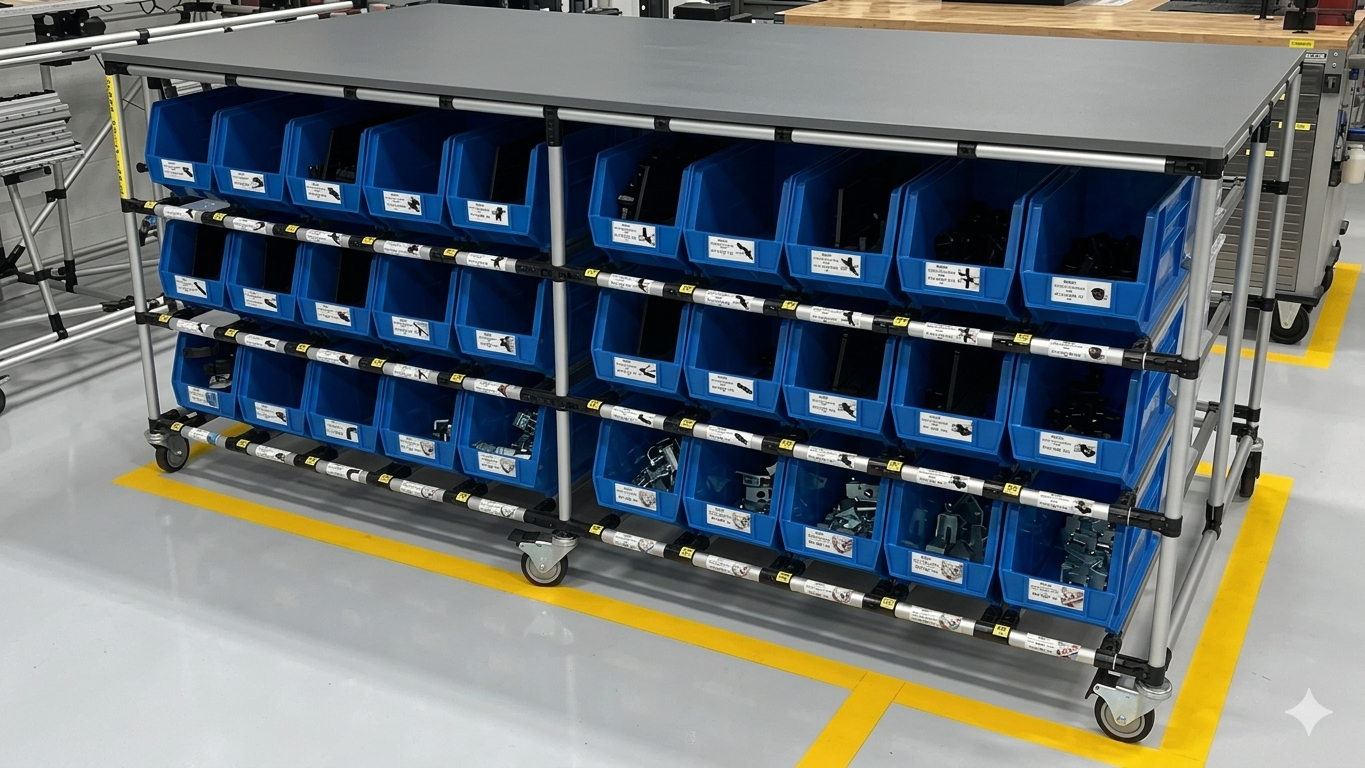
Rolling workstations that bring the work surface, tools, parts, and utilities to the exact point of use — eliminating the need to transport parts to a fixed bench or return to a central tool storage area during each operation. Built from T-slot aluminum with integrated work surfaces, pegboard panels, bin rails, and power provisions designed around your specific task, tool inventory, and ergonomic requirements.
Why Choose Modular Solutions for Mobile Workstation Carts?
Engineered to your task — not a catalog cart with a work surface bolted on.
Work Surface at the Correct Height
Surface height is calculated from your operator population height range and the task type — seated assembly, standing inspection, or mixed-posture operation. NIOSH ergonomic surface height guidelines are applied at the design stage so the workstation fits the operator, not the other way around.
Tool Organization Designed Around Your Task
The pegboard, bin rail, and tool holder layout is designed from your actual tool and consumable inventory list — not a generic layout. Frequently used tools are at primary reach zone height. Consumables are in labeled bins at the correct pick position. Everything has a fixed address.
Power and Utility Built In From the Start
Outlet strips, USB rails, pneumatic manifold mounts, and cable management are integrated into the T-slot frame during design. Power and air supply reach the work surface through the frame interior — not via external cords and hoses hanging from the workstation.
Reconfigurable as Processes Change
When tool inventory changes, new consumables are added, or the task sequence is updated, T-slot panel positions, bin rail heights, and bracket locations are adjusted with hex keys. The structural frame is not replaced when the process evolves.
Fleet Standardization for Shared Use
Mobile workstation carts designed to a common standard across a maintenance or assembly department allow any technician to operate any cart in the fleet using the same workflow. Standard tool positions, identical surface heights, and consistent utility provisions eliminate the learning curve when technicians switch between carts.
In-House Engineering in Auburn Hills
Every mobile workstation cart is designed and manufactured at our Auburn Hills, MI facility. Our engineers review your task requirements, tool inventory, utility needs, and floor constraints before beginning the design — not after.
Key Features & Benefits
Structural and ergonomic features that make mobile workstation carts effective in high-frequency production and maintenance environments.
45 Series T-Slot Frame
The workstation frame uses 45 Series T-slot aluminum uprights and cross rails. The four-sided mounting channel system allows work surfaces, panels, bins, rails, and accessories to mount at any position on any frame face and reposition without drilling or welding.
Fixed or Fold-Out Work Surfaces
Hardboard, phenolic laminate, ESD-dissipative, and stainless steel work surface options are available. Fixed surfaces provide maximum stability for assembly and inspection tasks. Fold-out surfaces maximize aisle clearance when the workstation is in transit.
Pegboard and Perforated Panel Uprights
Pegboard and perforated steel panels mount to T-slot upright frames and accept standard hook and holder accessories for tools, gauges, and inspection equipment. Panel position and height are set per operator reach zone requirements.
Bin Rail and Labeled Parts Storage
Euro-style bin rails with multiple bin size options provide labeled, organized small parts and consumable storage. Kanban card holders, part number labels, and minimum quantity indicators are integrated at each bin position.
Power Strip and Cable Management System
Surface-mounted or frame-integrated outlet strips provide convenience outlets for power tools and electronic equipment. Cable management clips and conduit routing brackets route cords through the frame interior to prevent trip hazards and entanglement.
Locking Casters for In-Position Stability
Foot-operated locking casters prevent the workstation from moving during use. Full four-swivel configurations allow 360-degree positioning in congested areas. Two-swivel two-fixed configurations suit straight-aisle transport and in-position use.
Common Applications
Mobile workstation carts are deployed wherever bringing the work surface to the task reduces travel time, ergonomic risk, and process interruption.
- Assembly Cell Support Stations - Mobile workstations positioned at assembly cells to carry tools, gauges, and consumables for the specific assembly task — eliminating repeated trips to central tool storage during each assembly cycle.
- Maintenance Technician Stations - Rolling workstations for maintenance technicians performing planned maintenance on production equipment, carrying the tools, spare parts, and documentation for the specific equipment being serviced.
- Quality and Inspection Stations - Mobile inspection workstations with work surfaces at the correct height for dimensional measurement, visual inspection, and document completion — positioned at in-process or final inspection points.
- Line Changeover Tooling Stations - Workstations preloaded with all changeover tooling, fixture hardware, and reference documentation for a specific production run change, positioned at the changeover point before the changeover begins.
- Field Service and On-Site Repair - Mobile workstations for field service technicians performing on-site equipment installation, calibration, and repair operations at customer facilities or remote production areas.
- Training and Demonstration Stations - Portable workstations configured for training environments, carrying training materials, sample parts, and demonstration tools to any classroom or production floor location.
Specifications & Configurations
Standard design ranges. All specifications are configurable to your task, tool inventory, and ergonomic requirements.
| Specification | Detail |
|---|---|
| Frame Profile | 45 Series T-slot aluminum uprights and cross rails |
| Work Surface Size | 12 in. x 18 in. to 24 in. x 48 in.; fixed or fold-out |
| Work Surface Height | 32 in. to 42 in. standard; custom heights available |
| Work Surface Material | Hardboard, phenolic laminate, ESD-dissipative, stainless steel |
| Upright Panel | Pegboard, perforated steel, or slotted panel; custom heights |
| Storage | 1 to 4 bin rail rows; adjustable height positions |
| Cart Width | 18 in. to 36 in. |
| Cart Length | 24 in. to 60 in. |
| Caster Size | 3 in. to 5 in.; swivel with 2-4 locking brakes |
| Power Options | Outlet strip, USB rail, pneumatic manifold mount |
| Lead Time | 3 to 5 weeks from approved drawings |
Frequently Asked Questions
Common questions about mobile workstations from Modular Solutions.
What work surface material is best for assembly operations?
Phenolic laminate is the most common choice — it provides a hard, smooth, chemical-resistant surface that resists marking from metal parts, hand tools, and assembly lubricants. Hardboard is a lower-cost option for light assembly. ESD-dissipative laminate is required where electrostatic-sensitive components are handled. Stainless steel is specified for food-grade, pharmaceutical, and cleanroom environments where chemical compatibility and sanitation are priorities.
Can mobile workstations include computer or monitor mounting?
Yes. Monitor arms, tablet holders, and laptop trays mount directly to T-slot upright frames using standard T-slot fasteners. Cable management for computer peripherals is routed through the frame interior. Display mounting positions are set at ergonomic viewing height during the design phase. Power and data connections are integrated into the utility provisions at the workstation.
How are mobile workstations kept from moving during use?
Foot-operated locking casters are standard on all mobile workstations. Rear casters lock independently via a foot pedal so the operator can lock and unlock without bending. For applications requiring absolute immobility during high-force operations, four-brake caster configurations are available. Workstations that dock at fixed stations can use precision docking provisions to locate and secure the cart during use.
Can I specify a different work surface height for seated versus standing use?
Yes. We can design a single workstation with a surface height suitable for standing use at a fixed station, or provide a manually height-adjustable surface mechanism for mixed seated and standing operations. Height-adjustable mechanisms mount to the T-slot uprights and lock at any position within the adjustment range. Specify your operator height range and task posture requirements during the design inquiry.
How do I specify a mobile workstation for my application?
Start by providing the task description, the list of tools and consumables used in the task, the available floor space for the workstation, the operator height range, and any utility requirements. Our engineering team will develop a layout proposal showing the work surface, panel configuration, bin positions, and utility provisions. You review and approve the layout before fabrication begins.
Ready to Design Your Mobile Workstation?
Share your task requirements, tool list, utility needs, and floor space constraints. Our engineers will design a workstation that puts everything at the point of use.
Modular Solutions - 4280 Giddings Rd, Auburn Hills, MI 48326