AGC Carts
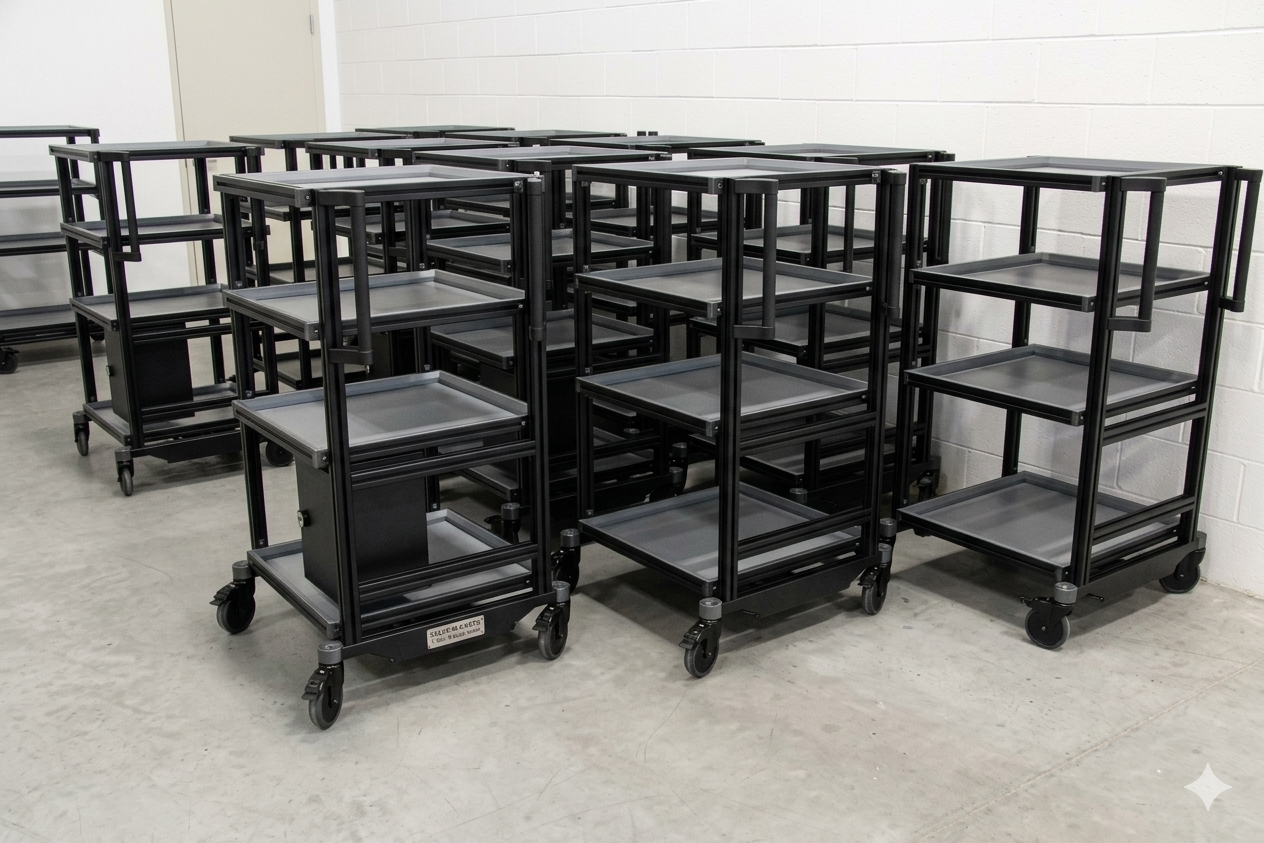
T-slot aluminum carts engineered for automated guided cart (AGC) material delivery systems. Precision coupling geometry, standardized cart dimensions, consistent deck height, and stable center of gravity geometry — all specified to interface reliably with your AGC vehicle and operate safely on your facility's automated delivery loop.
Why Choose Modular Solutions for AGC Carts?
AGC carts are a precision component of your automation system — engineering matters.
Designed for Your AGC Vehicle
AGC cart coupling geometry, cart height, and center of gravity position are designed around your specific AGC vehicle model. Generic carts bolted with an afterthought coupling bracket do not provide the coupling repeatability and dynamic stability that automated guidance systems require.
Consistent Coupling Geometry Across the Fleet
Automated systems depend on cart-to-cart and cart-to-vehicle coupling dimensional consistency. Fleet-standardized AGC carts from Modular Solutions are manufactured to drawing tolerances with inspection verification, so coupling engages reliably on every cycle.
Stable Dynamic Behavior Under Automation Control
AGC vehicles accelerate, decelerate, and navigate curves under automated control without the variable operator behavior of manual tugger driving. Cart center of gravity height, load distribution, and caster specification are engineered to maintain stability under automated motion profiles — not just manual push transport.
Low-Maintenance Design for Automated Environments
AGC systems are designed to run unattended for extended periods. Cart maintenance requirements — caster lubrication, coupling hardware inspection, and frame inspection intervals — are documented and designed to align with AGC vehicle maintenance schedules for coordinated downtime.
Scalable Fleet for Demand Changes
T-slot aluminum AGC cart fleets can be expanded, and cart configurations can be changed to accommodate product mix changes, route additions, and delivery frequency changes. Fleet expansion carts are manufactured to the same drawing dimensions as original fleet carts for seamless integration.
Compatible with All Major AGC Platforms
We have designed AGC carts for systems from JBT, Jervis B. Webb, Seegrid, Locus Robotics, 6 River Systems, Bastian Solutions, and custom AGC platforms. Coupling interface geometry is designed from your AGC vehicle's technical documentation.
Key Features & Benefits
Technical details that ensure reliable automated operation across your AGC cart fleet.
Precision AGC Coupling Interface
AGC coupling brackets are fabricated to dimensional tolerances consistent with automated coupling repeatability requirements — typically ±1.0 mm on coupling engagement geometry. Coupling inserts and guide features are designed from AGC vehicle coupling documentation.
Standardized Cart Width and Length
Cart plan dimensions are standardized across the fleet to the dimension tolerances required by your AGC navigation system for consistent aisle clearance, turn radius calculation, and collision detection zone configuration.
Consistent Deck Height for Automated Transfer
For AGC carts that perform automated load transfers to conveyors or automated handling systems, deck height is held to ±2 mm across the fleet to ensure consistent transfer engagement without height-sensing adjustments at each station.
Center of Gravity Engineering
Loaded cart center of gravity position is calculated for the nominal load configuration and compared against stability limits under automated motion profiles. Frame geometry and caster positioning are adjusted to maintain stability within automated operating parameters.
RFID and Barcode Integration
RFID tag mounts, QR code label positions, and barcode scan targets are integrated into the cart frame at designed positions for reliable automated identification at AGC dispatch, load, and unload stations.
Anti-Static Options for Electronics Handling
ESD-dissipative cart surfaces, grounding straps, and conductive casters are available for AGC carts operating in electronics manufacturing environments where electrostatic discharge during automated handling is a process risk.
Common Applications
AGC carts are used in the most advanced automated material delivery systems across manufacturing and distribution.
- Automated Assembly Line Feeding - AGC cart systems delivering parts and sub-assemblies to assembly line-side positions on automated schedules driven by WMS or MES consumption signals. Cart deck configuration matches line-side bin and rack layouts for automated transfer.
- Goods-to-Person Fulfillment - AGC carts in distribution centers delivering inventory totes and bins to person picking stations on demand, eliminating picker walking and reducing order fulfillment cycle time in high-SKU environments.
- Automated Hospital and Pharma Logistics - AGC carts delivering medications, medical supplies, and lab specimens through hospital corridors and pharmaceutical facility production areas on automated routes without human guidance.
- Electronics Manufacturing Component Delivery - ESD-protected AGC carts delivering PCB components, assemblies, and test fixtures between storage, SMT, assembly, and test stations in automated electronics manufacturing lines.
- Automotive Sequenced Part Delivery - AGC cart systems delivering sequenced parts to mixed-model assembly lines — delivering the correct part for each vehicle in build sequence — synchronized with line speed and build schedule.
- Post-Production Automated Staging - AGC carts moving finished goods, packaged products, and completed assemblies from production line ends to automated warehouse induction points without manual material handling.
Specifications & Configurations
AGC cart specifications are defined by your AGC system requirements. Representative design parameters are listed below.
| Specification | Detail |
|---|---|
| Frame Profile | 45 Series or 90 Series T-slot aluminum based on load and stability requirements |
| Load Capacity | 500 lb to 2,000 lb typical for AGC applications |
| Coupling Interface | Custom to AGC vehicle; tolerance ±1.0 mm on engagement features |
| Cart Width | Standardized to fleet dimension; typically 24 in. to 48 in. |
| Deck Height | Custom to transfer interface height; ±2 mm across fleet |
| Center of Gravity | Engineered for automated motion profile stability |
| Identification | RFID, QR code, and barcode positions per AGC system requirements |
| ESD Options | ESD-dissipative surfaces, grounding straps, conductive casters available |
| Fleet Dimensional Tolerance | Manufacturing to drawing tolerances with dimensional inspection report |
| Lead Time | 4 to 6 weeks from approved drawings; fleet quantities may vary |
Frequently Asked Questions
Common questions about AGC carts from Modular Solutions.
What information from our AGC system is needed to design the coupling interface?
We need the AGC vehicle coupling mechanism drawing or technical datasheet showing the coupling geometry, the coupling engagement force and direction, the approach path geometry, and the cart guide feature positions if the AGC navigation system uses cart-mounted targets. For most commercial AGC platforms, we have or can obtain the relevant technical documentation directly from the AGC manufacturer.
How is AGC cart fleet dimensional consistency maintained during manufacturing?
AGC cart fleet consistency is maintained by manufacturing all carts to the same approved drawing with tolerances specified for the critical AGC interface dimensions. We perform a dimensional inspection on coupling interface features and deck height for every cart in a fleet order and provide an inspection report confirming conformance to drawing. This gives your AGC system commissioning team verified dimensional data for each cart.
Can AGC carts be used manually between automated route operations?
Yes. AGC carts include manual push handles as standard so they can be moved by hand for initial positioning, maintenance, fleet changes, and emergency bypass of automated sections. Handle height is designed to not interfere with AGC vehicle coupling access.
What happens to the AGC cart design if the AGC system is upgraded or replaced?
If the AGC vehicle or coupling system changes, the cart coupling bracket and guide features are the primary elements that need to be updated. T-slot aluminum frame construction allows coupling brackets to be replaced at the cart base frame without replacing the full cart. We engineer replacement coupling assemblies for fleet upgrades when AGC platform changes occur.
Are AGC carts compatible with manual tugger operation as a backup mode?
Manual tugger operation as a backup can be accommodated by designing the AGC cart with both an AGC coupling provision and a manual tow hitch provision. The two coupling systems occupy different positions on the base frame and do not interfere with each other. Switchover between AGC and manual tugger operation requires only changing the coupling connection — no cart modification.
Ready to Engineer Your AGC Cart Fleet?
Share your AGC vehicle model, load configuration, delivery route, and fleet size. Our engineers will design AGC carts that integrate precisely with your automated material delivery system.
Modular Solutions - 4280 Giddings Rd, Auburn Hills, MI 48326