Component Transport Carts
Part-specific transport carts designed around the exact geometry of your components — with nesting cradles, locating pins, foam or urethane padding, and support rails configured to hold each component in the correct orientation throughout transport. Eliminates surface damage, dimensional distortion, and mixed-part errors in high-value component handling applications.
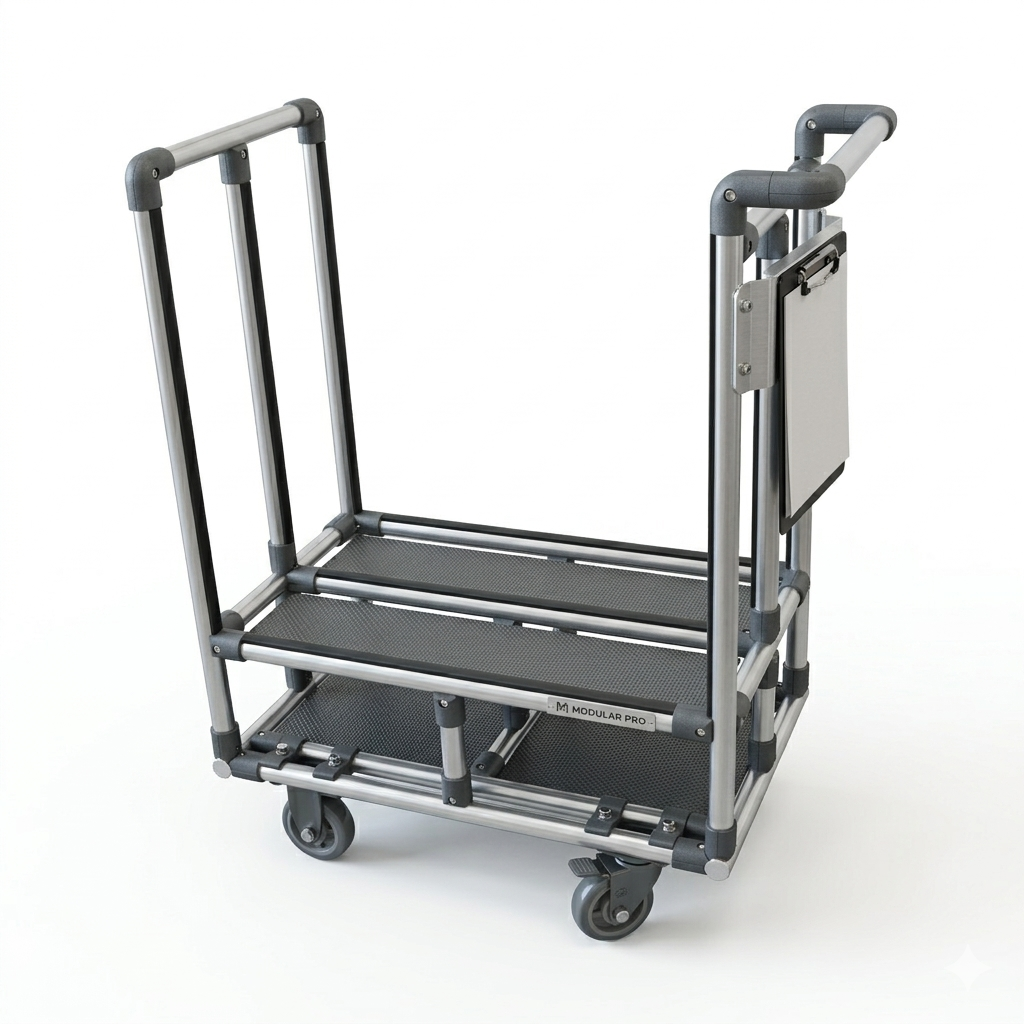
Why Choose Modular Solutions for Component Transport Carts?
Custom-engineered to the exact geometry of your parts — not a generic rack with improvised padding.
Designed to Your Part Geometry
Component transport carts are engineered from your part drawings or 3D models. Nest positions, cradle profiles, locating pin positions, and support rail heights are calculated to hold the part in the correct orientation without contact at critical surfaces.
Eliminates Improvised Padding and Blocking
Generic carts with improvised foam blocks and cardboard padding are inconsistent between operators and shifts. Designed nesting positions ensure every part is loaded in the same position every time, eliminating transport damage from inconsistent handling.
Prevents Surface Damage on High-Value Parts
Urethane, foam, and polyethylene pad materials are selected for the specific part material and surface finish. Contact surfaces are limited to non-critical areas. Critical surfaces — machined datums, sealing faces, decorative surfaces — are protected by clearance in the nest design.
Multiple Part Numbers per Cart
Component transport carts can be configured for multiple part numbers on separate tiers or nest positions, enabling mixed-model delivery in assembly environments without separate dedicated carts per part number.
Standardized Loading Verification
Nest positions that accept parts only in the correct orientation provide inherent error-proofing — a part loaded backwards or in the wrong nest position will not seat properly, providing a visual indicator that the cart is incorrectly loaded before it reaches the assembly line.
Automotive, Aerospace, and Electronics Grade Engineering
Component transport cart engineering follows the same practices used in automotive stamping, aerospace sub-assembly, and electronics manufacturing environments where part damage during internal transport is a documented quality issue.
Key Features & Benefits
Engineering details that ensure reliable, damage-free component transport on every cycle.
90 Series T-Slot Frame Structure
Component transport carts use 90 Series T-slot aluminum frames for higher structural stiffness under dynamic transport loads. Frame geometry is designed to minimize deflection at nest positions under the maximum cart load.
Custom Nest and Cradle Profiles
Nest profiles are fabricated from aluminum or steel and mounted to the T-slot frame. Cradle profiles match the part radius or contour within 0.5 mm for cylindrical parts. Flat part nests use precision-located stop pins and support rails to maintain part orientation.
Urethane and Foam Pad Surfaces
Contact pad materials are selected for Shore hardness appropriate to part material and weight. Urethane pads (60A to 90A) are used for heavy metal parts. Closed-cell foam pads are used for formed sheet metal and plastic parts where contact marking is a concern.
Locating Pin and Datum Interface
For parts with established datums, precision-located locating pins engage datum holes or features on the part to constrain position during transport. Pin diameter and position are matched to part datum specifications. Locating pins are removable for nest cleaning and inspection.
Multi-Level Nest Configurations
Component carts can accommodate multiple tiers of nest positions for the same part number, enabling higher parts-per-cart density for small to medium components. Tier-to-tier clearance is calculated for safe loading and unloading without part-to-part contact.
Color Coding and Part Number Identification
Nest positions are color-coded by part number and labeled with part identifiers, Kanban quantities, and scan targets. Color-coded nest panels make loading verification visual without separate documentation.
Common Applications
Component transport carts serve high-value, damage-sensitive component handling in manufacturing and assembly environments.
- Automotive Body Panel Transport - Stamped and formed body panels transported from press to paint or assembly operations in custom-contoured nests that prevent surface marking, edge damage, and dimensional distortion.
- Engine and Transmission Sub-Assembly - Machined engine blocks, cylinder heads, crankshafts, and transmission cases transported in precision-located cradles from machining to assembly operations without regrinding or cleaning required for transport contact points.
- Aerospace Structure and Skin Panels - Formed aluminum skins, composite panels, and precision machined structural components transported in datum-referenced nests that maintain part orientation and protect aerodynamic surfaces.
- Electronics and PCB Sub-Assemblies - ESD-protected component transport carts for populated PCB assemblies, sensor sub-assemblies, and precision electronic components from SMT through system integration.
- Plastic Injection Molded Parts - Large injection molded parts — bumpers, fascias, interior trim panels — transported in soft-contact cradle nests that prevent sink marks, scuffs, and surface distortion between molding and assembly operations.
- Weldment and Fabrication Staging - Structural weldments and fabricated frames staged in support cradles between welding, grinding, and painting operations to prevent distortion from stacking or floor contact during inter-operation transport.
Specifications & Configurations
Standard design ranges. All specifications are available custom to your part geometry and production requirements.
| Specification | Detail |
|---|---|
| Frame Profile | 90 Series T-slot aluminum; custom heavier profiles for large or heavy parts |
| Load Capacity | 300 lb to 2,500 lb depending on frame and caster specification |
| Part Nest Material | Aluminum, steel, urethane, closed-cell foam, or polyethylene per application |
| Locating Feature Tolerance | Nest position to ±1.0 mm standard; ±0.5 mm for precision datum applications |
| Parts per Cart | 1 to 12 parts per cart depending on part size and tier configuration |
| Cart Footprint | Custom to part envelope; standard ranges 24 in. x 36 in. to 60 in. x 96 in. |
| Caster Diameter | 4 in., 5 in., or 6 in. depending on load; swivel and brake options |
| Surface Protection | Urethane 60A–90A pads; closed-cell foam; polyethylene wear strips |
| Lead Time | 4 to 6 weeks from approved drawings and part data |
Frequently Asked Questions
Common questions about component transport carts from Modular Solutions.
Do you need part drawings or 3D models to design a component transport cart?
Preferred inputs are 3D CAD models (STEP or IGES format) of the part and its datum scheme. 2D drawings with critical dimensions and datum callouts are also sufficient for most applications. If neither is available, we can design around part samples or detailed dimension sketches — but 3D data produces the most accurate nest geometry with the least revision cycles.
How are the nest positions load-tested before delivery?
Nest and cradle designs are reviewed by our engineers for structural adequacy under static load and dynamic transport forces before fabrication. After fabrication, nest geometry is verified against part data or sample parts. For high-value or precision applications, a load trial with actual parts is conducted at our facility before shipment.
Can component transport carts be cleaned and sanitized?
Yes. T-slot aluminum frames and urethane or polyethylene nest pads are compatible with standard industrial cleaners, solvents, and sanitizing agents. Foam pad materials are selected for cleanability requirements. Closed-cell foam does not absorb fluids. Open-cell foam is not used in food, pharma, or precision cleaning environments.
What if my part geometry changes when the product is revised?
T-slot frame construction allows nest positions and support rails to be repositioned when part geometry changes. Minor nest geometry changes can often be accommodated by adjusting bracket positions and replacing pad inserts without fabricating a new cart. Major geometry changes may require new nest inserts, which mount to the original frame at reduced cost compared to a full replacement cart.
Can one cart handle multiple related part numbers?
Yes. Multi-nest carts with separate positions for each part number in a family are common in automotive and aerospace applications where related parts travel together between operations. Nest positions are color-coded and labeled for each part number, and position geometry is specific to each part to prevent loading errors.
Ready to Design Your Component Transport Cart?
Share your part drawings, production volumes, and transport route. Our engineers will design a component cart that protects your parts on every cycle.
Modular Solutions - 4280 Giddings Rd, Auburn Hills, MI 48326