Heavy-Duty Load Carts
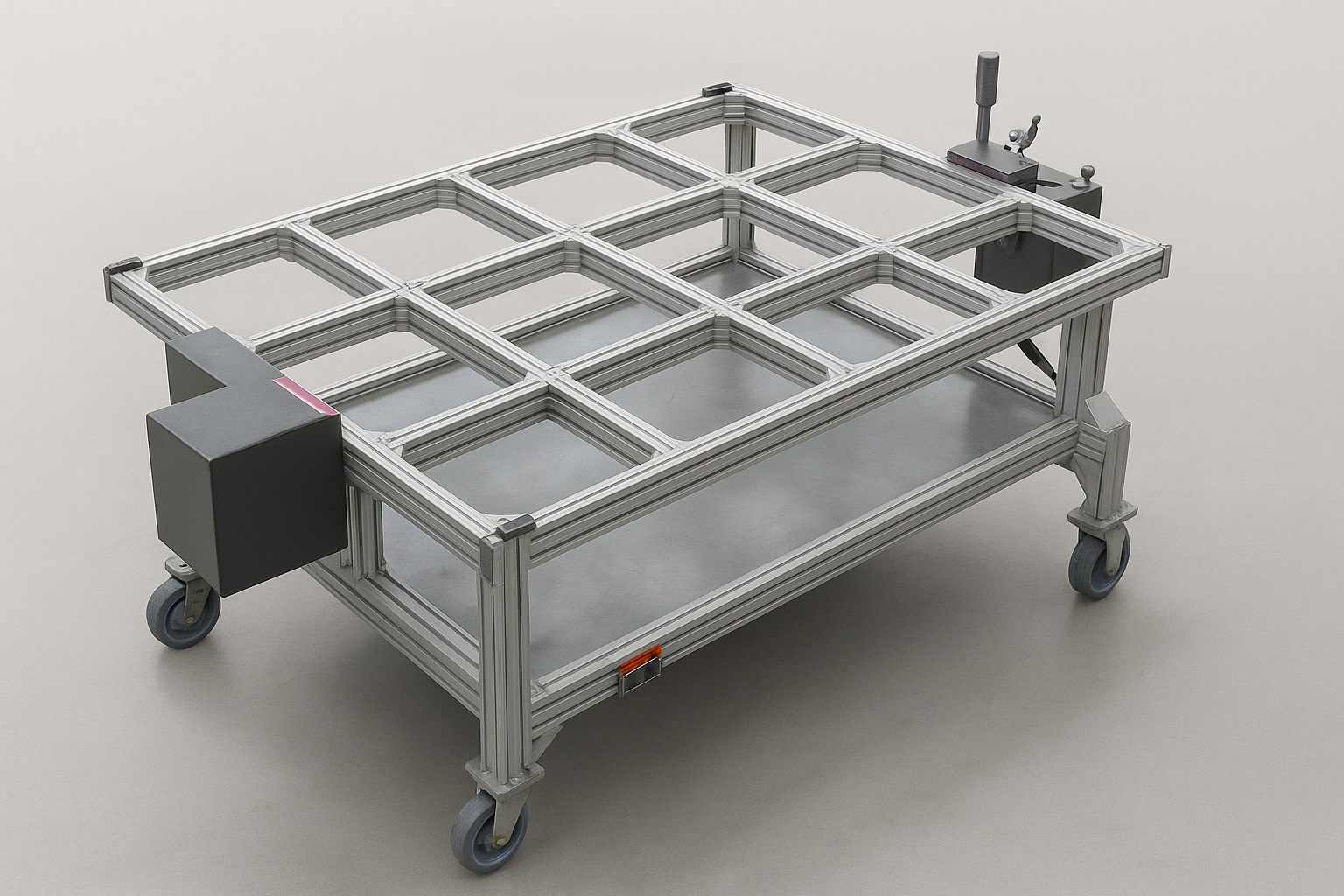
High-capacity transport carts engineered from 90 Series T-slot aluminum structural framing for loads from 1,000 to 5,000 lb. Designed for engine blocks, large weldments, press tooling, machine components, and heavy industrial assemblies that exceed the capacity of standard platform carts — with verified load ratings, heavy-duty caster packages, and structural geometry calculated for your specific load.
Why Choose Modular Solutions for Heavy-Duty Load Carts?
Verified structural engineering for high-consequence loads — not a catalog upsize.
Structurally Engineered for Your Load
Heavy-duty load carts are designed from first principles for your specific load weight, load geometry, and transport conditions. Frame section selection, caster rating, and joint design are all calculated — not estimated from a product family catalog.
90 Series and Structural T-Slot Profiles
Heavy load carts use 90 Series T-slot aluminum as the minimum frame profile. For extreme loads or long spans, custom structural T-slot profiles are specified. Multiple parallel rails and cross-bracing members are added based on bending and shear load analysis.
Heavy-Duty Industrial Caster Packages
6-inch to 12-inch diameter industrial casters rated from 1,500 to 4,000 lb per caster are specified for the total cart load, dynamic towing forces, and floor surface. Caster mounting plates distribute load into the aluminum base frame through steel transition hardware.
Low Center of Gravity Frame Design
Heavy loads benefit from low-deck cart designs that minimize the loaded center of gravity height and maximize transport stability. Low-profile 6-inch to 8-inch deck height options are available where load geometry permits.
Forklift Loading Provisions
Forklift tine pockets in the base frame allow heavy loads to be placed on the cart by forklift. Pocket dimensions are sized for your facility forklift tine width and spaced for stable two-point lift geometry.
Structural Tow Hitch for Train Integration
Heavy-duty carts used in tugger train operations include load-rated drawbar tow hitches designed for the combined dynamic forces of towing a heavily loaded cart in a train.
Key Features & Benefits
Engineering details that ensure structural integrity and safe transport for high-consequence heavy loads.
90 Series T-Slot Aluminum Frame
90 mm T-slot aluminum extrusion provides high section modulus and bending stiffness for heavy load spans. Multiple parallel rails in the load direction increase total frame capacity and distribute concentrated loads from small-footprint items.
Steel-Reinforced Caster Mounting
High-load casters bolt to steel plate mounting assemblies that transfer caster forces into the aluminum base frame through large contact areas. Direct bolt-through connections into aluminum are not used for casters above 1,000 lb capacity.
Structural Cross-Bracing Members
Cross-bracing members in both horizontal and diagonal orientations are added to heavy-duty cart frames to resist torsion during single-caster-raised threshold crossings and off-axis towing forces. Brace positions are determined by structural analysis.
V-Block and Saddle Support Options
Cylindrical loads — shafts, rolls, cylinders, pipe assemblies — are supported in V-block or saddle cradles fabricated from steel or aluminum and mounted to the T-slot base frame. V-block positions are adjustable to accommodate different diameter loads.
Leveling Foot Option
Screw-adjustable leveling feet replace or supplement casters for carts used in staging positions where load stability during assembly or inspection operations is required. Leveling feet bolt to the same caster mount positions using the same hardware pattern.
Load Rating Plate and Documentation
Every heavy-duty load cart is delivered with a permanently attached load rating plate and engineering documentation including frame design calculations, caster load verification, and recommended operating procedures.
Common Applications
Heavy-duty load carts serve the most demanding transport applications in manufacturing, maintenance, and tooling operations.
- Engine and Powertrain Assembly Transport - Large engine blocks, transmission cases, and complete powertrain assemblies transported from machining and sub-assembly operations to final assembly lines in automotive and heavy equipment manufacturing.
- Large Weldment and Fabrication Staging - Structural weldments, machine frames, and fabricated assemblies staged between welding, machining, painting, and final assembly operations where loads exceed standard platform cart capacity.
- Press Tooling and Die Transport - Die sets and press tooling transported from storage to press areas without overhead crane dependency. Forklift pockets in the base frame allow loading from storage racks without additional fixtures.
- Machine Component Handling - Large motors, gearboxes, hydraulic power units, and machine tool components moved during capital equipment installation, maintenance, and plant rearrangement operations.
- Aerospace Structure Transport - Large structural assemblies, spar sections, and fuselage frames transported between fabrication, assembly, and inspection operations in aerospace manufacturing facilities.
- Cast and Forged Part Staging - Large castings and forgings staged between heat treatment, machining, and assembly operations in heavy manufacturing environments where loads regularly exceed 1,000 lb per part.
Specifications & Configurations
Standard design ranges. All specifications are available custom to your load requirements.
| Specification | Detail |
|---|---|
| Frame Profile | 90 Series T-slot aluminum minimum; structural profiles for extreme loads |
| Load Capacity | 1,000 lb to 5,000 lb depending on frame and caster specification |
| Platform Size | Custom to load envelope; typically 24 in. x 36 in. to 60 in. x 96 in. |
| Deck Height | 6 in. to 18 in.; low-profile options for forklift-loaded configurations |
| Caster Capacity | 1,500 lb to 4,000 lb per caster; 6 in. to 12 in. diameter |
| Caster Configuration | 4, 6, or 8 caster patterns depending on load and maneuverability |
| Forklift Pockets | Standard tine width options; custom sizing available |
| Tow Provisions | Load-rated drawbar hitch; custom styles for tugger compatibility |
| Lead Time | 4 to 6 weeks from approved drawings |
Frequently Asked Questions
Common questions about heavy-duty load carts from Modular Solutions.
How is maximum load capacity verified for a heavy-duty cart?
Load capacity is verified through a structural engineering review of the frame under the specific load geometry, including worst-case load positions, dynamic transport forces, and threshold crossing shocks. We calculate frame bending stress, deflection, joint load, and caster reaction forces and compare these against material allowable values with an appropriate safety factor. Verification is documented in the engineering package delivered with the cart.
Can heavy-duty load carts be used on dock-level ramps?
Yes, with appropriate design provisions. Ramp grades and threshold transitions create dynamic load spikes on casters and frame members. We account for these in the structural analysis when ramp use is specified. Larger diameter casters, increased safety factors on frame joints, and tow hitch geometry that prevents tipping on grades are all specified for carts used on ramps.
What is the difference between a heavy-duty load cart and a structural dolly?
A heavy-duty load cart is designed for repeated general transport of a load category — engine blocks, large weldments — with a platform or deck configuration. A structural dolly is designed for a specific load with precise locating features, nest positions, and datum interfaces. Load carts are more general in application; structural dollies are part-specific. Many applications use a load cart for general transport and a dedicated structural dolly for precision staging and positioning.
Can heavy-duty carts accommodate loads that overhang the deck?
Yes, with specific engineering provisions. Overhang loads create bending moments in the deck frame rails and change caster reactions — potentially unloading rear casters and creating a tipping risk. We calculate overhang bending moments and caster reactions for your specific load geometry and adjust frame structure, cross-member positions, and caster placement to maintain stability under the overhang condition.
What maintenance do heavy-duty load carts require?
Routine maintenance includes caster lubrication per the caster manufacturer schedule, inspection of tow hitch pins and retainers before each use, and periodic inspection of frame joint fastener torque. T-slot aluminum frames do not require painting, rust treatment, or weld inspection. Load carts used in towing applications should have hitch hardware inspected for wear after every 500 operating hours or annually, whichever comes first.
Ready to Engineer Your Heavy-Duty Load Cart?
Provide your load weight, dimensions, floor path, and loading method. Our engineers will design a cart with verified capacity for your heaviest transport applications.
Modular Solutions - 4280 Giddings Rd, Auburn Hills, MI 48326