Platform Carts
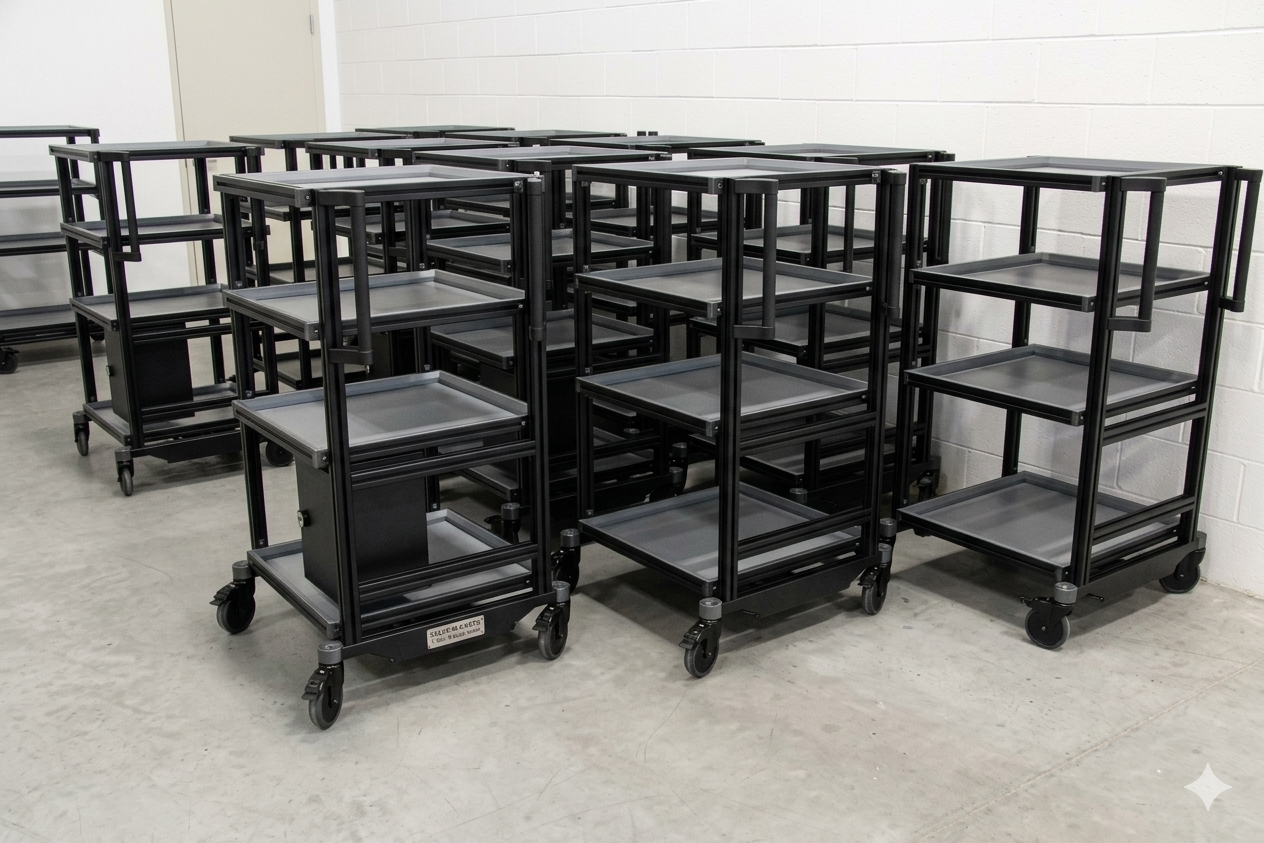
Open flat-deck carts built from T-slot aluminum structural framing for general-purpose factory floor transport, large component staging, and bulk material movement. Platform carts are the foundation of any cart fleet — sized to your payload, aisle width, and deck surface requirements with the flexibility to add shelves, racks, or accessories as your process evolves.
Why Choose Modular Solutions for Platform Carts?
Engineered for your specific load, aisle, and floor — not a catalog approximation.
Verified Load Ratings
Every platform cart is designed to a verified structural load rating. Frame profile size, cross-member spacing, and caster selection are calculated together so the cart performs at rated capacity across its full service life — not just at initial delivery.
Custom Deck Dimensions
Platform decks are sized to your specific payload envelope. Standard widths from 18 to 48 inches and lengths from 24 to 72 inches are available, with custom dimensions available at no additional engineering cost when specified at order.
Low-Profile Options for Forklift Loading
Low-deck platform carts with 3-inch or 4-inch casters are available for loads that are floor-loaded by hand truck, floor-level conveyor, or pallet jack rather than forklift or overhead crane. Deck height is specified based on your loading method.
Multiple Deck Surface Materials
Hardboard, phenolic laminate, steel plate, expanded metal, and ESD-dissipative decking are all available. Deck material is selected based on load type, surface protection requirements, and facility hygiene standards.
Expandable Frame Architecture
T-slot aluminum uprights can be added to a flat platform cart to convert it into a multi-tier shelf cart as storage needs change. The structural platform frame continues to serve as the base, protecting your investment when process requirements evolve.
Auburn Hills In-House Engineering
Designed and manufactured at our Auburn Hills, MI facility. Our engineers review your payload geometry, floor surface, aisle constraints, and ergonomic push force requirements before specifying frame size and caster package.
Key Features & Benefits
Structural and mechanical details that separate engineered platform carts from catalog alternatives.
45 or 90 Series T-Slot Frame
Platform carts use 45 Series T-slot aluminum for loads up to 800 lb and 90 Series for loads from 800 to 3,000 lb. Profile selection is determined by span length, load distribution, and dynamic transport forces — not by cost minimization.
Full-Perimeter Frame Rails
Structural rails on all four sides of the platform deck distribute load evenly to the caster corner posts and prevent deck deflection under off-center or point loads. End rails double as bumper protection for aisle impacts.
Swivel, Fixed, and Brake Caster Packages
Caster configuration is specified for your maneuverability requirements. Two swivel front and two fixed rear casters suit straight-aisle transport. Four-swivel configurations allow 360-degree maneuvering in open floor areas. Brake casters lock the cart at work stations.
Integrated Push Handle Options
Ergonomic push-pull tube handles and over-the-top grab bars mount directly to the T-slot upright frame at the design stage. Handle height is set per operator ergonomic requirements and can be field-adjusted using T-slot bracket positions.
Deck Surface Protection Options
Phenolic laminate and hardboard decks protect sensitive part surfaces. Steel plate and expanded metal decks are used for heavy, abrasive, or wet loads. ESD-dissipative decking is specified for electronics handling to prevent electrostatic discharge damage.
Modular Accessory Mounting
Any face of the T-slot frame uprights and cross rails accepts standard T-slot accessories — bin rails, label holders, document pouches, panel mounts, and utility hooks. Accessories are added at the design stage or retrofitted in the field without drilling or welding.
Common Applications
Platform carts are used across manufacturing, warehousing, assembly, and distribution facilities.
- General Floor Transport - Moving components, sub-assemblies, and finished goods between departments, production stations, and shipping areas without overhead material handling equipment.
- Large Component Staging - Staging oversized panels, frames, weldments, and castings between fabrication, painting, and assembly operations where the component occupies most or all of the deck surface.
- Bulk Bin and Tote Transport - Transporting stacked bins, totes, and containers between receiving, storage, and production areas. Platform carts sized for standard bin footprints simplify loading and unloading at each station.
- Tooling and Fixture Transfer - Moving production fixtures, tooling, and jigs between storage and machine areas without dedicated material handling equipment or overtime forklift scheduling.
- Maintenance Parts and Equipment - Maintenance departments use platform carts for moving motors, gearboxes, pumps, and machine components during planned and emergency maintenance operations.
- Cross-Facility Delivery Loops - Platform carts operated in fixed delivery loops between receiving, kitting, production, and shipping areas, eliminating individual forklift trips and improving material flow predictability.
Specifications & Configurations
Standard design ranges. All specifications are available custom to your exact requirements.
| Specification | Detail |
|---|---|
| Frame Profile | 45 Series T-slot aluminum for loads under 800 lb; 90 Series for 800–3,000 lb |
| Load Capacity | 200 lb to 3,000 lb depending on frame and caster specification |
| Deck Width | 18 in. to 48 in. standard; custom widths available |
| Deck Length | 24 in. to 72 in. standard; custom lengths available |
| Deck Height | 6 in. (low-profile) to 18 in. standard; custom heights available |
| Deck Surface | Hardboard, phenolic laminate, steel plate, expanded metal, ESD-dissipative |
| Caster Diameter | 3 in., 4 in., 5 in., or 6 in.; swivel, fixed, or brake options |
| Handle Type | Push/pull tube, ergonomic grip, tow hitch; height-adjustable |
| Lead Time | 3 to 5 weeks from approved drawings |
Frequently Asked Questions
Common questions about platform carts from Modular Solutions.
What deck surface is best for heavy steel parts?
Steel plate decking is recommended for heavy, abrasive, or wet loads where hardboard or laminate surfaces would be damaged. Expanded metal decking allows coolant, chips, and debris to fall through and is common in machining environments. For loads that require surface protection — painted assemblies, precision castings — phenolic laminate provides a hard, smooth, chemically resistant surface that resists marking.
Can a platform cart be converted to a shelf cart later?
Yes. T-slot aluminum uprights can be added to any platform cart base frame using standard T-slot fasteners. Shelf supports and cross rails mount to the uprights at any height. The platform frame structure is unchanged, and the entire conversion is done with standard hex keys. No welding, cutting, or frame replacement is required.
How do I specify the correct caster for my floor?
Caster selection depends on load weight, floor surface condition, and required rolling force. Smooth concrete and epoxy-coated floors work well with polyurethane tread casters. Rough concrete and threshold crossings require larger diameter casters with softer tread compounds for manageable push force. We select caster type, tread material, and diameter based on your floor specification or on-site assessment.
What is the maximum overhang load a platform cart can support?
Overhang capacity depends on the deck structure and caster positions. Our engineers calculate bending moments and caster reactions for your specific overhang geometry during the design phase. If overhang loads are present, frame rails and caster positions are adjusted to maintain stability and prevent tipping under dynamic transport conditions.
Can platform carts be used in tugger train configurations?
Yes. Tow hitch attachments are a standard option for platform carts used in tugger or AGC train loops. We standardize hitch height, bumper geometry, and cart width across a fleet so trains form consistently and aisle clearance planning is straightforward. Contact our engineering team with your tugger model and train configuration for specific hitch design.
Ready to Configure Your Platform Cart Fleet?
Tell our engineering team your load requirements, deck dimensions, floor surface, and fleet size. We will design a platform cart configuration that fits your facility and your material flow.
Modular Solutions - 4280 Giddings Rd, Auburn Hills, MI 48326