Towable Industrial Carts
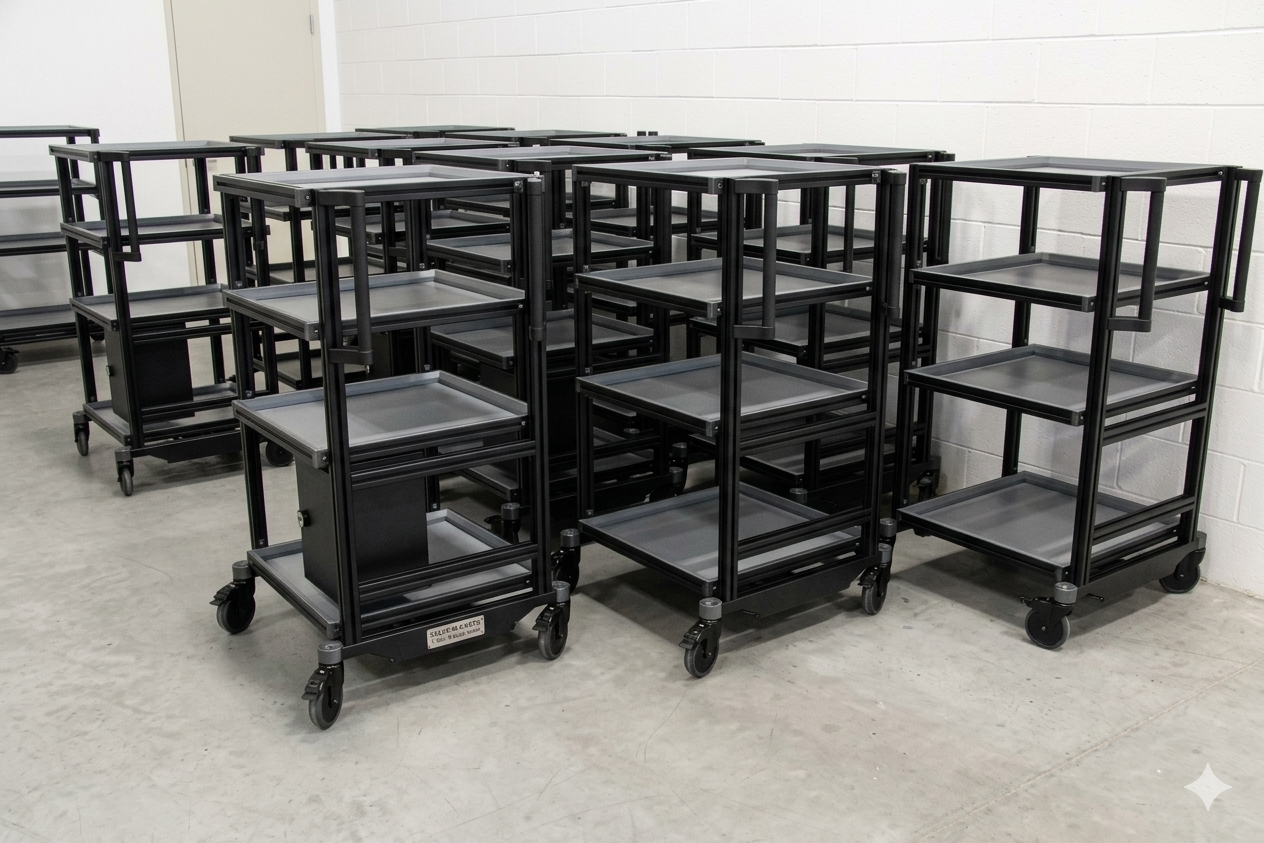
T-slot aluminum carts engineered for tugger train delivery loops, AGC-towed material trains, and facility-wide tow routes. Standardized hitch geometry, bumper rails, and cart dimensions across a fleet enable consistent train formation, predictable aisle clearance, and interchangeable deployment at any line-side position on the delivery loop.
Why Choose Modular Solutions for Towable Industrial Carts?
Fleet-standardized towable carts engineered for reliable tugger and AGC train operation.
Standardized Hitch Geometry Across the Fleet
Consistent tow hitch height, bumper geometry, and cart-to-cart connection clearance across a fleet ensure trains form predictably and the same cart can be inserted at any position in any train. Non-standardized carts create train formation problems and aisle clearance variance.
Load-Rated Tow Provisions
Tow hitch attachments are load-rated for the combined dynamic tow force of the train position — not a generic catalog hitch bolted to a frame. Tow point structural integrity is verified during engineering review to prevent hitch failures in service.
Consistent Cart Width for Aisle Planning
Towable cart fleet width is standardized to your aisle clearance specification. Consistent width across all carts in the fleet simplifies aisle planning and prevents clearance violations when substituting carts in a train.
Compatible with All Major Tugger Systems
Towable cart hitch and bumper geometry is designed to interface with your existing tugger vehicle. We work from your tugger model specifications and current train geometry to design compatible cart hitching systems.
Scalable Fleet Configuration
T-slot aluminum frame construction allows a fleet of towable carts to be expanded, reconfigured, or converted between platform, shelf, and multi-tier configurations as delivery route requirements change.
Low Maintenance Design
Mechanical hitch connections use standard industrial clevis pins and clip retainers — field-replaceable with common hardware. Aluminum frame construction eliminates rust, paint maintenance, and corrosion issues common on steel tugger carts.
Key Features & Benefits
Tow-specific engineering details that ensure reliable train operation and long fleet service life.
Drawbar Tow Hitch Assembly
Front and rear drawbar hitch assemblies are fabricated from structural steel plate and bolted to the T-slot aluminum base frame. Hitch height is set to your tugger connection point height. Clevis pin connection is standard; custom hitch styles available for tugger compatibility.
Front and Rear Bumper Rails
Structural bumper rails on the front and rear of each cart protect frame members during train formation, coupling, and aisle travel. Bumper rail geometry is matched to adjacent cart dimensions for clean cart-to-cart contact during tight-radius turns.
Anti-Jackknife Hitch Geometry
Tow hitch connection point position and drawbar length are calculated to minimize jackknifing tendency during tight-radius turns at loop ends. Anti-jackknife geometry is critical for trains operating in narrow aisles with constrained turning radii.
Platform or Shelf Deck Options
Towable carts are available with flat platform decks, multi-tier shelf configurations, or component nest configurations depending on the material being delivered on the route. All deck types use the same standardized towable base frame.
Fleet Identification Markings
Towable cart fleet numbering, route identification, and load capacity markings are applied at the factory stage using durable label stock or engraved aluminum tags. Fleet markings support train assembly verification, preventive maintenance tracking, and cart replacement scheduling.
Forklift Pocket Option
Forklift tine pocket provisions in the base frame allow towable carts to be lifted and repositioned by forklift during initial setup, route changes, and maintenance operations without separate handling equipment.
Common Applications
Towable industrial carts are the standard delivery vehicle in lean manufacturing and distribution facilities with fixed material delivery loops.
- Tugger Train Line-Side Delivery - Fixed-route tugger train loops delivering materials from supermarket storage to assembly line-side positions on a takt-aligned schedule. Towable cart fleet size is matched to train frequency and per-route material volume.
- AGC-Towed Material Trains - Automated guided cart systems towing material trains on fixed floor-path routes in facilities with high-frequency, predictable delivery cycles. AGC-compatible cart geometry is designed to interface with your AGC vehicle coupling system.
- Cross-Facility Material Transfer - Long-distance material delivery routes spanning multiple production areas or building wings, where individual trip costs of lift trucks justify investment in dedicated towable cart fleets operating on scheduled routes.
- Receiving to Production Delivery - Towable cart trains transporting received goods from dock-level staging through internal delivery routes to kitting, supermarket, and line-side positions without intermediate transfer.
- Scrap and Empty Container Return - Return-route use of towable carts for collecting empty bins, scrap containers, and packaging waste from line-side positions back to supermarket and waste collection areas on the same train route.
- Milk Run Delivery Operations - Milk run delivery loops using towable carts to pick and deliver multiple part numbers from a central supermarket to multiple assembly line positions on a single tug route per delivery cycle.
Specifications & Configurations
Standard design ranges. All specifications are available custom to your tugger system and route requirements.
| Specification | Detail |
|---|---|
| Frame Profile | 45 Series or 90 Series T-slot aluminum based on load requirement |
| Load Capacity | 500 lb to 2,500 lb per cart depending on frame and caster specification |
| Hitch Type | Drawbar clevis pin; custom styles for specific tugger compatibility |
| Hitch Height | Custom to your tugger connection point height |
| Bumper Rail | Front and rear structural bumper rails; height matched to adjacent cart |
| Cart Width | Standardized to your aisle clearance specification; typically 24–48 in. |
| Cart Length | 36 in. to 72 in. standard; custom lengths available |
| Deck Configuration | Platform, multi-tier shelf, or component nest |
| Caster Diameter | 4 in., 5 in., or 6 in. depending on load; swivel and fixed combinations |
| Lead Time | 3 to 5 weeks from approved drawings |
Frequently Asked Questions
Common questions about towable industrial carts from Modular Solutions.
What information is needed to design a compatible tow hitch?
We need your tugger vehicle model and the height of its tow connection point from the floor, the maximum tow force your tugger develops, the cart-to-cart spacing you plan to use in a train, and your minimum aisle turning radius. With this information, our engineers design hitch geometry, drawbar length, and bumper positions for compatible, reliable train operation.
How many carts can be safely towed in a single train?
Maximum safe train length depends on tugger tow capacity, total train load, floor gradient, and aisle geometry. We calculate train pull force requirements based on total loaded cart weight, rolling resistance for your caster and floor combination, and ramp grades in your facility. The result is a maximum cart count recommendation for safe, controllable train operation with your tugger.
Can towable carts be used manually without a tugger?
Yes. Towable carts are designed with manual push handles as standard so they can be moved individually by hand when not in a train. This is important for initial positioning, maintenance, and route changes where the tugger is not available.
What is the difference between an AGC cart and a tugger cart?
AGC carts are designed for automated coupling and towing by automated guided cart vehicles that follow floor-embedded magnetic strips, laser targets, or vision-based navigation paths. Tugger carts are towed by manually driven tugger vehicles on planned routes. The structural frame and load-carrying design are similar — the hitch geometry and coupling system are different. We design for both applications.
Can a towable cart fleet be expanded after initial purchase?
Yes. T-slot aluminum frame construction allows additional carts to be ordered with identical dimensions and hitch geometry to integrate seamlessly into the existing fleet. Fleet expansions are specified with reference to the original cart design drawings to ensure dimensional consistency.
Ready to Build Your Towable Cart Fleet?
Share your tugger model, aisle dimensions, delivery route, and material volumes. Our engineers will design a towable cart fleet that integrates with your delivery system.
Modular Solutions - 4280 Giddings Rd, Auburn Hills, MI 48326