Warehouse Utility Carts
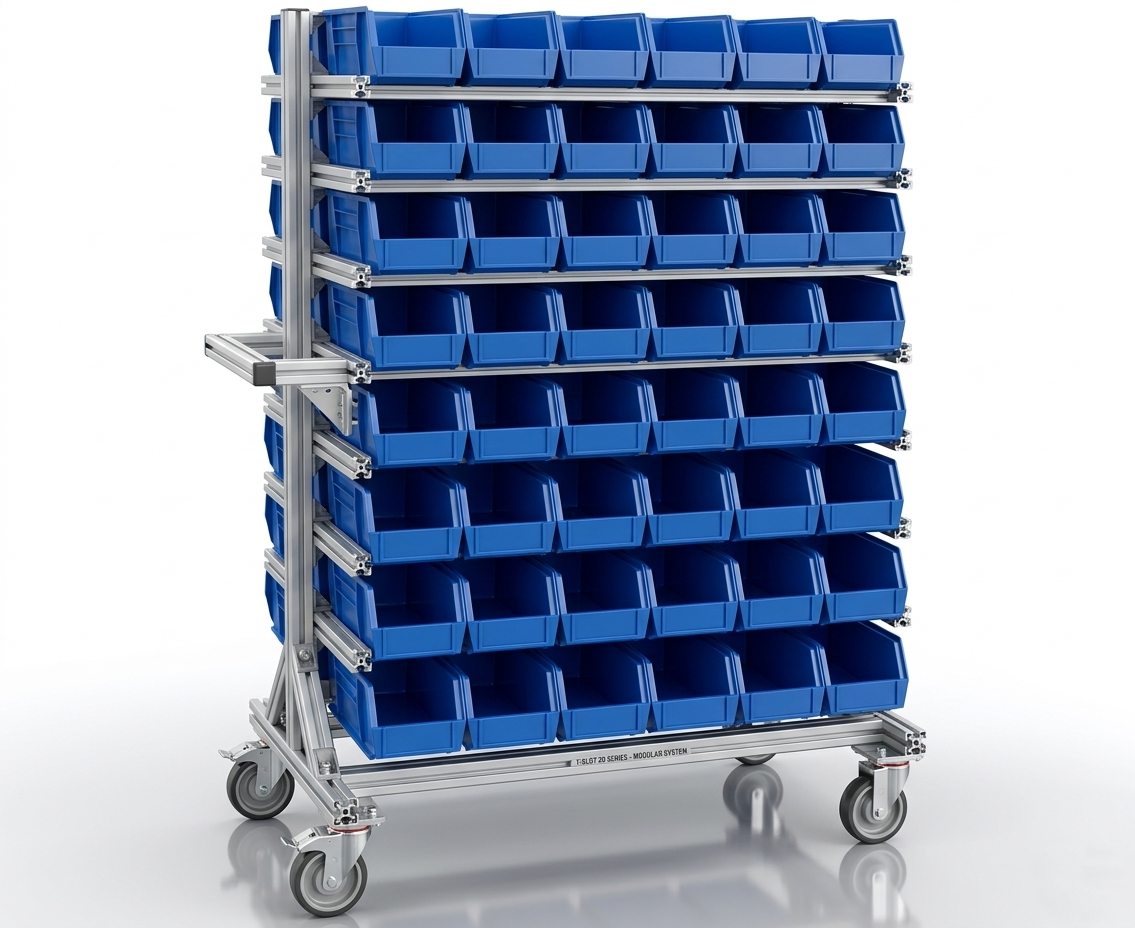
General-purpose aluminum warehouse carts for order picking, stock replenishment, maintenance supply runs, and facility-wide material transport. Built from T-slot aluminum with adjustable shelves, integrated bin rails, and ergonomic handles — designed for high-cycle warehouse operations where durability, flexibility, and easy cleaning are daily requirements.
Why Choose Modular Solutions for Warehouse Utility Carts?
Built for the demands of daily warehouse operations — not consumer-grade alternatives dressed up in industrial packaging.
Built for High-Cycle Commercial Durability
Warehouse utility carts in high-volume DCs and manufacturing facilities complete 50 to 100+ pick or replenishment cycles per day. T-slot aluminum frames and commercial-grade casters are specified for the cycle count and load of your operation — not the lowest price point.
Reconfigures Without Replacement
As product mix, bin sizes, and pick zone layouts change, T-slot aluminum shelf carts adjust to match — no new carts required. This eliminates the recurring capital cost of replacing fixed-configuration wire or tubular steel carts when operations change.
Label and Scanner Integration
Label holder channels, barcode scan rails, and mobile device mount positions are designed into the cart at the factory stage. This ensures consistent scan geometry across a fleet and eliminates improvised label tape that peels in warehouse temperature ranges.
Cleanable for Food and Pharma Environments
Aluminum T-slot frames are non-porous and compatible with standard cleaning agents, including food-grade sanitizers. Unlike painted steel carts, T-slot aluminum does not chip, flake, or create contamination risk in regulated environments.
Ergonomic Push Force Compliance
Cart weight, caster selection, and load rating are specified to maintain push and pull forces within NIOSH and OSHA ergonomic guidelines for manual cart transport. Ergonomic push force analysis is included in the engineering review for carts used in high-frequency picking operations.
Fleet Standardization
Warehouse utility cart fleets benefit from identical cart dimensions, shelf layouts, and bin configurations. Standardized carts are interchangeable across pick zones, simplify operator training, and enable consistent WMS scan workflows.
Key Features & Benefits
Durable, cleanable, and configurable construction for demanding warehouse environments.
45 Series T-Slot Aluminum Uprights
Four corner uprights with full-height T-slot channels on all four faces provide continuous mounting positions for shelves, bin rails, document holders, mobile device mounts, and utility accessories.
Adjustable Shelf Bracket System
Shelf brackets engage the T-slot channel at any position and lock with a standard M6 fastener. Shelf heights are set at the factory stage based on your bin and tote specifications and can be field-adjusted in under two minutes per shelf.
Commercial-Grade Swivel Casters
300 lb per caster swivel casters with polyurethane tread as standard. Brake casters at two positions lock the cart during picking and loading operations. Optional quiet-roll casters are available for environments where cart noise is a concern.
Integrated Document and Label Holders
Clip-mounted document pouches and label holder channels mount to T-slot upright faces at eye level for pick list, work order, and kanban card presentation. Positions are set at the factory stage and align with WMS paper or scan workflows.
Wire Basket Drawer Option
Pull-out wire baskets mount between T-slot uprights as an alternative to fixed shelves for bulk loose parts, packaging materials, and consumables that do not fit on flat shelf surfaces cleanly.
Modular Expansion Accessories
Power strip mounts, mobile device charging brackets, cup holders, hand sanitizer holders, and waste bin mounts all install on T-slot upright faces without modification. Accessories are added at order or retrofitted in the field as operational needs evolve.
Common Applications
Warehouse utility carts serve picking, replenishment, maintenance, and facility operations in distribution and manufacturing environments.
- E-commerce Order Picking - Multi-tier picking carts configured for the bin and tote system in your pick zone, with label holders for pick list management and barcode scan targets for WMS integration.
- Bulk Replenishment Runs - Platform and shelf carts for bulk replenishment of overstock to forward pick locations, moving cases and palletized product from bulk storage to floor-level bin positions.
- Maintenance Supply Delivery - Maintenance departments use utility carts for delivering spare parts, lubricants, tools, and consumables to planned maintenance work orders across large facilities.
- Janitorial and Facility Services - Utility carts configured for janitorial supply storage, waste collection, and facility cleaning operations with appropriate surface materials and compartmentalization.
- Returns Processing - Reverse logistics carts for collecting, sorting, and routing returned product through inspection and disposition workflows in returns processing areas.
- Value-Added Services (VAS) Operations - Utility carts in kitting, labeling, and bundling VAS operations where products move through multiple sequential work steps on the same cart before packing.
Specifications & Configurations
Standard design ranges. All specifications are available custom to your exact requirements.
| Specification | Detail |
|---|---|
| Frame Profile | 45 Series T-slot aluminum uprights and cross rails |
| Load Capacity | 200 lb to 600 lb total depending on tier count and caster specification |
| Shelf Count | 2 to 4 tiers adjustable |
| Cart Width | 18 in. to 30 in. |
| Cart Depth | 12 in. to 24 in. |
| Cart Height | 48 in. to 66 in. overall |
| Shelf Surface | Hardboard, wire mesh, or phenolic laminate |
| Caster Diameter | 3 in. or 4 in. polyurethane; 2 brake casters standard |
| Handle Height | 36 in. to 42 in. from floor; ergonomic adjustable |
| Lead Time | 3 to 4 weeks from approved drawings |
Frequently Asked Questions
Common questions about warehouse utility carts from Modular Solutions.
How are warehouse utility carts different from hardware store utility carts?
Consumer and light-commercial utility carts use tubular steel or plastic frames, fixed shelf heights, and low-load-rated plastic casters. They are suitable for occasional light use but fail quickly in high-cycle warehouse operations due to frame fatigue, caster wear, and shelf deformation. T-slot aluminum utility carts are engineered for commercial duty cycles — specified load ratings, commercial caster packages, and field-adjustable configurations that adapt as operations change.
Can carts be designed to integrate with our WMS scanning workflow?
Yes. Barcode scan rail positions, mobile device mount brackets, and scan gun holster positions can all be integrated into the T-slot frame at the design stage. We work from your WMS scan process description to position scan targets and device mounts at the ergonomically correct position relative to pick zones and transport aisles.
What caster option reduces floor noise in quiet warehouse environments?
Quiet-roll polyurethane casters with softer tread compounds significantly reduce cart rolling noise on smooth concrete and sealed floors. Larger diameter casters (5 or 6 inch) also roll more quietly over floor irregularities than 3-inch casters. Noise reduction caster options are available as a standard selection during cart configuration.
Can utility carts be sanitized for food and pharmaceutical environments?
Yes. T-slot aluminum frames with clear or hard-coat anodize finish are compatible with food-grade cleaners and pharmaceutical sanitizing agents. Shelf surfaces for food and pharma environments use solid phenolic laminate rather than wire mesh to prevent product contact with the mesh wires. Fasteners are stainless steel in food and pharma configurations.
What is the standard lead time for a fleet of warehouse utility carts?
Standard lead time is 3 to 4 weeks per order from approved drawings. Fleet orders for identical configurations can often be processed in parallel to shorten total delivery time. Contact our sales engineering team with your fleet size and required delivery date for a specific schedule.
Ready to Build Your Warehouse Cart Fleet?
Tell us your pick zone layout, bin dimensions, cycle count requirements, and fleet size. Our engineers will design warehouse utility carts that keep your operation running efficiently.
Modular Solutions - 4280 Giddings Rd, Auburn Hills, MI 48326