Battery Handling Carts
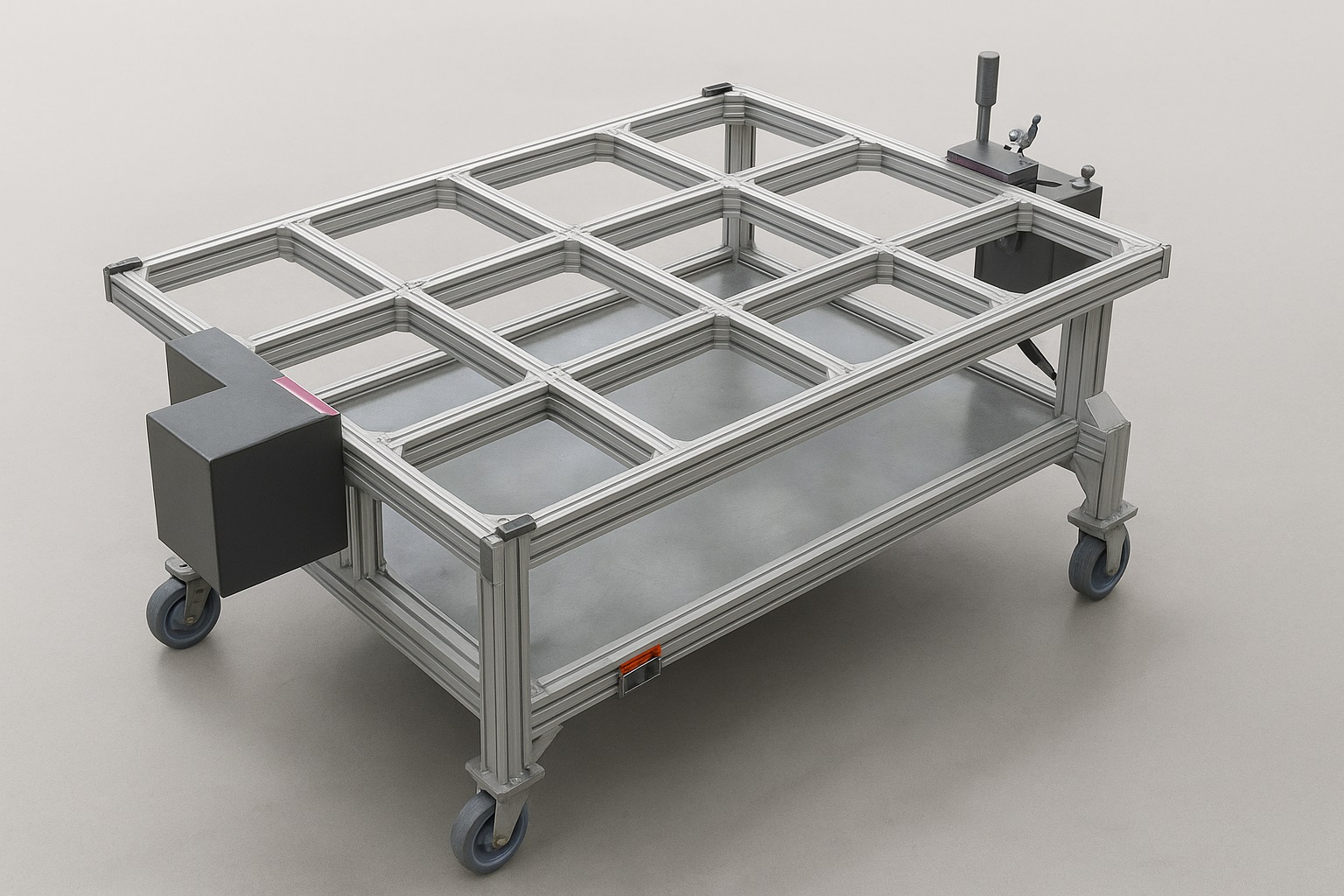
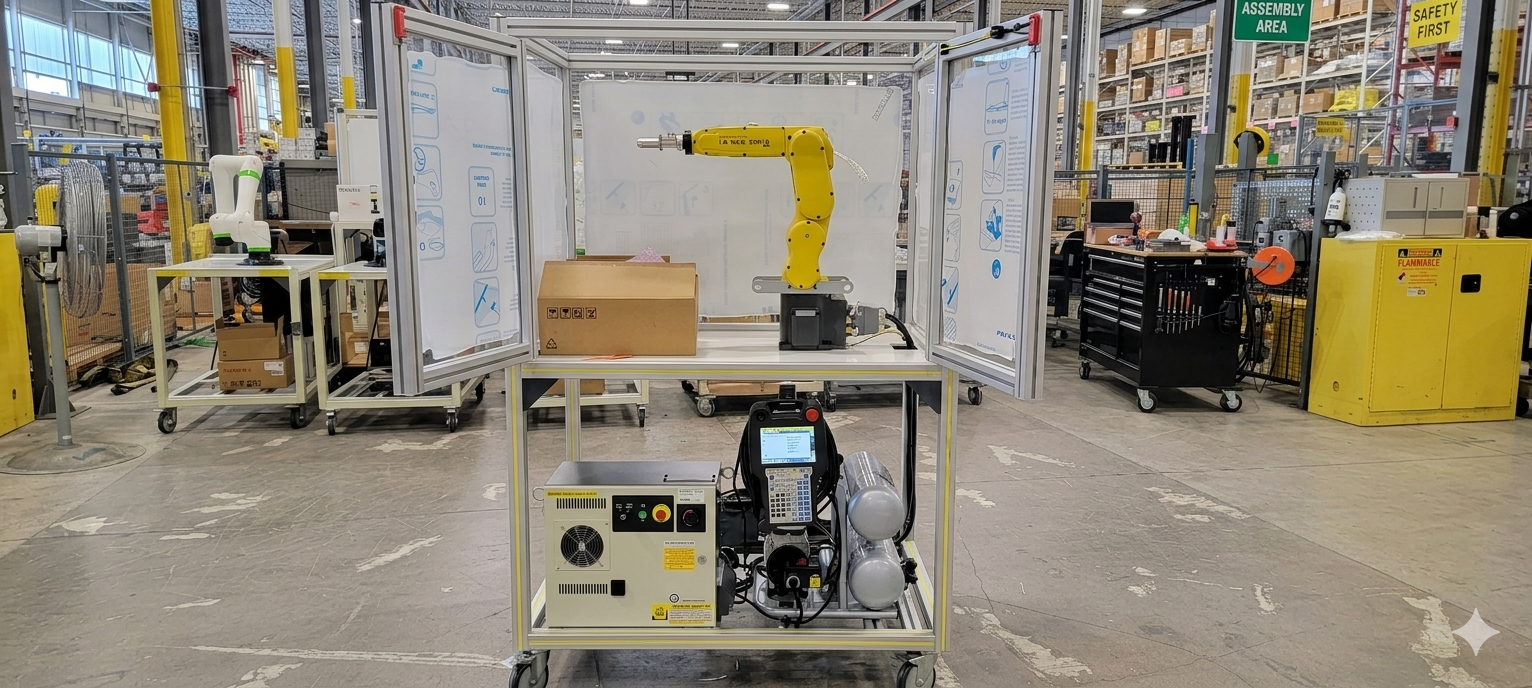
T-slot aluminum carts engineered for EV battery cell, module, and pack handling in lithium battery manufacturing environments. Non-sparking aluminum construction, ESD-dissipative surfaces, format-specific position stops, grounding provisions, and high-capacity casters — designed for the safety and process requirements of battery gigafactory and tier-one supplier assembly lines.
Why Choose Modular Solutions for Battery Handling Carts?
Battery handling requires carts that address non-sparking safety, ESD protection, format-specific positioning, and load capacity — all at once. We engineer for every requirement simultaneously.
Non-Sparking Aluminum Construction
Lithium battery cell venting and electrolyte exposure can produce flammable hydrogen gas. In these environments, steel tools and steel equipment that generate sparks on impact are a fire and explosion risk. T-slot aluminum framing is inherently non-sparking and non-ferrous — safe for use in all areas of the battery assembly process from cell handling through pack assembly and formation charging.
Engineered to Your Cell and Module Format
Cylindrical cells (18650, 21700, 4680), prismatic cells, and pouch cells all have different handling requirements. Module formats vary by OEM program. Battery pack dimensions change with every vehicle platform. T-slot framing allows position stops, retention rails, and support pockets to be precisely located for your specific cell geometry, module envelope, or pack dimensions — and repositioned when the program changes.
ESD Protection for Cell Management Electronics
Battery module and pack assembly involves handling sensitive management board electronics — cell voltage sensors, balancing circuits, and communication interfaces. ESD discharge into these components causes latent defects that appear as warranty claims in the field. ESD-dissipative cart surfaces with verified grounding paths protect management electronics from the point of first contact through full assembly completion.
High-Capacity Casters for Heavy Modules
EV battery modules weigh from 30 to over 150 lbs. Battery packs for full EV platforms can weigh 500–1,000 lbs. Cart casters are specified to the actual load with safety factors appropriate for the production environment. Swivel-plus-fixed caster configurations provide directional control for heavy-load battery carts navigating production aisles safely.
Reconfigurable Between Vehicle Programs
Battery format changes with every new vehicle program. T-slot framing positions, stop blocks, foam inserts, and retention bracket locations can all be repositioned using standard hex tools when a new program launches. This eliminates the expense of scrapping and replacing welded steel carts with each new EV battery platform — an increasingly costly problem as battery formats evolve rapidly.
Compatible With Automated Guided Vehicle Integration
Battery handling carts can be engineered with standard AGV interface points — docking brackets, locating pins, and connection features compatible with your facility's AGV system. This supports integration of battery cart transport into automated material handling systems without requiring custom AGV attachments that differ from cart to cart.
Key Features & Benefits
Design details specific to battery handling that standard material handling carts do not address.
Format-Specific Cell and Module Position Stops
T-slot aluminum stop blocks, retention rails, and pocket inserts are configured to the exact cell or module format being handled. Position accuracy prevents cell-to-cell contact that can cause short circuits during transport. Stop blocks are adjustable at any time using hex tools, allowing cart format to match new cell sizes without cart replacement.
ESD-Dissipative Surface With Grounding Lug
Cart deck surfaces are specified in ESD-dissipative laminate or ESD-dissipative foam insert material. Point-to-ground resistance is verified through the frame-to-caster path. A grounding lug at the frame allows ground cord connection in areas where the facility does not have ESD flooring or where static storage of partially assembled battery modules requires a direct ground connection.
Non-Reactive Aluminum in Electrolyte Exposure Areas
Lithium battery electrolyte — lithium hexafluorophosphate in organic carbonate solvent — is corrosive to many metals. Aluminum forms a stable oxide layer that resists electrolyte attack far better than galvanized or painted steel. In cell-level handling areas where accidental electrolyte spill is possible, aluminum framing does not corrode and does not produce corrosion products that can contaminate adjacent cells.
Foam and ESD Insert Compatibility
T-slot deck surfaces accept precisely cut ESD-pink polyethylene foam inserts, ESD-dissipative foam, and custom vacuum-formed carriers. Inserts are retained in T-slot channel-mounted perimeter rails or snap-in bracket systems. Insert replacement for new cell formats requires only new foam cuts — the cart frame remains the same.
Heavy-Duty Cross-Member Reinforcement
Battery packs and high-density module stacks create significant deflection loads on cart shelving. Critical load positions are reinforced with intermediate T-slot cross-members that reduce shelf span and deflection under load. Cross-member spacing and extrusion profile size are calculated for the actual battery load in the engineering process — not estimated from generic shelf load tables.
Visual Management Integration
Battery handling carts are integrated into production kanban and visual management systems through T-slot label holders, position numbering, and color-coded frame sections. Visual position labels for cell count, polarity orientation, and charge state are mounted to T-slot upright faces without permanent marking or adhesive that is difficult to remove for cart cleaning or format changes.
Common Applications
Battery handling carts from Modular Solutions are deployed across EV battery gigafactories, tier-one battery suppliers, and consumer electronics battery assembly lines.
- EV Battery Cell Handling and Staging — Carts for cylindrical, prismatic, and pouch cell transport from incoming inspection through module assembly in electric vehicle battery gigafactory environments.
- Battery Module Assembly Staging — Module-level carts for WIP staging between module assembly, management board installation, and module testing stations on EV battery assembly lines.
- Battery Pack Sub-Assembly Transport — Heavy-duty carts for transporting partially assembled battery packs between assembly stations, structural integration areas, and electrical connection completion.
- Formation and Aging Staging — Carts for staging module and pack assemblies at formation cycling and aging oven stations, including management of multiple units in sequence for first-cycle formation protocols.
- Consumer Electronics Battery Assembly — ESD-safe carts for handling small-format lithium-ion cells and management PCBs in laptop, tablet, and power tool battery assembly.
- Stationary Energy Storage Assembly — Carts for cell and module handling in grid-scale and commercial stationary energy storage system assembly, where cell formats are large and module weights are high.
- Battery Recycling and Second-Life Processing — Carts for safely handling partially discharged and potentially compromised cells in battery recycling and second-life testing facilities.
Specifications & Configurations
Standard design parameters for battery handling aluminum carts. All specifications are custom-engineered to your cell format, module weight, and process requirements.
| Specification | Detail |
|---|---|
| Frame Profile | 45 Series T-slot aluminum; non-sparking; non-ferrous; anodized finish |
| ESD Surface | ESD-dissipative laminate or ESD-dissipative foam insert; 10^6–10^9 Ω point-to-ground |
| Grounding | Grounding lug at lower frame; ESD casters with conductive tread for ESD floor environments |
| Position Stops | T-slot aluminum stop blocks and retention rails; adjustable to any cell/module format |
| Load Capacity | Engineered to specific application; heavy-duty 45 Series framing for packs to 500+ lbs |
| Casters | High-capacity swivel and fixed casters; conductive tread (ESD); locking wheel brakes standard |
| Insert Compatibility | T-slot perimeter rail retains ESD foam, ESD laminate, or vacuum-formed cell carriers |
| AGV Interface | Standard AGV docking bracket and locating pin provisions available on request |
| Material Safety | Non-sparking aluminum framing; non-reactive with lithium electrolyte compounds |
| Lead Time | 4 to 6 weeks from approved drawings |
Frequently Asked Questions
Common questions about battery handling carts from Modular Solutions.
Why is aluminum preferred over steel for lithium battery handling carts?
Aluminum is non-sparking when impacted, which is a critical safety property in lithium battery handling environments where electrolyte spills or cell venting events can produce flammable gases. Steel is ferromagnetic and creates sparks on impact. Additionally, aluminum is lighter than steel, reducing cart mass and improving maneuverability for operators handling heavy battery modules and packs. Aluminum is also non-reactive with lithium battery electrolyte compounds.
How do ESD-safe designs protect lithium battery cells?
Lithium battery cells — particularly at the cell and module level — are sensitive to electrostatic discharge because the internal cell management electronics and voltage sensing circuits are susceptible to gate oxide damage from ESD. ESD-dissipative cart surfaces provide a controlled dissipation path that prevents charge accumulation on the cart surface from discharging through battery terminals or management electronics. This is most critical during cell assembly, module stacking, and management board installation.
What capacity battery handling carts do you build?
Battery handling carts are engineered to the actual load requirement of the application. Individual EV battery module weights range from 30 to over 150 lbs depending on format. Complete battery pack assemblies may weigh several hundred pounds. Cart capacity is determined during the engineering process based on your specific module or pack weight, cart platform dimensions, and the number of positions per cart. Heavy-duty 45 Series T-slot framing with reinforced lower cross-members and high-capacity casters are specified for high-load battery transport applications.
Can battery handling carts be configured for specific cell or module formats?
Yes. The T-slot framing system allows precise positioning of hold-down rails, stop blocks, foam or ESD-dissipative inserts, and module retention brackets at any position on the cart surface. Cell handling carts can be configured with individual cell pockets. Module transport carts can have adjustable position locators matching your module envelope. This is one of the primary advantages of modular T-slot framing over welded cart designs for battery applications where formats change between generations.
Do battery handling carts need to be grounded during storage or transport?
For most cell and module-level handling, ESD casters maintaining contact with an ESD floor provide adequate grounding during transport. During static storage in an assembly area, some facilities require a ground cord connection from the cart frame to a facility ground point. We include a grounding lug on battery handling carts for this purpose. Battery pack-level transport carts — particularly for fully assembled and energized packs — have additional considerations; we discuss your specific pack voltage, capacity, and safety protocols as part of the engineering process.
Ready to Engineer Your Battery Handling Cart?
Share your cell format, module dimensions, pack weight, production volume, and facility ESD requirements. Our engineering team will design a battery handling cart that meets your safety, process, and reconfigurability requirements.
Modular Solutions — 4280 Giddings Rd, Auburn Hills, MI 48326